# Mainnet Upgrade 2026


# MATRIX MAINNET UPGRADE

1 August 2026

**To all MAN holders,**

I am writing not only as CEO of Matrix AI Network, but as a holder who has stood shoulder to shoulder with you since 2017. I have lived through every cycle, felt the weight of every market shift, and never wavered in what we are building.

Nothing about today is a sudden turn. NeuraMATRIX, Morpheus, MANTA, MANAS, MANIA and the Intelligent Contracts framework have been in development for nine years, built for exactly this moment. On 8 August that work becomes a live network: the new Matrix mainnet, built specifically as the chain BioData real-world assets run on. The infrastructure goes live first. The applications are built on top of it.

That step needs a new mainnet and a new economic model. This announcement covers both, and exactly what happens to the MAN you hold today. Step-by-step instructions are in the three guides published alongside it: the Asset Migration & Mainnet Transition Guide, the Miner & Validator Migration Guide, and the OG Holder Airdrop FAQ.

### Before Anything Else

* **No existing holder loses a single token**. Nothing is taken away, converted at a discount, or written down.
* **Migration is 1:1.** What you hold on the old chain is what you hold on the new one.
* **You do not need a new wallet**. Your existing private key, mnemonic or keystore still controls your assets on the new chain, at a new EVM-format address.
* **The new supply is fully allocated today**. Every category is named, capped and published below.
* **It does not arrive all at once**. Almost all of it is released over 24 to 36 months, or only as milestones are met.

### In 60 Seconds

* New mainnet live 8 August 2026. The old chain closes at the end of September.
* Maximum supply moves from 1 billion to 2 billion MAN, and stops there permanently.
* 27% of the new supply goes straight to existing holders and node operators.
* Existing holders qualify for a loyalty airdrop weighted by how long they have held. Exchange holdings count.
* Every biodata upload burns MAN permanently.
* The new supply is released over 24 to 36 months, or only as milestones are met.

### The Upgrade Happens in Two Stages

This is a staged process, not a single switch.

**Stage 1: the current mainnet is upgraded**. The chain you hold on today is upgraded so that its data format matches the new mainnet. At the same time its supply is aligned from 1 billion to 2 billion. The supply change happens here, on the chain you already hold, in public, before anything is switched over.

**Stage 2: switchover and migration**. The new mainnet goes live. During the dual-chain period, holdings move across at 1:1. The old chain closes once most of the migration is done.

Doing it in this order means you can see the supply change before any of your tokens move, and the migration itself is a simple equal swap with nothing to reconcile.

### What the New Mainnet Actually Does

**Higher capacity, lower cost**. The new L2 design uses a Sequencer, Validators and Staking. It handles far more transactions and costs much less to run. That is what biodata applications need to work at real scale. POW mining retires, and the network is secured by staked tokens instead.

**Standard EVM compatibility**. Exchanges, wallets and bridges can connect in days rather than months, and any Ethereum developer can build on Matrix straight away. You can use MetaMask or any standard EVM wallet by adding the Matrix network parameters. There is no proprietary wallet to install, and the network parameters are published when the new mainnet goes live on 8 August.

**Permanent burn on biodata usage, built into the protocol**. Every biodata upload destroys MAN for good. It is written into the code, so it is not a policy, not a buyback, and not anyone’s decision to reverse. This is separate from ordinary network fees, which are shared with the validators and stakers who secure the chain.

**Built for biological data**. Consent, ownership, access control and pricing for biodata are part of the protocol itself, not features added on top.

### Why Now

Every buyer of biological data needs the same four things: proof it came from a real person, permission to use it, control over who can see it, and a compliant way to pay for it. Whether the buyer is an AI lab, a drug company, a research institute or a wearables maker, the problem is the same. That is the infrastructure Matrix now provides.

The difference between 2018 and today is not our ambition. It is the market. AI now needs verified biological data, DeSci has emerged, RWA infrastructure has matured, and consumer devices that capture biosignals have arrived. Nine years ago the technology came before the market. Today the market has caught up.

### Why the Supply Changes

**Alignment**. The new mainnet is built around a fixed maximum of 2,000,000,000 MAN. The current chain has to reach that same number for Stage 2 to be a simple 1:1 move rather than a reconciliation between two different totals.

**Capability**. Our technology is further ahead than our reach in the market. This upgrade provides what we need to deploy what has already been built, and 2 billion is where it stops. This is the only structural supply change in the project’s history.

### Allocation of the New 1 Billion MAN

<table data-header-hidden><thead><tr><th valign="bottom"></th><th valign="bottom"></th><th valign="bottom"></th><th valign="bottom"></th></tr></thead><tbody><tr><td valign="bottom"><strong>Allocation</strong></td><td valign="bottom"><strong>Share</strong></td><td valign="bottom"><strong>Amount</strong></td><td valign="bottom"><strong>Core purpose</strong></td></tr><tr><td valign="bottom">Data on-chain mining</td><td valign="bottom">30%</td><td valign="bottom">300M</td><td valign="bottom">Earned progressively by users contributing biological data (auto-distributed on DCS scoring).</td></tr><tr><td valign="bottom">Loyalty airdrop (holders only)</td><td valign="bottom">17%</td><td valign="bottom">170M</td><td valign="bottom">Tenure-weighted airdrop for holders since 2017. Self-custody holdings released in 5 rounds; exchange-held positions are covered by the same pool, on arrangements agreed with each exchange.</td></tr><tr><td valign="bottom">BioData blockchain core development</td><td valign="bottom">15%</td><td valign="bottom">150M</td><td valign="bottom">L2 network / Sequencer / Validator client development, BioData RWA protocol and core code (5/9 multisig, milestone-unlocked).</td></tr><tr><td valign="bottom">DAO + DEX</td><td valign="bottom">15%</td><td valign="bottom">150M</td><td valign="bottom">DAO governance pool and DEX liquidity pool.</td></tr><tr><td valign="bottom">POW to POS node migration bonus</td><td valign="bottom">10%</td><td valign="bottom">100M</td><td valign="bottom">Additional dividend for miners and validators who migrate and keep staking, sized by stake, lock-up, uptime and past contribution (calculated separately from the airdrop; released over 3 years, front-loaded 40% / 35% / 25%).</td></tr><tr><td valign="bottom">Market &#x26; ecosystem expansion</td><td valign="bottom">10%</td><td valign="bottom">100M</td><td valign="bottom">Commercial partnerships, market growth, exchange liquidity (3/5 foundation multisig, quarterly public reporting).</td></tr><tr><td valign="bottom">Strategic reserve</td><td valign="bottom">3%</td><td valign="bottom">30M</td><td valign="bottom">Extreme black-swan events only (5/7 multisig plus CEO veto, dual confirmation).</td></tr></tbody></table>

None of this enters circulation on 8 August. Data mining is released over three years, the loyalty airdrop to self-custody holders in five rounds over 24 months, and the node migration bonus over three years, front-loaded at 40% in year one, 35% in year two and 25% in year three, so the earlier you migrate the sooner you reach the largest tranche. Core development is unlocked only as milestones are delivered, under 5-of-9 multisig control. Market and ecosystem spending runs through a 3-of-5 multisig with quarterly public reports, and the reserve is for extreme emergencies only. Most of the new supply reaches people only as they earn it: by contributing data, by holding through each airdrop round, or by completing node migration.

### What This Means For You

**Am I being diluted?** Partly, and I will not talk around it: before airdrops, what you already hold is one half of the new total. Pushing back the other way, the 17% loyalty airdrop and the 10% node migration bonus send 27% of the new supply straight back to existing holders and node operators, instead of out to fund operations. The longer you have held, the more of your share you get back; people who bought recently get less. That is intentional. Add the 15% DAO and DEX pool, and 42% is either held by the community or works directly for it.

But look at what the alternative actually costs. Doing nothing keeps your share of the supply perfectly intact and changes nothing else. No funded deployment. No users. No fee burn. No reason for anyone new to want MAN. Your percentage would be safe, and it would be a percentage of a network that never switched on — which is exactly the position we have been holding for nine years, watching the price find a new floor and then find a lower one.

So the real question is not how much of the supply you hold. It is whether the thing you hold a share of is going anywhere. This issuance is what funds the answer: the biodata chain shipped, MAN put in front of the buyers who actually need it, liquidity and market presence that match what we built. For the first time this project has fuel. Fuel guarantees nothing on its own, but nothing moves without it — and we have spent nine years without any.

**Am I losing tokens?** No. Not one. No existing balance is burned, rescaled or force-converted.

**What happens to my MAN?** It moves to the new chain at 1:1, and your existing keys still control it. Of the 2 billion on the new chain, 1 billion is what holders already own, carried across untouched. The other 1 billion is the allocation set out above.

**Do I need to do anything?** If you hold on an exchange: nothing. If you hold in your own wallet: one mapping transaction, once self-custody mapping opens. If your MAN is staked, or you run a miner or validator node: your stake and delegation move across automatically, but your node role does need a decision from you — the Miner & Validator Migration Guide sets out the options. If you are a developer running contracts on the old chain: see Migration below.

### Loyalty Airdrop

The airdrop rewards earlier, longer-term holders. Earlier purchases receive higher weight:

<table data-header-hidden><thead><tr><th valign="bottom"></th><th valign="bottom"></th></tr></thead><tbody><tr><td valign="bottom"><strong>When you first bought</strong></td><td valign="bottom"><strong>Weight multiplier</strong></td></tr><tr><td valign="bottom">2017–2018 (Genesis era)</td><td valign="bottom">3.5×</td></tr><tr><td valign="bottom">2019–2020</td><td valign="bottom">2.0×</td></tr><tr><td valign="bottom">2021–2023</td><td valign="bottom">1.2×</td></tr><tr><td valign="bottom">2024–2025</td><td valign="bottom">0.8×</td></tr><tr><td valign="bottom">2026</td><td valign="bottom">0.5x</td></tr></tbody></table>

Updated 3 August 2026

**Self-custody:** five rounds over 24 months. Keep your balance at or above its snapshot baseline. Lower balances reduce or forfeit later rounds.

**Self-custody:** five rounds over 24 months. Keep your balance at or above its snapshot baseline. Lower balances reduce or forfeit later rounds.

**Exchange holdings:** included in the same 17% pool and tenure weighting. Each exchange’s distribution plan will be published when confirmed.

See the OG Holder Airdrop FAQ for rules, formulas, and examples.

**If you hold in your own wallet:** five rounds over 24 months. Each round requires your balance to stay at or above your snapshot baseline; if it drops below, later rounds are reduced or lost.

### Migration

Full instructions are in the Asset Migration & Mainnet Transition Guide and the Miner & Validator Migration Guide, both published today. In short: if you hold in your own wallet, you make one mapping transaction; if you hold on an exchange, you do nothing; if you are a staker, miner or validator, your stake, node rights and delegations move automatically, and what you do need to choose is the role you take on the new chain; and if you miss the window, you can still recover your assets using a Migration Voucher.

**Migration runs in stages**. Exchange partners migrate first. Self-custody mapping opens once that work is settled, which keeps the two tracks from colliding and means the mapping contract goes live against a stable exchange picture rather than a moving one. We are not fixing a date for it today, because it depends on exchange readiness and we would rather give you a date we can keep. The opening of self-custody mapping will be announced in advance through official channels, and there is no advantage to mapping early: the migration is 1:1 whenever you do it, and anyone who misses the window entirely can still recover their assets with a Migration Voucher.

**Exchange timing**. Each exchange opens new-chain deposits, withdrawals and trading on its own upgrade schedule, and may suspend MAN deposits and withdrawals while that work is carried out. Follow your exchange’s own announcements for exact timing.

**Developers**. The new chain is EVM, so existing dApps are redeployed on the new mainnet rather than carried across; in most cases this means updating the RPC endpoint and Chain ID and deploying again. If a contract on the old chain holds MAN on behalf of users, please contact the team before 8 August: balances held inside contracts cannot complete the standard mapping on their own and are handled directly with us.

### Critical Timeline

<table data-header-hidden><thead><tr><th valign="bottom"></th><th valign="bottom"></th></tr></thead><tbody><tr><td valign="bottom"><strong>Date</strong></td><td valign="bottom"><strong>Milestone</strong></td></tr><tr><td valign="bottom">1 August</td><td valign="bottom">This announcement and three guides published. Question collection opens.</td></tr><tr><td valign="bottom">1–4 August</td><td valign="bottom">Community question collection.</td></tr><tr><td valign="bottom">5 August</td><td valign="bottom">AMA #1: open Q&#x26;A.</td></tr><tr><td valign="bottom">8 August</td><td valign="bottom">New mainnet live. Total supply 2,000,000,000 MAN.</td></tr><tr><td valign="bottom">15 August</td><td valign="bottom">AMA #2: open Q&#x26;A.</td></tr><tr><td valign="bottom">31 August</td><td valign="bottom">AMA #3: open Q&#x26;A.</td></tr><tr><td valign="bottom">August–September</td><td valign="bottom">Migration runs in stages: exchange partners first, then self-custody mapping. Each stage is announced in advance.</td></tr><tr><td valign="bottom">30 September</td><td valign="bottom">Old mainnet closes. Final snapshot and Migration Vouchers issued beforehand. Exact snapshot time, halt block height and final migration window published in advance.</td></tr></tbody></table>

These dates reflect current planning. A mainnet upgrade always carries some uncertainty, and the schedule, especially the mapping and old-chain closure dates, depends on how the upgrade progresses and on exchange partners’ own timetables. Any change will be announced in advance through official channels.

### How This Decision Was Made

Three alternatives, argued over months:

* **No expansion:** no dilution at all, and no change to where we stand today. Nothing gets funded, and nine years of capability keeps sitting idle.
* **A smaller expansion:** less dilution now, but only partial funding, and we would probably have to ask again.
* **Outside investors:** no new supply, but tokens go to funds instead of holders, and outsiders gain influence over direction.

The path we chose involves the most dilution on paper and also returns the most directly to holders. None of the others protected long-term holders better.

### Closing

I have been part of this project since 2017 and I have never sold a position. This is not fundraising dressed up as tokenomics. It is the supply the new mainnet is built on, published in full before it happens, and it happens once.

For nine years most of this work happened where nobody could see it. That was never dormancy. It was foundation. And the people who stayed through it are the reason there is anything to launch at all.

I will not make a price prediction, and no one honest can. What I can give you is my own judgement: with the network funded and live, I believe the next 24 months give MAN more room to move upward than it has had at any point in the last nine years. That is a judgement, not a promise. The execution still has to be delivered, and I am staying fully invested alongside you while we deliver it.

What I commit to is execution: the dates above, three AMAs, and bi-weekly transparency reports. Judge us on whether the network is live on 8 August, whether your migration works, and whether the applications arrive.

**Nine years of infrastructure is ready. On 8 August, it goes to work.**

**Owen Tao**

CEO, Matrix AI Network

{% file src="/files/GMOKm9PxVWv7zXcuq25p" %}


# Asset Migration & Mainnet Transition Guide

1 August 2026

As part of the MATRIX AI Network mainnet upgrade, the Foundation will officially launch the **Asset Migration Program**.

The migration will follow a phased approach based on:

**Dual-Chain Operation + Voluntary Asset Migration + Final Snapshot Recovery**

This approach is designed to ensure:

* Asset security
* Exchange compatibility
* Smooth node migration
* Stable ecosystem operation

while enabling a seamless transition from the legacy mainnet to the new MATRIX mainnet.

&#x20;

#### Q1: What changes will be made to the wallet structure on the new mainnet?

**A:**

The upgraded MATRIX mainnet will fully adopt the **standard EVM wallet format**.

This means wallet addresses on the new mainnet will be compatible with the same format used by leading EVM blockchains, including:

* Ethereum
* BNB Chain
* Base
* Arbitrum
* Optimism

&#x20;

#### Q2: What does this mean for existing users?

**A:**

Every existing MATRIX legacy wallet can be used to generate its corresponding wallet on the new MATRIX EVM mainnet.

This includes wallets accessed using:

* Private Key
* Mnemonic Phrase (Seed Phrase)
* Keystore File

Users **do not need to create a new wallet**.

Your existing wallet credentials will continue to provide access to your assets on the new mainnet.

&#x20;

**Q3: Which wallets are supported?**

**A:**

The upgraded MATRIX mainnet is fully compatible with the **Ethereum Virtual Machine (EVM)**, allowing users to manage assets and interact with the network using popular EVM wallets such as **MetaMask**.

Simply add the MATRIX mainnet network configuration to your wallet—there is **no need to download or install a dedicated MATRIX wallet**.

The new MATRIX mainnet will offer the same wallet experience users are familiar with on Ethereum, BNB Chain, Arbitrum, Base and other EVM-compatible networks, making it easy to manage assets and access Web3 applications from a single wallet.

&#x20;

#### Q4: What do users need to do during the upgrade?

**A:**

Simply ensure you have securely backed up your existing wallet credentials, including:

* Mnemonic Phrase (Seed Phrase)
* Private Key
* Keystore File and Password

These credentials will allow you to access your assets on the new mainnet.

#### Q5: Will the legacy mainnet be shut down immediately after the new mainnet launches?

**A:**

No.

Until the ecosystem has completed its upgrade—including:

* Exchanges
* Wallets
* DApps
* Node operators

MATRIX AI Network will operate in a:

**Dual-Chain Transition Period**

Both networks will run in parallel until the migration is complete.

&#x20;

#### Q6: How do users migrate their assets?

**A:**

During the Dual-Chain Transition Period, users are required to **actively migrate** their assets.

**Migration Process**

**Step 1**

Transfer your legacy MAN tokens to the **official migration address** announced by the Foundation.

**Step 2**

Once the transaction has been verified, the system will automatically issue an equivalent amount of MAN to your corresponding wallet on the new MATRIX mainnet.

The migration process will normally be completed **within 24 hours**.

**Example**

Suppose your legacy wallet contains:

**10,000 MAN**

After transferring all **10,000 MAN** to the official migration address, the system will automatically credit:

**10,000 MAN**

to your corresponding wallet on the new MATRIX mainnet within 24 hours.

&#x20;

#### Q7: Why is MATRIX using an active migration process instead of a simple airdrop?

**A:**

Compared with a standard token airdrop, an active migration process is better suited for:

* Large-scale exchange migration
* Long-term ecosystem transition
* Managing circulating supply
* Preventing prolonged circulation of legacy-chain assets
* Avoiding data inconsistencies caused by exchanges upgrading at different times

It also provides a cleaner framework for:

* Recording token burns
* Synchronizing token supply across both chains
* On-chain auditing

&#x20;

#### Q8: How will MAN held on exchanges be migrated?

**A:**

Users **do not need to take any action**.

Migration of exchange-held assets will be coordinated jointly by:

**Participating Exchanges and the MATRIX Foundation**

Exchange migration typically includes:

* Official balance snapshot
* Asset migration
* Hot wallet transition
* New mainnet deposit support
* Withdrawal system upgrade

For most users, no manual action is required.

&#x20;

#### Q9: What happens to staked assets belonging to Miners and Validators?

**A:**

Existing Miner and Validator staking positions **do not require manual migration.**

The system will automatically migrate staked MAN to the corresponding staking contracts on the new mainnet.

For detailed procedures, please refer to the **Miner & Validator Migration Guide**.

&#x20;

#### Q10: How will the new mainnet operate after launch?

**A:**

The upgraded MATRIX network introduces a new architecture consisting of:

* Sequencers
* Validators
* Stakers

**Phase One**

At launch, the core Sequencer will be operated by the MATRIX Foundation to:

* Ensure network stability
* Deliver higher transaction throughput (TPS)
* Provide a secure migration process
* Reduce operational complexity during the early stages

**Phase Two**

As the ecosystem matures, the network will progressively introduce:

* Community Validators
* Multiple Sequencers
* Independent third-party nodes

This phased approach will deliver progressively greater decentralization.

&#x20;

#### Q11: Will existing DApps need to be redeployed?

**A:**

Yes.

Because the upgraded MATRIX mainnet is fully EVM-compatible, existing DApps can be migrated and redeployed on the new network.

Developers generally only need to:

* Update the RPC endpoint
* Update the Chain ID
* Redeploy or migrate smart contracts (depending on the original architecture)

to begin operating on the new MATRIX mainnet.

&#x20;

#### Q12: When will exchanges support deposits and withdrawals on the new mainnet?

**A:**

Each exchange will enable:

* Deposits
* Withdrawals
* Trading

according to its own upgrade schedule.

Please refer to the official announcements of your exchange for availability.

&#x20;

#### Q13: What happens if a user never migrates their assets?

**A:**

Once all major exchanges have completed their migration, MATRIX AI Network will prepare to retire the legacy mainnet.

Before the legacy chain is shut down, the Foundation will perform a:

**Final Network Snapshot**

This snapshot will record all eligible assets that have not yet been migrated.

&#x20;

#### Q14: Will unmigrated assets be lost?

**A:**

No.

For assets that have not yet been migrated, the system will automatically issue a:

**Migration Voucher**

to the user's corresponding wallet on the new MATRIX mainnet.

&#x20;

#### Q15: What is a Migration Voucher?

**A:**

A Migration Voucher is an on-chain proof of entitlement issued on the new MATRIX mainnet.

It represents the amount of MAN that remains unmigrated on the legacy chain.

At a later date, users will be able to use the voucher through the official migration contract to claim the corresponding amount of MAN on the new mainnet.

&#x20;

#### Q16: Why was the Migration Voucher mechanism introduced?

**A:**

The Migration Voucher serves several important purposes.

**Protecting User Assets**

Some users may:

* Be inactive for an extended period
* Forget to migrate
* Lose track of the migration schedule

The voucher preserves their right to claim their assets in the future.

**Allowing the Legacy Mainnet to Be Retired**

Keeping the legacy network operational indefinitely would impose unnecessary maintenance costs.

Migration Vouchers allow the legacy chain to be retired while still preserving users' ability to recover eligible assets later.

**Supporting a Sustainable Ecosystem Upgrade**

The mechanism enables an orderly transition without delaying the long-term development of the new ecosystem.

&#x20;

#### Q17: When will the legacy mainnet be retired?

**A:**

The legacy MATRIX mainnet will be officially retired after:

* Major exchanges have completed their upgrades
* The ecosystem migration has been substantially completed
* Most eligible assets have been migrated

Before the shutdown, the Foundation will announce:

* Final snapshot date and time
* Final snapshot block height
* Migration Voucher claim procedures
* Final migration window

This will ensure all users have sufficient notice before the legacy mainnet is permanently retired.


# MATRIX AI Network-Miner & Validator Migration Guide

1 August 2026

As part of the MATRIX AI Network mainnet upgrade, the network architecture will transition from a traditional Proof-of-Work (PoW) blockchain to a next-generation Layer 2 (L2) infrastructure.

This guide explains how the upgrade affects existing Miners, Validators and Stakers, how current staking positions will be migrated, and the opportunities available in the new ecosystem.

&#x20;

#### Q1: How will mining change after the mainnet upgrade?

**A:**

Following the upgrade, the traditional **Proof-of-Work (PoW)** mining mechanism will be gradually phased out.

This means:

* Miners will no longer produce blocks through computational mining.
* The network will no longer rely on hash power competition for consensus.

Instead, the upgraded network will operate through:

* Validators
* Sequencers
* Stakers
* Data Availability (DA) Nodes

However, the existing mining community remains an important part of the MATRIX ecosystem.

To recognize and protect long-term contributors, the Foundation will introduce:

* Historical snapshots
* Loyalty airdrops
* Long-term reward programs
* Automatic staking migration

&#x20;

#### Q2: How does the new L2 network operate?

**A:**

The upgraded MATRIX AI Network adopts a modern Layer 2 architecture based on:

**L2 + Sequencers + Validators + Staking**

Unlike a traditional PoW blockchain, network operations are no longer driven by mining competition.

Instead, three core participants work together to maintain the network:

* **Sequencers** — Process and order transactions.
* **Validators** — Verify network state and maintain security.
* **Stakers** — Secure the network by staking MAN and delegating to Validators.

&#x20;

#### Q3: What is a Sequencer?

**A:**

A **Sequencer** is one of the core components of the Layer 2 network.

Its responsibilities include:

* Receiving user transactions
* Ordering transactions
* Producing blocks quickly
* Submitting state updates
* Increasing network throughput (TPS)

A Sequencer can be thought of as the **high-speed transaction processing layer** of the network.

&#x20;

#### Q4: Why is the Sequencer important?

**A:**

Traditional blockchains require validators or miners to compete to produce each block.

In an L2 architecture, the Sequencer can process transactions immediately before final validation, enabling:

* Lower latency
* Higher throughput
* Lower gas costs

This architecture is a key reason why Layer 2 networks are significantly faster than traditional Layer 1 blockchains.

&#x20;

#### Q5: Why will the Foundation operate the Sequencer initially?

**A:**

During the initial launch phase, the MATRIX Foundation will operate the core Sequencer.

This approach helps:

* Ensure network stability
* Prevent chain forks during migration
* Support a smooth ecosystem transition
* Increase transaction throughput
* Reduce confirmation times
* Simplify network coordination during launch

It also allows exchanges, wallets, bridges and DApps sufficient time to complete their integrations with the new network.

&#x20;

#### Q6: Will the Sequencer become decentralized?

**A:**

Yes.

As the ecosystem matures, MATRIX AI Network will progressively introduce:

* Multiple Sequencers
* Community-operated Sequencers
* Independent third-party Sequencers
* A decentralized transaction ordering network

The long-term objective is a fully decentralized Layer 2 infrastructure.

&#x20;

#### Q7: What are the responsibilities of Sequencers and Validators?

| **Role**      | **Primary Responsibility**                                        |
| ------------- | ----------------------------------------------------------------- |
| **Sequencer** | Process, order and package transactions efficiently               |
| **Validator** | Verify transactions, validate network state and maintain security |

&#x20;

#### Q8: What does a Validator do?

**A:**

Validators are responsible for maintaining the security and integrity of the network.

Their responsibilities include:

* Verifying block state
* Validating data submitted by Sequencers
* Participating in network consensus
* Detecting abnormal behaviour
* Protecting overall network security

In simple terms:

* **Sequencers optimize speed**.
* **Validators ensure security**.

&#x20;

#### Q9: How will existing Validators migrate?

**A:**

Existing Validators will be eligible for:

**Early Validator Migration Qualification**

Selection for the initial Validator set will be based on factors such as:

* Historical uptime
* Node stability
* Long-term contribution
* Staking amount

These criteria help ensure the new network launches with experienced and reliable operators.

&#x20;

#### Q10: How do Validators earn rewards?

**A:**

Validator rewards may include:

* Network rewards
* Staking commission
* A share of network transaction fees
* Future Sequencer revenue sharing

&#x20;

#### Q11: What is a Staker?

**A:**

A **Staker** is any user who contributes to network security by staking MAN.

Unlike Validators, Stakers do not need to operate servers or maintain infrastructure.

Users simply:

* Hold MAN
* Stake their tokens
* Delegate to a Validator

to earn staking rewards.

&#x20;

#### Q12: Where do Staking rewards come from?

**A:**

Potential reward sources include:

* Network staking rewards
* Validator revenue sharing
* Transaction fee distribution
* DAO incentive programs

Future reward sources may also include:

* AI Compute revenue
* BioData Network revenue

&#x20;

#### Q13: How will existing Miner and Validator staking positions be migrated?

**A:**

This is one of the most important changes introduced by the upgrade.

Existing staked MAN held by Miners and Validators **will be migrated automatically**.

Users **do not need to**:

* Unstake their MAN
* Transfer assets
* Use a bridge
* Restake manually

&#x20;

#### Q14: How will the migration process work?

**A:**

The official migration system will automatically transfer:

* Existing staked MAN
* Validator staking rights
* Delegation relationships

into the corresponding staking contracts on the new MATRIX mainnet.

Users will automatically retain:

* Their staking balance
* Validator rights
* Delegation status
* Certain historical contribution weighting

&#x20;

#### Q15: Why is staking migrated automatically?

**A:**

Automatic migration provides several important benefits.

**1. Preventing Large-Scale Unstaking**

Requiring every Validator to unstake simultaneously could create:

* Network instability
* Liquidity risks
* Validator disruption

Automatic migration enables a smoother network transition.

**2. Reducing Operational Risk**

Many node operators manage:

* Large staking balances
* Multiple wallet addresses
* Long-running infrastructure

Automatic migration minimizes the risk of:

* Transfer errors
* Missed migration steps
* Loss of validator rights

**3. Maintaining Network Security**

Automatic migration allows the new network to inherit:

* Validator reputation
* Historical contribution
* Existing validation structure

This enables the new mainnet to launch with an established security foundation.

**4. Protecting Long-Term Locked Staking**

Some Miners and Validators participate in:

* Fixed-term staking
* Long-term staking programs
* Locked validator deposits

Manual migration could prevent these users from participating before their lock-up periods expire.

Automatic migration ensures these users are included without interrupting their staking commitments.

&#x20;

#### Q16: How can existing Miners participate in the new network?

**A:**

MATRIX AI Network provides three migration paths.

**Option 1 — Become a Staker (Recommended)**

Existing Miners can convert:

* Existing MAN holdings
* Mining rewards
* Node-related staking rights

into staking positions on the new mainnet.

Without operating mining hardware, users can continue earning:

* Network rewards
* Transaction fee sharing
* Ecosystem incentives
* DAO governance participation

This is the recommended migration path for most Miners.

&#x20;

**Option 2 — Upgrade to a Validator**

Eligible Miners may apply to become:

* Validators
* Sequencers (when available)
* Data Availability (DA) Nodes
* AI/BioData Service Nodes

Applicants will be required to satisfy criteria such as:

* Minimum staking requirements
* Stable uptime
* Server specifications
* Community reputation

Successful applicants will continue participating in:

* Network consensus
* Block validation
* Data verification
* On-chain governance

&#x20;

**Option 3 — Become an AI Infrastructure Provider**

Existing GPU and server resources may eventually participate in:

* AI inference networks
* AI Agent networks
* BioData computing
* Distributed AI training
* DePIN infrastructure

This enables former Miners to evolve from traditional blockchain mining into providers of AI and decentralized infrastructure services.

&#x20;

#### Q17: How are Early Validator Migration Qualifications determined?

**A:**

Early Validator Migration Qualification will prioritize operators with strong historical performance.

Evaluation factors may include:

| **Criteria**              | **Weight** |
| ------------------------- | ---------- |
| Historical uptime         | High       |
| Node stability            | High       |
| Operating history         | High       |
| Historical staking amount | Medium     |
| Community contribution    | Medium     |
| Governance participation  | Medium     |

Qualified Validators may receive priority access to:

* The initial Validator set
* Testnet participation
* Early mainnet deployment
* Higher initial network weighting

&#x20;

#### Q18: What are the responsibilities of Validators on the new network?

**A:**

Validators will primarily perform:

* State validation
* Data verification
* Consensus participation
* Data Availability (DA) validation
* Security auditing

Unlike the previous network, Validators no longer perform Proof-of-Work mining.

Validators are expected to:

* Stake MAN
* Operate validator infrastructure
* Maintain high availability
* Meet network performance requirements

&#x20;

#### Q19: Can existing Miners still earn rewards?

**A:**

Yes.

Reward sources will shift from traditional mining rewards to participation in the new ecosystem.

Potential rewards include:

**Staking Rewards**

Users may earn rewards through:

* Direct staking
* Delegated staking

**Validator Revenue Sharing**

Users who delegate to Validators may receive a share of:

* Block rewards
* Future Sequencer revenue
* Network transaction fees

&#x20;

#### Q20: Will existing Miners and Validators receive additional migration incentives?

**A:**

Yes.

To recognize the long-term contributions of existing Miners and Validators, the Foundation plans to introduce a dedicated migration incentive program.

**Reward Release Schedule**

| **Year** | **Distribution** |
| -------- | ---------------- |
| Year 1   | 40%              |
| Year 2   | 35%              |
| Year 3   | 25%              |

The migration incentive will include an **additional allocation equivalent to 10%** of rewards, specifically reserved as a migration bonus for eligible PoW Miners and Validators.

Rewards will be distributed using a **three-year linear vesting schedule** combined with a **dynamic weighted reward mechanism**.

Rather than rewarding short-term participation alone, the program emphasizes:

* Long-term staking
* Stable node operation
* Continuous participation
* Sustainable network security

Frequent exits and short-term speculation will receive lower weighting.

The final reward calculation will incorporate multiple parameters, including:

| **Parameter** | **Description**                |
| ------------- | ------------------------------ |
| **S**         | Staking amount                 |
| **L**         | Lock-up period weighting       |
| **U**         | Validator uptime               |
| **C**         | Historical contribution factor |
| **P**         | Penalty factor                 |

&#x20;


# MATRIX AI Network OG Holder Airdrop FAQ

1 August 2026

As MATRIX AI Network completes its new mainnet upgrade, the Foundation is launching the **OG Holder Airdrop** as a token of appreciation for the community's long-standing support.

**OG Holder Airdrop (Loyalty Reward Program)**

This airdrop rewards long-term supporters based on a combination of:

* Length of time holding MAN
* Amount of MAN held
* Consistency of holdings over time

The program is designed to recognize community members who have supported MATRIX since 2017.

&#x20;

#### Q1: What is the OG Holder Airdrop?

**A:**

The **OG (Original Holder) Airdrop** is a loyalty reward program exclusively for users who have held MAN since the early years of MATRIX AI Network.

The total allocation for this program is:

**170,000,000 MAN (17% of the newly issued supply)**

This allocation is dedicated to rewarding long-term holders who have continued to support the MATRIX ecosystem.

&#x20;

#### Q2: Who is eligible for the airdrop?

**A:**

You may qualify if you meet any of the following criteria:

* You hold MAN in an original MATRIX mainnet wallet.
* You hold MAN on an exchange that supports the MATRIX mainnet upgrade.
* You have continuously held MAN without transferring or selling your holdings.

Final eligibility will be determined based on the official snapshot data.

#### Q3: Are exchange users eligible?

**A:**

Yes.

Users who hold MAN on exchanges that support the MATRIX mainnet upgrade are also eligible for the OG Holder Airdrop.

Participating exchanges will distribute the airdrop to eligible users based on the official snapshot. In most cases, **no manual application is required**.

&#x20;

#### Q4: How is the airdrop calculated?

A:

The airdrop is **not distributed equally**.

Rewards are calculated using several factors, including:

* Date of first MAN holdings
* Amount of MAN held
* Stability of holdings
* Continuous holding history

Generally, the longer and more consistently you have held MAN, the greater your reward.

&#x20;

#### Q5: Will the airdrop be distributed all at once?

**A:**

No.

To encourage long-term participation, the airdrop will be released in **five phases**.

| **Release Time** | **Distribution** |
| ---------------- | ---------------- |
| Month 4          | 15%              |
| Month 8          | 20%              |
| Month 12         | 20%              |
| Month 18         | 20%              |
| Month 24         | 25%              |

The full distribution will be completed over approximately **two years**.

&#x20;

#### Q6: Why is the airdrop released in phases?

**A:**

The phased release is designed to:

* Encourage long-term holding
* Reduce short-term selling pressure
* Reward continued community participation
* Support the long-term health and stability of the ecosystem

&#x20;

#### Q7: When will the snapshot take place?

**A:**

Before the mainnet upgrade, the Foundation will announce:

* Snapshot date and time
* Snapshot block height
* Snapshot rules

All eligible wallets will automatically be included.

&#x20;

#### Q8: How do OG holders claim their airdrop?

**A:**

When each distribution phase opens, eligible users can claim their rewards by following these steps.

**Step 1**

Connect your wallet to the official **MATRIX Airdrop Portal**.

**Step 2**

The system will automatically verify:

* Your eligibility
* The amount currently available to claim
* Your remaining unclaimed balance

**Step 3**

Click:

**Claim**

After confirming the transaction in your wallet, the corresponding amount of MAN will be sent automatically to your wallet.

Only the standard gas fee on the new MATRIX mainnet is required.

&#x20;

**Example**

Suppose **Alice** began holding MAN in **2018**.

Her original MATRIX wallet address is:

**MAN.3rA5FAmuCnUKaSsWX91fPnb7MnbA3**

Her corresponding new MATRIX EVM wallet address is:

**0xCC645D113Eb025b5bA2EB353Ba490852f746f611**

At the time of the official snapshot, her balance is:

**10,000 MAN**

Based on the reward calculation, Alice is allocated:

**5,000 MAN** through the OG Holder Airdrop.

Since rewards are released over five phases:

During the **first distribution,** Alice can claim:

**750 MAN (15%)**

To claim, she simply:

1. Visits the official Airdrop Portal.
2. Connects her MATRIX EVM wallet using MetaMask.
3. Clicks **Claim**.
4. Confirms the transaction.

Within seconds, **750 MAN** will be credited to her wallet.

When later distribution phases become available, Alice can return to the portal and claim the remaining rewards:

* Phase 2: **1,000 MAN**
* Phase 3: **1,000 MAN**
* Phase 4: **1,000 MAN**
* Phase 5: **1,250 MAN**

Total rewards received:

**5,000 MAN**

&#x20;

#### Q9: Can I buy more MAN after the snapshot to receive a larger airdrop?

**A:**

No.

Eligibility and reward allocation are determined at the time of the official snapshot.

Any MAN purchased **after** the snapshot **will not increase your OG Holder Airdrop allocation.**

&#x20;

#### Q10: Will selling MAN after the snapshot affect my airdrop?

**A:**

Yes.

To encourage long-term holding, the system will verify eligible holdings before each distribution phase.

If you:

* Significantly reduce your holdings
* Sell all your MAN
* Transfer all eligible assets

your remaining airdrop allocation may be reduced, or you may become ineligible for future distribution phases.

&#x20;

#### Q11: If I continue holding MAN, will I receive my full airdrop?

**A:**

Yes.

As long as you continue to meet the eligibility requirements throughout the distribution period, you will be able to claim your full allocated reward according to the release schedule.

&#x20;

#### Q12: What happens if I forget to claim?

**A:**

Each distribution phase will have its own claim window.

The Foundation will announce the claim schedule and instructions before every release.

Users are encouraged to follow official announcements and claim their rewards promptly.

&#x20;

#### Q13: Are there any fees to claim the airdrop?

**A:**

No application or claim fee is required.

If the claim is processed on-chain, you only need to pay the normal gas fee on the new MATRIX mainnet.

**Any individual or website requesting an upfront payment to receive your airdrop is a scam**.

&#x20;

#### Q14: Which wallet will receive the airdrop?

**A:**

The airdrop will be distributed to:

**Your corresponding MATRIX EVM wallet address on the new mainnet**.

For exchange users, participating exchanges will distribute rewards directly to eligible accounts.

&#x20;

#### Q15: If I have already completed asset mapping, do I need to apply separately for the OG Holder Airdrop?

**A:**

No.

Asset migration and the OG Holder Airdrop are two separate processes.

Once your assets have been successfully migrated, eligible users will be able to claim their airdrop automatically when each distribution phase opens.

&#x20;

#### Q16: How can I check whether I am eligible?

**A:**

After the new mainnet launches, the Foundation will provide:

* An eligibility checker
* Claimable reward balance
* Historical snapshot records
* Distribution and claim status for each release phase

Users will be able to check their eligibility simply by entering their wallet address.

&#x20;

#### Q17: Why is MATRIX launching the OG Holder Airdrop?

A:

Since its launch in 2017, MATRIX AI Network has been built with the support of a dedicated global community.

The OG Holder Airdrop is designed to:

* Thank community members who have supported MATRIX over the years
* Reward long-term holders
* Encourage the continued growth of the ecosystem
* Share the success of the new mainnet with the community that helped build it

**We believe that those who help build a community over the long term deserve to share in its success.**

&#x20;


# MATRIX 主网升级公告

2026/8 /1

致全体MAN持有者：

我不仅是以 **Matrix AI Network CEO** 的身份写下这封信，更是以一名自 2017 年起就与大家风雨同舟的持币者身份与各位交心。我经历了每一个牛熊周期，深知每一次市场剧变带来的压力，但对我们正在构建的愿景始终坚信不疑。

今天的决定，不是一次突然的转向。自 2017 年起我们潜心打磨的基础设施，包括 **NeuraMATRIX、Morpheus、MANTA、MANAS、MANIA** 以及智能合约体系，正是为这一刻量身定制。8 月 8 日，这些积累将正式成为一条运行中的网络：全新的 **Matrix** 主网，专为承载 **BioData** 现实世界资产而建。先有基础设施上线，应用在其之上生长。

这一步需要一条新主网，也需要一套新的经济模型。本公告说明这两件事，以及各位持有的 **MAN** 会发生什么；具体操作步骤，见今日同步发布的三份指引：《资产迁移与主网切换指引》《矿工与验证者迁移指引》《OG持有者空投FAQ》。

### 首先，最重要的五件事

* **现有持有者不会损失任何一枚代币**。不扣减、不折价兑换、不减记。
* **迁移按 1:1 进行**。您在老链上持有多少，在新链上就持有多少。
* **无需创建新钱包**。原有私钥、助记词或 Keystore 在新链上继续掌控您的资产，对应生成一个 EVM 格式的新地址。
* **新增供应量的用途今天全部落定**。每一类别均已命名、封顶，并在下文公开列明。
* **而且不会一次性到位**。其中绝大部分在 24 至 36 个月内分批释放，或按里程碑逐步解锁。

### 60 秒速览

* 新主网 2026 年 8 月 8 日上线，老主网于 9 月底关闭。
* 最大供应量由 10 亿枚提升至 20 亿枚，此后永久封顶。
* 新增供应量中的 27% 直接分配给现有持币者与节点运营者。
* 现有持有者可参与按持币时长加权的忠诚度空投，交易所持仓同样纳入。
* 每一次生物数据上传，都会永久销毁 MAN。
* 新增供应量在 24 至 36 个月内分批释放，或按里程碑逐步解锁。

### 升级分两个阶段

这是一个分步推进的过程，而不是一次性的开关切换。

**第一阶段：老主网升级**。对各位当前持币的这条链进行升级，使其数据格式与新主网标准保持一致，同时将供应量由 10 亿对齐至 20 亿。供应量的调整发生在这一阶段，即在各位已经持币的这条链上完成，公开进行，且早于任何切换动作。

**第二阶段：主网切换与资产迁移**。新主网上线，双链并行期间持仓按 1:1 平移至新链；待迁移基本完成后，老主网关闭。

按这个顺序推进，意味着在您的代币发生任何移动之前，总量调整就已公开可见；而迁移本身只是一次等量平移，不存在需要对账的部分。

### 新主网带来什么实际改变

**容量更高，成本更低**。新的 L2 架构（Sequencer + Validator + Staking）可处理的交易量大幅提升，运行成本大幅降低，这正是 BioData 应用达到真实规模所必需的条件。PoW 挖矿停止，网络安全性改由质押的代币承担。

**标准 EVM 兼容**。交易所、钱包与跨链桥的对接周期从数月缩短至数日；任何以太坊开发者都可以立即在 **Matrix** 上开发。用户可直接使用 MetaMask 等主流 EVM 钱包，只需在钱包中添加 **Matrix** 新主网网络参数即可，无需安装专用钱包；网络参数将于 8 月 8 日新主网上线时一并公布。

**生物数据使用永久销毁，写入协议底层**。每一次生物数据上传都会永久销毁 MAN。该机制写入代码之中：不是政策，不是回购，也不由任何人决定撤回。这与网络的普通交易手续费是两回事——后者由维护网络安全的验证者与质押者分享。

**为生物数据而生**。授权、确权、访问控制与定价机制，本身就是协议的一部分，而不是事后叠加的功能模块。

### 为何是现在

所有生物数据的买方，需要的其实是同样四件事：证明数据来自真实的人、获得使用授权、控制谁可以看到、以及合规的付款方式。无论买方是 AI 实验室、制药公司、科研机构还是可穿戴设备厂商，问题都是同一个。而这正是 **Matrix** 现在提供的基础设施。

2018 年与今天的差别，不在于我们的野心，而在于市场。AI 如今真正需要可验证的生物数据，**DeSci** 已经出现，**RWA** 基础设施日趋成熟，能够采集生物信号的消费级设备也已面世。九年前，技术走在了市场前面；今天，市场终于追了上来。

### 为何要调整供应量

**总量对齐**。新主网以 **2,000,000,000 枚（20 亿）**&#x4D;AN 的固定最大供应量为基础设计。当前链必须对齐至同一数字，第二阶段才能是一次简单的 **1:1** 平移，而无需在两套不同总量之间对账。

**执行能力**。我们的技术进度，走在市场触达之前。本次升级提供的，正是把已经建成的东西真正部署出去所需的资源；而 **20** 亿就是终点。这是本项目历史上唯一一次结构性供应量调整。

### 新增 10 亿 MAN 的分配方案

<table data-header-hidden><thead><tr><th valign="bottom"></th><th valign="bottom"></th><th valign="bottom"></th><th valign="bottom"></th></tr></thead><tbody><tr><td valign="bottom"><strong>分配</strong></td><td valign="bottom"><strong>占比</strong></td><td valign="bottom"><strong>数量</strong></td><td valign="bottom"><strong>核心用途</strong></td></tr><tr><td valign="bottom">数据上链挖矿</td><td valign="bottom">30%</td><td valign="bottom">3亿</td><td valign="bottom">用户通过贡献生物数据逐步赚取（基于DCS评分自动发放）。</td></tr><tr><td valign="bottom">忠诚度空投（持币者专属）</td><td valign="bottom">17%</td><td valign="bottom">1.7亿</td><td valign="bottom">针对2017年以来的老用户进行“持币工龄加权”空投。自有钱包持仓分5轮释放；CEX持仓同样由该池覆盖，发放安排与各交易所另行商定。</td></tr><tr><td valign="bottom">BioData区块链核心开发</td><td valign="bottom">15%</td><td valign="bottom">1.5亿</td><td valign="bottom">L2网络/排序器/验证者客户端研发，BioData RWA协议及核心代码（5/9多签控制，按里程碑解锁）。</td></tr><tr><td valign="bottom">DAO + DEX</td><td valign="bottom">15%</td><td valign="bottom">1.5亿</td><td valign="bottom">DAO治理资金池和DEX资金池。</td></tr><tr><td valign="bottom">POW 转 POS 节点迁移红利</td><td valign="bottom">10%</td><td valign="bottom">1亿</td><td valign="bottom">给予完成迁移并持续质押的矿工与验证者的额外分红，按质押量、锁仓周期、在线率与历史贡献计算（在空投之外单独计算；分3年释放，前重后轻，40%/35%/25%）。</td></tr><tr><td valign="bottom">市场与生态拓展</td><td valign="bottom">10%</td><td valign="bottom">1亿</td><td valign="bottom">用于商业合作、市场增长及交易所流动性对接（3/5基金会多签控制，按季度发布公开财报）。</td></tr><tr><td valign="bottom">战略储备</td><td valign="bottom">3%</td><td valign="bottom">3000万</td><td valign="bottom">仅用于应对极端黑天鹅事件（需5/7多签及CEO一票否决权双重确认）。</td></tr></tbody></table>

这些代币不会在 8 月 8 日一次性进入流通。数据上链挖矿分三年释放；忠诚度空投中的自有钱包持仓部分在 24 个月内分 5 轮释放；节点迁移红利分三年释放，前重后轻，第1年 40%、第2年 35%、第3年 25%，越早完成迁移，越早进入份额最大的一年；核心开发仅在交付里程碑后解锁，由 5/9 多签控制；市场与生态支出经 3/5 多签控制并按季度公开财报；战略储备仅用于应对极端情况。新增供应量中的大部分，要靠贡献数据、守住每一轮空投的持仓、或完成节点迁移才能拿到。

### 这对您意味着什么

**我会被稀释吗？**&#x90E8;分会，我不回避这一点：在空投发放之前，现有持仓在新总量中占比为二分之一。向相反方向发力的，是忠诚度空投 17% 加节点迁移红利 10%：合计 27% 的新增供应量直接回流至现有持币者与节点运营者，而非向外流出用于运营开支。持币时间越久，能拿回的份额越多；近期入场者拿回较少，这是有意为之。若计入 15% 的 DAO/DEX 资金池，则 42% 掌握在社区手中或直接服务于社区。

但也请看清另一条路的代价。什么都不做，您在总量中的占比可以分毫不动，而除此之外，什么都不会改变：没有资金推动部署，没有用户，没有手续费销毁，也没有任何新的理由让人想要 MAN。占比是保住了，可它对应的，是一条始终没有真正启动的网络——这正是我们守了九年的处境：看着价格跌出一个底，再跌出更低的一个底。

所以真正的问题，从来不是您手里占多少比例，而是您占的这一份，还有没有向前走的可能。这次增发，正是为这个答案买单：把 BioData 公链交付出去，把 MAN 送到真正需要它的买方面前，拿到与我们技术相称的流动性与市场声量。这个项目第一次有了燃料。燃料本身保证不了任何结果，但没有燃料，什么都动不了——而过去九年，我们恰恰一直没有燃料。

**我会丢失代币吗？**&#x4E0D;会，一枚都不会。现有余额不销毁、不重算、不强制兑换。

**我的 MAN 会怎样？**&#x6309; 1:1 平移至新链，仍由您原有的密钥控制。新链 20 亿总量中，10 亿是现有持仓原样平移，另外 10 亿即为上表列明的分配。

**我需要做什么？**&#x6301;仓在交易所：无需任何操作。持仓在自有钱包：待自有钱包映射通道开放后，完成一次映射转账。已质押、或运行矿工与验证者节点：质押资产与委托关系自动平移，但节点角色需要您自己做一次选择，具体选项见《矿工与验证者迁移指引》。在老链上运行合约的开发者：详见下文“迁移安排”。

### 忠诚度空投

我们要奖励的是经得起时间考验的坚守，而不是在快照前一天才进场的资金。建仓越早、持仓越久，权重越高：

<table data-header-hidden><thead><tr><th valign="bottom"></th><th valign="bottom"></th></tr></thead><tbody><tr><td valign="bottom"><strong>首次建仓时间</strong></td><td valign="bottom"><strong>权重乘数</strong></td></tr><tr><td valign="bottom">2017—2018（创世期）</td><td valign="bottom">3.5×</td></tr><tr><td valign="bottom">2019—2020</td><td valign="bottom">2.0×</td></tr><tr><td valign="bottom">2021—2023</td><td valign="bottom">1.2×</td></tr><tr><td valign="bottom">2024—2025</td><td valign="bottom">0.8×</td></tr><tr><td valign="bottom">2026</td><td valign="bottom">0.5x</td></tr></tbody></table>

2026年8月3日更新

**持仓在自有钱包：**&#x7A7A;投在 24 个月内分 5 轮释放。每一轮领取均要求您的余额不低于快照时的基准线；一旦跌破，后续轮次将相应减少甚至取消。

**持仓在交易所：**&#x540C;样由这 17% 的空投池覆盖，工龄加权规则一致。CEX 空投将按各交易所情况具体安排，确认后另行公布。

完整规则、计算公式与示例，详见今日同步发布的《OG持有者空投FAQ》。

### 迁移安排

完整操作说明见今日同步发布的《资产迁移与主网切换指引》与《矿工与验证者迁移指引》。简要而言：持仓在自有钱包的，完成一次映射转账；持仓在交易所的，无需任何操作；质押用户、矿工与验证者的质押资产、节点权益与委托关系自动迁移，需要您自己决定的是在新链上承担哪一种角色；错过窗口期的，仍可凭“映射凭证（Migration Voucher）”补领。

**迁移分阶段推进**。交易所伙伴先行迁移；待这部分工作稳定后，再开放自有钱包的映射通道。这样安排是为了避免两条通道相互冲突，也让映射合约在交易所侧格局稳定之后再上线，而不是在变动之中。今天我们不为这一步锁定具体日期，因为它取决于各交易所的准备进度——与其给一个守不住的日期，不如给一个能守住的。自有钱包映射的开放时间，我们会通过官方渠道提前公告。也请放心，早映射并没有额外好处：无论何时进行，迁移都是 1:1；即便完全错过窗口期，仍可凭“映射凭证（Migration Voucher）”补领。

**交易所时间安排**。各交易所将按自身升级排期，陆续开放新主网的充值、提现与交易；期间可能暂停 MAN 的充提。具体时间以各交易所官方公告为准。

**面向开发者**。新链完全兼容 EVM，原有 DApp 需在新主网重新部署，而非自动平移；多数情况下只需更新 RPC 与 Chain ID 后重新部署。如果老链上的合约代用户持有 MAN，请在 8 月 8 日前与团队联系：合约内持有的余额无法自行完成标准映射，需由我们单独处理。

### 关键时间表

<table data-header-hidden><thead><tr><th valign="bottom"></th><th valign="bottom"></th></tr></thead><tbody><tr><td valign="bottom"><strong>日期</strong></td><td valign="bottom"><strong>节点</strong></td></tr><tr><td valign="bottom">8月1日</td><td valign="bottom">本公告与三份指引同步发布；开放问题征集。</td></tr><tr><td valign="bottom">8月1—4日</td><td valign="bottom">社区问题征集。</td></tr><tr><td valign="bottom">8月5日</td><td valign="bottom">第一场 <strong>AMA</strong>：开放问答。</td></tr><tr><td valign="bottom">8月8日</td><td valign="bottom">新主网上线，总供应量 <strong>2,000,000,000 MAN</strong>。</td></tr><tr><td valign="bottom">8月15日</td><td valign="bottom">第二场 <strong>AMA</strong>：开放问答。</td></tr><tr><td valign="bottom">8月31日</td><td valign="bottom">第三场 <strong>AMA</strong>：开放问答。</td></tr><tr><td valign="bottom">8月—9月</td><td valign="bottom">迁移分阶段推进：交易所先行，随后开放自有钱包映射；每一阶段均提前公告。</td></tr><tr><td valign="bottom">9月30日</td><td valign="bottom">老主网关闭；关闭前完成最终快照并发放映射凭证。最终快照时间、停链区块高度及迁移窗口期均提前公布。</td></tr></tbody></table>

以上时间为当前计划安排。主网升级总会存在一定的不确定性，具体时间，尤其是映射完成与老主网关闭这两个节点，将取决于升级的实际进度以及各交易所自身的排期。如有调整，我们将通过官方渠道提前公布。

### 这个决定是如何做出的

三个备选方案，我们推演了数月：

* **不增发：**&#x5B8C;全没有稀释，也完全维持今天的处境：没有任何一项业务能获得资金，九年积累的能力继续闲置。
* **小额增发**：当下稀释更小，但资金只能部分到位，且极可能日后仍需再次开口。
* **引入外部投资人：**&#x65E0;需增发，但代币流向基金而非持币者，外部力量还会介入项目方向。

我们最终选择的方案，账面稀释最大，直接回馈持有者的比例也最大。其余任何一条，都不比它更能保护长期持有者。

### 结语

自 2017 年起我便投身于此，历经每一轮周期，从未卖出过仓位。这不是披着代币经济学外衣的圈钱行为，而是新主网赖以运行的供应量基础：在其发生之前完整披露，且仅此一次。

九年里，这些工作大多发生在看不见的地方。那从来不是沉寂，而是在打地基。而一路留下来的各位，正是今天还有东西可以发布的原因。

我不会做价格预测，任何诚实的人都不会。我能给各位的，是我自己的判断：在网络拿到资金并真正跑起来之后，我认为未来 24 个月里 **MAN** 所拥有的上行空间，会大于过去九年中的任何一个时点。这是判断，不是承诺——执行仍要一步一步交付出来；在交付的过程中，我会和各位一起，全数留在这个位置上。

我能承诺的是执行：上述每一个日期、三场 **AMA**、双周透明度报告。请用三件事检验我们：新主网是否在 8 月 8 日如期上线，各位的迁移是否顺畅，应用是否真正落地。

**九年基础设施已经就位。8 月 8 日，正式投入运转。**

**Owen Tao**

**CEO，Matrix AI Network**

{% file src="/files/LoXbmXGvdj8FQxzcZEIc" %}


# 资产迁移与主网切换指引

2026/8/1

随着 **MATRIX AI Network** 升级为新一版本公链，平台将正式启动：资产迁移计划。

本次升级将采用：

“双链并行 + 主动映射 + 最终快照补领”

的方式完成全网迁移。

该方案将在保证：

•          用户资产安全

•          交易所兼容性

•          节点平滑迁移

•          生态稳定运行

的基础上，逐步完成新旧主网切换。

&#x20;

### Q1：新主网钱包结构会发生什么变化？

**A：**&#x5347;级后的 **MATRIX** 主网：

将全面采用：

标准 **EVM** 钱包格式。

即：

新主网钱包结构将与：

* **Ethereum**
* **BNB Chain**
* **Base**
* **Arbitrum**
* **Optimism**

等主流 **EVM** 公链保持一致。

&#x20;

### Q2：对于用户来说这意味着什么？

**A：**&#x6BCF;一个原 **MATRIX** 老主网钱包：

无论是：

* 私钥（**Private Key**）
* 助记词（**Mnemonic**）
* **Keystore** 文件

都能够直接对应生成：

一个新的 **MATRIX**主网**EVM**格式钱包地址。

用户无需重新创建钱包。

&#x20;

### Q3：新主网兼容哪些钱包？

**A：**&#x5347;级后的 **MATRIX** 新主网将全面兼容 **EVM（Ethereum Virtual Machine）** 标准，可直接使用主流 **EVM** 钱包进行资产管理和链上交互，例如**MetaMask**。

用户只需在钱包中添加 **MATRIX** 新主网网络参数，即可正常使用，无需下载或安装专用钱包。

**MATRIX** 新主网将拥有与 **Ethereum、BNB Chain、Arbitrum、Base** 等主流 EVM 公链一致的钱包使用体验，方便用户在统一的钱包生态中管理资产并使用各类 **Web3** 应用。

&#x20;

### Q4：升级过程中用户需要做什么？

用户仅需：

* 保存原钱包助记词
* 保存私钥
* 保存 **Keystore** 与密码

即可直接访问新主网资产。

&#x20;

### Q5：旧主网会在新主网启动时就关闭吗？

**A：**&#x5728;所有：

* 交易所
* 钱包
* **DApp**
* 节点生态

完成升级前，**MATRIX AI** 将进入：

“双链并行阶段”。

&#x20;

### Q6：普通用户如何完成资产映射？

**A：**&#x53CC;链并行期间，

用户需要主动完成资产映射。

#### 映射流程如下：

#### Step 1：

用户将老主网 **MAN**：

转入官方指定映射地址。

#### Step 2：

系统检测到账后，

将在：

新主网对应的钱包地址

自动发放：

等量的新主网 **MAN**。（这个周期不会超过24小时）

#### 举例：

假设：

用户老主网地址：

**Old Address A**

拥有：

**10,000 MAN**

用户将：

**10,000 MAN**

转入官方映射地址后，

系统将在24小时内：

对应的新主网钱包地址

自动发放：

**10,000** 新主网 **MAN**。

&#x20;

### Q7：为什么采用主动映射方式？

相比纯空投：

主动映射更适合：

* 大规模交易所迁移
* 长周期生态切换
* 控制流通供应
* 避免旧链长期流通
* 避免交易所完成升级不同步带来的数据误差

同时也方便：

* **Token** 销毁记录
* 新旧链供应同步
* 链上审计

&#x20;

### Q8：交易所中的MAN如何迁移？

**A：**&#x4EA4;易所中的资产：

不会要求用户个人操作。

而是由：

交易所与 **MATRIX** 基金会

统一完成映射。

#### 交易所迁移方式：

包括：

* 统一快照
* 官方映射
* 热钱包切换
* 新链充值支持
* 提币系统升级

用户通常无需操作。

&#x20;

### Q9：Miner 与 Validator 的质押资产如何处理？

原 **Miner** 与 **Validator**：

已质押的 **MAN**：

不需要手动映射。

系统将自动，把原有质押资产，迁移至：

新主网对应的 **Staking** 合约。

#### 详情请见Miner与Validator映射指南

&#x20;

### Q10：新主网初期如何运行？

**A：**&#x5347;级后的 **MATRIX**主网：

将采用：

* **Sequencer**
* **Validator**
* **Staker**

的新型网络架构。

#### 第一阶段：

初期将由：

**MATRIX** 官方运行核心 **Sequencer**。

主要目的包括：

* 保证网络稳定
* 提高 **TPS**
* 保证迁移安全
* 降低早期复杂度

#### 第二阶段：

随着生态成熟，

将逐步开放：

* 社区 Validator
* 多 Sequencer
* 第三方节点

实现：

更高程度的去中心化。

&#x20;

### Q11：DApp 是否需要重新部署？

**A：**&#x9700;要。

由于升级后的 **MATRIX** 主网完全兼容 **EVM**，

原有 **DApp** 可迁移至新主网部署。

开发者仅需：

* 更新 **RPC**
* 更新 **Chain ID**
* 重新部署或迁移智能合约（视原链架构而定）

即可接入 MATRIX 新主网。

&#x20;

### Q12：交易所什么时候开放新主网充值和提现？

**A：**&#x5404;交易所将根据自身升级进度，

陆续开放：

* 新主网充值
* 新主网提现
* 新主网交易

具体时间以各交易所官方公告为准。

&#x20;

### Q13：如果用户一直没有映射怎么办？

**A：**&#x5728;所有主要交易所完成升级后：

**MATRIX AI** 将准备关闭老主网。

#### 关闭前：

官方将进行：**全网最终快照**。

记录所有尚未完成映射的资产。

### Q：未映射资产会丢失吗？

**A：**&#x4E0D;会。

对于未迁移资产：

系统将在：

新主网对应钱包地址

自动发放：

“映射凭证（**Migration Voucher**）”

&#x20;

### Q14：什么是“映射凭证”？

**A：**&#x6620;射凭证本质上是：

新主网上的一种领取证明。

代表：

用户在旧链仍拥有：

对应数量的未迁移 **MAN**。

#### 用户未来可通过：

新主网钱包中的凭证，

在官方映射合约中：

领取对应数量的新主网 **MAN**。

&#x20;

### Q15：为什么设计“映射凭证”机制？

**A：**&#x4E3B;要原因包括：

#### 防止用户资产永久丢失

部分用户：

* 长期不活跃
* 忘记迁移
* 很久未登录钱包

凭证机制能够保留其未来领取权利。

#### 避免老主网长期运行

如果无限期等待所有用户迁移：

老主网将长期存在维护成本。

凭证机制允许老链关闭后，用户仍可补领资产。

#### 更适合长期生态升级

&#x20;

### Q16：老主网什么时候停止运行？

当：

* 主流交易所完成升级
* 生态完成迁移
* 大部分资产完成映射后，老主网将正式停止运行。

官方会提前公布：

* 最终快照时间
* 停链区块高度
* 凭证领取规则
* 最终迁移窗口期


# 矿工与验证者迁移指引

2026/8/1

本次主网升级中，网络架构将由传统的 **PoW**（工作量证明）公链，转向新一代 **L2** 架构。本指引说明本次升级对现有矿工（**Miner**）、验证者（**Validator**）与质押者（**Staker**）的影响，已质押资产将如何迁移，以及在新生态中可以选择的路径。

&#x20;

### Q1：本次升级后，挖矿结构会发生什么变化？

A：升级后：

传统 PoW 挖矿机制将逐步停止。

也就是说：

* 原有矿工不再负责区块生产
* 新网络不再依赖算力竞争
* 网络将转向：

&#x20;     –   **Validator**

&#x20;     –   **Sequencer**

&#x20;     –   **Staking**

&#x20;     –   **DA/Data** 节点

但原矿工生态不会被放弃。

**MATRIX AI** 将通过：

* 快照
* 空投
* 忠诚度奖励
* 质押迁移

保障老矿工权益。

### Q2：新 L2 主网是如何运行的？Sequencer、Validator 和 Staker 分别负责什么？

**A：**&#x5347;级后的 **MATRIX AI Network** 将采用：

**“L2 + Sequencer + Validator + Staking”**

的新型网络架构。

相比传统 **PoW** 公链：

新网络不再依赖矿工算力竞争出块，

而是通过：

* **Sequencer**（排序器）
* **Validator**（验证节点）
* **Staker**（质押者）

共同维护网络运行。

### Q3：Sequencer 是什么？

**A：Sequencer**（排序器）是 **L2** 网络中的核心组件之一。

它的主要职责包括：

* 接收用户交易
* 对交易进行排序
* 快速生成区块
* 提交状态更新
* 提升网络 **TPS**

可以理解为：

**L2** 网络中的“高速交易调度中心”。

### Q4：Sequencer 为什么重要？

**A：**&#x4F20;统公链中：

所有节点共同竞争出块。

而在 **L2** 中：

**Sequencer** 可以先快速处理交易，

从而实现：

* 更低延迟
* 更高吞吐量
* 更低 **Gas** 成本

这也是 **L2** 网络速度远高于传统主链的重要原因。

### Q5：为什么前期由官方运行 Sequencer？

在网络启动初期，**MATRIX AI** 将采用：

“官方 **Sequencer**”

方案。主要原因包括：

#### 保证网络稳定性

新主网启动阶段，需要：

* 保证交易稳定
* 防止网络分叉
* 保证生态顺利迁移

官方统一运行 **Sequencer**，能够降低初期复杂度。

#### 提升网络性能

初期集中式 **Sequencer** 可以：

* 提高 **TPS**
* 降低确认时间
* 优化用户体验

方便生态快速启动。

#### 方便生态迁移

包括：

* 交易所
* 钱包
* **Bridge**
* **DApp**

都需要时间适配新网络。官方统一 **Sequencer** 更适合早期协调。

### Q6：后续会开放去中心化 Sequencer 吗？

**A：**&#x4F1A;。

MATRIX AI 后续将逐步开放：

* 多 **Sequencer**
* 社区 **Sequencer**
* 第三方 **Sequencer**
* 去中心化排序网络

最终形成：

去中心化 **L2** 基础设施。

### Q7：Validator（验证节点）负责什么？

**A：Validator** 的核心职责包括：

* 验证区块状态
* 验证 **Sequencer** 提交的数据
* 保证网络安全
* 参与共识
* 监督异常行为

可以理解为：

**Validator** 是整个网络的“安全层”。

### Q8：Validator 与 Sequencer 的区别？

<table data-header-hidden><thead><tr><th valign="bottom"></th><th valign="bottom"></th></tr></thead><tbody><tr><td valign="bottom"><strong>模块</strong></td><td valign="bottom"><strong>职责</strong></td></tr><tr><td valign="bottom">Sequencer</td><td valign="bottom">快速处理与排序交易</td></tr><tr><td valign="bottom">Validator</td><td valign="bottom">验证交易与状态正确性</td></tr></tbody></table>

**Sequencer** 负责“快”。

**Validator** 负责“安全”。

### Q9：原来的 Validator 如何迁移？

**A：**&#x539F;有 **Validator** 将获得：

“**Early Validator Migration Qualification**（早期迁移资格）”

官方会根据：

* 历史在线率
* 节点稳定性
* 历史贡献
* 质押规模

筛选第一批新 **Validator**。

### Q10：Validator 如何获得收益？

**A：Validator** 收益主要包括：

* 网络奖励
* **Staking** 分润
* **Gas** 手续费分成
* **Sequencer** 收益分成（未来）

### Q11：Staker（质押者）是什么？

**A：Staker** 是：

通过质押 **Token** 参与网络安全的普通用户。

用户无需运行服务器，也无需维护节点。

只需：

* 持有 **Token**
* 进行质押
* 委托 **Validator**

即可获得收益。

### Q12：Staker 的收益来源是什么？

主要包括：

* 网络 **Staking** 奖励
* **Validator** 分润
* 网络手续费分成
* **DAO** 激励

未来可能还包括：

* **AI Compute** 收益
* **BioData Network** 收益

### Q13：Miner 与 Validator 的质押资产如何迁移？

**A：**&#x8FD9;是本次升级中最重要的调整之一。

原 **Miner** 与 **Validator** 已质押的 **MAN**：

不需要用户手动映射。

也无需：

* 解除质押
* 转账
* **Bridge**
* 重新质押

### Q14：系统将如何处理这些质押资产？

**A：MATRIX AI** 将通过官方迁移系统，直接将：

* 原主网质押资产
* 节点质押权益
* 委托关系

自动迁移至：

新主网对应的 **Staking** 合约中。

用户在新主网上，将自动继承：

* 原有质押数量
* 节点权益
* 委托状态
* 部分历史贡献权重

### Q15：为什么采用自动迁移？

**A：**&#x4E3B;要原因包括：

#### 1. 避免大规模解除质押

如果所有节点同时解除质押，可能导致：

* 网络波动
* 流动性风险
* 节点不稳定

自动迁移可保证网络平滑升级。

#### 2. 降低节点用户操作风险

节点用户通常涉及：

* 大额质押
* 多地址管理
* 长周期运行

自动迁移可避免：

* 转账错误
* 漏操作
* 节点权益丢失

#### 3. 保持网络安全连续性

通过自动迁移，可以快速继承：

* 节点信誉
* 历史贡献
* 验证结构

从而保证：

新主网启动后立即具备安全性。

#### 4. 避免定期质押用户因解押周期错过迁移

部分 **Miner** 与 **Validator** 用户可能参与了：

* 定期锁仓质押
* 长周期 **Staking**
* 不可提前解除的节点质押

如果采用手动迁移方式，用户可能因为：

* 解押时间未结束
* 锁仓周期未到期
* 无法及时提取资产

而错过主网升级窗口。

### Q16：原有 Miner 如何迁移到新网络？

**A：MATRIX AI** 将提供三种迁移路径。

#### 方案一：转换为普通质押用户（推荐）

原矿工可将：

* 原有 **MAN/MATRIX** 资产
* 挖矿收益
* 节点权益

转换为新链上的 **Staking** 权益。

用户无需维护矿机，仅需参与质押即可获得：

* 网络奖励
* **Gas** 分润
* 生态激励
* **DAO** 治理权

这是最适合普通矿工的迁移方案。

#### 方案二：升级为 Validator（验证节点）

**Miner** 也可申请升级为：

* **Validator**
* **Sequencer**（未来开放）
* **DA** 节点
* **AI/BioData** 服务节点

需要满足：

* 最低质押数量
* 稳定在线率
* 服务器配置要求
* 社区信誉要求

升级后将继续参与：

* 网络共识
* 区块验证
* 数据验证
* 链上治理

#### 方案三：转换为纯生态算力节点

原有 **GPU**/服务器资源未来可接入：

* **AI** 推理网络
* **Agent** 网络
* 生物数据计算网络
* 分布式训练平台
* **DePIN** 基础设施

原矿工未来可从“传统区块挖矿”，转变为“**AI** 与数据基础设施提供者”。

### Q17：原 Validator 如何获得新 Validator 资格？

前期 **Validator** 将拥有：

“**Early Validator Migration Qualification**（早期迁移资格）”

优先条件可能包括：

<table data-header-hidden><thead><tr><th valign="bottom"></th><th valign="bottom"></th></tr></thead><tbody><tr><td valign="bottom"><strong>条件</strong></td><td valign="bottom"><strong>权重</strong></td></tr><tr><td valign="bottom">历史在线率</td><td valign="bottom">高</td></tr><tr><td valign="bottom">节点稳定性</td><td valign="bottom">高</td></tr><tr><td valign="bottom">历史质押量</td><td valign="bottom">中</td></tr><tr><td valign="bottom">社区贡献</td><td valign="bottom">中</td></tr><tr><td valign="bottom">治理参与</td><td valign="bottom">中</td></tr><tr><td valign="bottom">运行时长</td><td valign="bottom">高</td></tr></tbody></table>

具备资格的节点可优先：

* 加入新 **Validator** 集合
* 获得测试网接入
* 提前开放主网节点
* 获得更高初始权重

### Q18：新 Validator 如何运行？

**A：**&#x672A;来 **Validator** 将主要负责：

* 状态验证
* 数据验证
* 共识参与
* **DA** 验证
* 安全审计

而不是传统 **PoW** 挖矿。

**Validator** 需要：

* 质押 **Token**
* 运行服务器
* 保持稳定在线
* 满足网络性能要求

### Q19：普通 Miner 未来还能获得收益吗？

**A：**&#x53EF;以。

未来收益来源将从“挖矿奖励”转向：

#### 1. Staking 收益

用户可通过：

* 普通质押
* 委托质押

获得网络收益。

#### 2. Validator 分润

委托给 **Validator** 后，用户可获得：

* 区块奖励分成
* Sequencer 收益分成
* 网络手续费分成

### Q20：老矿工和 Validator 会有额外奖励吗？

**A：**&#x4F1A;。

**MATRIX AI** 将设计：

**10% —— 作为 POW Miner 和 Validator 迁移奖金**

这部分奖金将作为迁移过来的矿工和验证者的额外产出部分。

#### 三年释放 + 动态权重机制

时间结构：

<table data-header-hidden><thead><tr><th valign="bottom"></th><th valign="bottom"></th><th valign="bottom"></th></tr></thead><tbody><tr><td valign="bottom">阶<strong>段</strong></td><td valign="bottom"><strong>时间</strong></td><td valign="bottom"><strong>释放比例</strong></td></tr><tr><td valign="bottom">Year 1</td><td valign="bottom">第 1 年</td><td valign="bottom">40%</td></tr><tr><td valign="bottom">Year 2</td><td valign="bottom">第 2 年</td><td valign="bottom">35%</td></tr><tr><td valign="bottom">Year 3</td><td valign="bottom">第 3 年</td><td valign="bottom">25%</td></tr></tbody></table>

#### 奖励核心逻辑

奖励不按“短期数量”计算，而采用：

**Long-Term Weighted Staking（长期加权质押）**

核心目标：

* 鼓励长期锁仓
* 鼓励长期在线
* 惩罚短期套利
* 惩罚频繁退出
* 强化网络稳定性

#### 核心奖励公式

节点最终奖励：

**R = S × L × U × C × P**

其中：

<table data-header-hidden><thead><tr><th valign="bottom"></th><th valign="bottom"></th></tr></thead><tbody><tr><td valign="bottom"><strong>参数</strong></td><td valign="bottom"><strong>含义</strong></td></tr><tr><td valign="bottom"><strong>S</strong></td><td valign="bottom">质押数量</td></tr><tr><td valign="bottom"><strong>L</strong></td><td valign="bottom">锁仓周期权重</td></tr><tr><td valign="bottom"><strong>U</strong></td><td valign="bottom">在线率</td></tr><tr><td valign="bottom"><strong>C</strong></td><td valign="bottom">历史贡献系数</td></tr><tr><td valign="bottom"><strong>P</strong></td><td valign="bottom">惩罚因子</td></tr></tbody></table>


# OG 持有者空投 FAQ

2026/8/1

随着 **MATRIX AI Network** 完成新主网升级，为感谢社区长期以来的支持，基金会将启动：

**OG Holder Airdrop（老用户忠诚度空投计划）**

本次空投将根据用户的历史持仓时间、持仓数量及持续持有情况进行综合计算，奖励自 2017 年以来长期支持 **MATRIX** 的社区成员。

&#x20;

### Q1：什么是 OG 老用户空投？

**A：**

**OG（Original Holder）**&#x7A7A;投是专门面向：

自 **2017** 年以来长期持有 **MAN** 的用户

推出的忠诚度奖励计划。

本次空投总量为：

**170,000,000 MAN（占新增发行的17%）**

用于奖励长期持有并持续支持 **MATRIX AI Network** 的社区成员。

### Q2：谁可以获得空投？

**A：**

满足以下任意条件的用户均有资格参与：

* 持有老主网 **MAN** 的钱包用户
* 在支持升级的交易所持有 **MAN** 的用户
* 长期未转移资产但仍持有 **MAN** 的用户

最终资格将依据官方快照数据进行确认。

### Q3：交易所用户可以获得空投吗？

**A：**

可以。

在支持 **MATRIX** 主网升级的交易所持有 **MAN** 的用户，同样享有空投资格。

交易所将根据官方快照数据，为符合条件的用户完成空投发放。

用户通常无需自行申请。

### Q4：空投依据什么计算？

**A：**

空投并非平均分配。

系统将综合考虑以下因素：

* 首次持仓时间
* 持仓数量
* 持仓稳定性
* 是否持续持有

持有时间越长、持仓越稳定，获得的空投奖励越高。

### Q5：空投会一次性发放吗？

**A：**

不会。

为了鼓励长期持有，空投将分五轮释放。

<table data-header-hidden><thead><tr><th valign="bottom"></th><th valign="bottom"></th></tr></thead><tbody><tr><td valign="bottom"><strong>时间</strong></td><td valign="bottom"><strong>释放比例</strong></td></tr><tr><td valign="bottom">第4个月</td><td valign="bottom">15%</td></tr><tr><td valign="bottom">第8个月</td><td valign="bottom">20%</td></tr><tr><td valign="bottom">第12个月</td><td valign="bottom">20%</td></tr><tr><td valign="bottom">第18个月</td><td valign="bottom">20%</td></tr><tr><td valign="bottom">第24个月</td><td valign="bottom">25%</td></tr></tbody></table>

全部空投将在约两年内完成发放。

### Q6：为什么采用分批释放？

**A：**

主要原因包括：

* 鼓励长期持有
* 降低市场短期抛压
* 奖励持续支持社区的用户
* 保持生态长期稳定发展

### Q7：快照什么时候进行？

**A：**

官方将在主网升级前公布：

* 快照时间
* 快照区块高度
* 快照规则

所有符合条件的钱包将自动参与统计。

### Q8：老用户如何领取 OG 空投？

**A：**

当每一轮空投开放后，

符合条件的用户只需：

#### Step 1：

使用自己的钱包连接：

**MATRIX** 官方空投领取页面（**Airdrop Portal**）

#### Step 2：

系统将自动检测：

* 是否符合空投资格
* 当前可领取数量
* 剩余未领取数量

#### Step 3：

点击：

**Claim（领取）**

钱包确认交易后，

对应数量的 **MAN** 将自动发放至用户钱包。

整个领取过程仅需支付新主网正常的 **Gas Fee**。

***

### 举例说明

假设：

用户 **Alice** 于 **2018** 年开始持有 **MAN**，原**MAN**钱包地址为：**MAN.3rA5FAmuCnUKaSsWX91fPnb7MnbA3**，其对应的新主网钱包地址为：**0xCC645D113Eb025b5bA2EB353Ba490852f746f611**。

升级前快照时：

钱包余额为：

**10,000 MAN**

根据系统计算，

**Alice** 共获得：

**5,000 MAN OG** 空投奖励

由于空投采用五轮释放，

第一轮开放时：

**Alice** 可在新钱包地址：**0xCC645D113Eb025b5bA2EB353Ba490852f746f611领取**：

**750 MAN（15%）**

**Alice** 只需：

1. 打开官方空投页面；
2. 使用 **MetaMask** 连接自己的 **MATRIX** 新主网钱包；
3. 点击 **Claim**；
4. 钱包确认交易。

几秒钟后，

**750 MAN** 将自动进入 **Alice** 的钱包。

第 **2、3、4、5** 轮开放时，

Alice 可按照官方公布的时间再次进入领取页面，

领取剩余：

* **第2轮：1,000 MAN**
* **第3轮：1,000 MAN**
* **第4轮：1,000 MAN**
* **第5轮：1,250 MAN**

最终累计领取：

**5,000 MAN**

### Q9：快照之后可以买入获得更多空投吗？

**A：**

不能。

空投资格将在快照时确定。

快照完成后新增购买的 **MAN**：

不会增加空投额度。

### Q10：快照后卖出 MAN 会影响空投吗？

**A：**

会。

为了鼓励长期持有，系统将在每轮空投发放前检查用户的持仓情况。

如果用户：

* 大幅减仓
* 全部卖出
* 转移全部资产

后续可领取的空投数量可能相应减少，甚至失去剩余轮次的领取资格。

### Q11：如果我一直持有，会获得全部空投吗？

**A：**

是。

只要持续满足领取条件，即可按照释放计划领取全部应得空投。

### Q12：如果忘记领取怎么办？

**A：**

空投将在每轮开放领取。

官方将在每轮发放前提前公告领取时间及方式。

建议用户关注官方公告，及时完成领取。

### Q13：空投需要支付费用吗？

**A：**

领取空投无需支付任何申请费用。

如涉及链上领取，仅需支付新主网正常网络 **Gas Fee**。

任何要求提前支付费用领取空投的信息均为诈骗，请勿相信。

### Q14：空投会发送到哪个钱包？

A：

空投将发放至：

用户对应的 **MATRIX** 新主网 **EVM** 钱包地址。

交易所用户则由交易所统一发放。

### Q15：如果我的资产已经完成映射，还需要再次申请空投吗？

**A：**

无需申请。

资产映射与 **OG** 空投属于两个独立流程。

完成资产迁移后，只要符合 **OG** 空投资格，系统将在对应时间自动开放领取。

### Q16：如何查询自己是否符合空投资格？

**A：**

官方将在主网上线后提供：

* 空投资格查询页面
* 可领取数量查询
* 历史快照记录
* 每轮领取状态

用户可通过钱包地址查询自己的空投信息。

### Q17：为什么 MATRIX 要推出 OG 空投？

**A：**

**MATRIX AI Network** 自 **2017** 年上线以来，得到了全球社区的大力支持。

本次 **OG** 空投旨在：

* 感谢长期支持 **MATRIX** 的社区成员
* 奖励长期持有者
* 鼓励生态长期发展
* 与社区共同分享新主网成长成果

我们相信，真正长期建设社区的参与者，值得获得更多回报。


# MATRIX

Welcome to MATRIX AI Network.

&#x20;

Matrix AI Network was founded in 2016 with a team of young professionals who dare to think big while no bow to failures. Not just with dreams, the Team rolls up sleeves to design and build with persistency, unlike many others. We are not perfect but we are getting better.

&#x20;

The Matrix 1.0 blockchain platform is the first AI-optimised blockchain platform. Low transaction speeds, lack of security, the complexity of usage, and squandered resources are four key concerns in blockchain that we address with AI technology. We built a public blockchain platform that is both functional and reliable.

&#x20;

The Matrix 2.0 constructs a blockchain-based AI economy based on data, computer power, and AI models. We're building a self-evolving AI platform with aggregated processing power, safe data management, transparent data sharing, and access to an ever-growing set of on-chain AI data, models, and applications.

&#x20;

We are now at Matrix 3.0, which we blend neuroscience with AI and Blockchain. This is very rare in the blockchain space, and the closet one is NeuraLink driven by Elon Musk. We use EEG or brain signal for Avatar Intelligence (AvI). AvI aims to realize the scenario imagined by the Matrix films where human brain is uploaded to the Internet, or where a program identical to a user's brain is created on the Internet. This means everyone will have his/her own digital avatar in the Metaverse. This avatar can be used to live life and do various tasks in the Metaverse under users' authorisation. It covers 4 phases, and we are on the journey of the 1st phase.

&#x20;

Into the Matrix.


# NeuraMATRIX


# Metatron


# Redefining BCI Hardware with Precision, Power, and Privacy

October 13, 2024

The Metatron is not your average EEG device. Built specifically for the NeuraMATRIX platform, this high-performance, advanced hardware sets a new standard in Brain-Computer Interface technology. Here’s why the Metatron is truly remarkable:

* **Precision at an Unmatched Scale:**\
  Capable of capturing EEG data at a blazing 1000Hz sampling rate, the Metatron delivers unrivaled accuracy and responsiveness. With five channels dedicated to the frontal lobe, it tracks the brain’s most critical areas for cognitive function, providing a level of detail that few devices can match.
* **Noise Reduction for Uncompromised Data Quality:**\
  The Metatron’s sophisticated noise filtering algorithms eliminate interference from environmental and biological sources, ensuring data clarity. This advanced processing means that users receive clean, dependable signals—perfect for real-time applications where data integrity is non-negotiable.
* **Blockchain-Integrated Security for Absolute Data Control:**\
  The Metatron doesn’t just capture data—it safeguards it. By recording brainwave data on a decentralized blockchain, users have complete ownership and control, knowing their information is secure from tampering or unauthorized access. This security feature sets the Metatron apart, as few devices can offer this level of privacy.
* **Engineered for Real-World Flexibility:**\
  With Bluetooth 5.0 and a range of up to 15 meters, the Metatron is lightweight, portable, and perfect for dynamic environments. Its robust 12-hour battery life ensures uninterrupted performance, whether in research or mobile scenarios. This adaptability makes it ideal for a wide array of applications, from clinical research to cognitive training and VR.

The Metatron isn’t just advanced; it’s transformative. Combining unparalleled precision, cutting-edge noise reduction, and blockchain security, it empowers users and developers to explore new frontiers in BCI technology with confidence and control.<br>


# Matrix AI Network Launches NeuraMATRIX:

##


# Redefining Brain-Computer Interfaces with Cutting-Edge Hardware and Blockchain Technology

October 9, 2024

Matrix AI Network is excited to announce the official launch of NeuraMATRIX, a groundbreaking Brain-Computer Interface (BCI) hardware open platform now accessible at [neura.matrix.io](http://neura.matrix.io). NeuraMATRIX uniquely combines advanced BCI technology with the security of blockchain, delivering a robust ecosystem that prioritizes data ownership and privacy for users, developers, and innovators alike.

### What NeuraMATRIX Brings to the Table:

NeuraMATRIX is built on state-of-the-art hardware that captures brainwave signals with high precision. Our platform utilizes Metatron, which offers real-time, multi-channel data acquisition, crucial for applications in neurofeedback, emotion recognition, and cognitive enhancement. With a sampling rate of up to 1000Hz and a wireless range of 15 meters, this hardware ensures accurate and efficient data capture, whether for stationary use or dynamic environments. For more information, please visit <https://docs.matrix.io/matrix/neuramatrix> What sets NeuraMATRIX apart is its integration with blockchain. Every piece of data from our EEG hardware is securely recorded on a decentralized ledger, providing users with unprecedented control over their information. Unlike traditional systems, NeuraMATRIX gives you the freedom to store, share, and trade your brainwave data within a tamper-proof, user-centric framework.

### Why NeuraMATRIX Hardware Matters to You:

NeuraMATRIX offers not just hardware, but peace of mind. By decentralizing the storage of highly personal brainwave data, the platform ensures your information remains within your control. This is especially valuable for users who prioritize data privacy and for developers who need a secure foundation for creating transformative applications. NeuraMATRIX’s hardware doesn’t just collect data—it empowers you to explore the possibilities of BCI with full ownership and transparency.

For developers, NeuraMATRIX’s hardware is designed with versatility in mind. Our platform provides ready-to-use algorithms and an array of SDKs, making it easier than ever to build applications that harness the potential of brainwave data. From cognitive training to virtual reality control, NeuraMATRIX’s hardware is engineered to meet the demands of cutting-edge BCI development, all while protecting user data.

### Get Started with NeuraMATRIX Today:

Visit [neura.matrix.io](http://neura.matrix.io) to discover how NeuraMATRIX’s powerful BCI hardware can redefine your approach to technology. Whether you’re a developer ready to innovate, an investor seeking the next breakthrough in hardware, or a user interested in exploring secure, thought-driven applications, NeuraMATRIX is the platform that brings these possibilities to life. Join us as we bridge brainwaves and blockchain, building a future where technology is not only advanced but also ethical and user-focused.

{% embed url="<https://coinmarketcap.com/community/articles/6707b89f8527587ca1885ee1>" %}

{% embed url="<https://coinmarketcap.com/community/post/341778987>" %}

{% embed url="<https://matrixainetwork.medium.com/redefining-brain-computer-interfaces-with-cutting-edge-hardware-and-blockchain-technology-6c19cb60b776>" %}

{% embed url="<https://x.com/MatrixAINetwork/status/1843990612149960981>" %}


# The Values

October 10, 2024

NeuraMATRIX platform ([neura.matrix.io](http://neura.matrix.io/)) is unique in that it combines Brain-Computer Interface (BCI) technology with blockchain, a pairing that unlocks unprecedented opportunities for secure, user-controlled data in the realm of digital interaction. Here’s what makes the platform special and valuable:

1. **Data Sovereignty and Privacy:** Unlike traditional systems, NeuraMATRIX leverages blockchain to decentralize data management, ensuring users have full ownership and control over their brainwave data. This approach eliminates reliance on centralized entities, allowing users to store, share, and trade their data on their terms. Privacy and data security are baked into the platform, aligning with today’s growing demand for data autonomy.
2. **Cutting-Edge BCI Capabilities:** NeuraMATRIX utilizes advanced EEG acquisition technology, capable of capturing high-precision brainwave data in real-time. This precision is crucial for a range of applications—from neurofeedback and emotion recognition to cognitive enhancement and VR interaction. The platform’s hardware, like the Metatron, supports these applications with accurate, multi-channel data acquisition, ensuring a solid foundation for complex BCI solutions.
3. **Comprehensive Development Ecosystem:** The platform provides a suite of development tools and SDKs, offering flexibility and ease of use for developers across various industries. By facilitating the rapid creation of BCI applications, NeuraMATRIX enables developers to innovate with minimal barriers, making it an ideal environment for both newcomers and seasoned experts in the field.
4. **Decentralized Applications (DApps) and Ecosystem Growth:** The integration of BCI with blockchain introduces new decentralized application scenarios, enriching the Web3 landscape. NeuraMATRIX allows developers to create unique DApps that can leverage brainwave data, contributing to the growth of the MATRIX ecosystem and the MAN token. This utility not only promotes innovation but also boosts ecosystem activity and value.
5. **Empowering the Future of Digital Interaction:** By merging BCI with blockchain, NeuraMATRIX opens the door to a future where technology is controlled by thought, and interactions are more natural and seamless. This positions NeuraMATRIX at the forefront of a new era of digital experiences, offering developers, users, and investors a stake in a transformative movement that’s redefining human-machine interaction.

In essence, NeuraMATRIX is valuable because it’s not just about technological advancement—it’s about creating a secure, user-centric ecosystem that empowers individuals to interact with technology in ways that are both innovative and ethically sound. The platform champions data autonomy and offers the tools needed to drive the next wave of BCI applications, making it a critical player in the evolving landscape of Web3 and beyond.<br>


# Event


# NeuraMATRIX Open Platform Launch Event

October 11, 2024

<figure><img src="/files/YwshvOuuoZIGvMANh3rW" alt=""><figcaption></figcaption></figure>

**Hey Matrixians!**

Welcome to an era where we are shaping the future of the digital world together!&#x20;

**The NeuraMATRIX Open Platform has officially launched, and to celebrate this groundbreaking event, we're kicking off a special rewards event!**&#x20;

**The NeuraMATRIX Open Platform, combining the power of BCI and Blockchain**, offers cutting-edge solutions in BCI tech, data security, transparency, and user control, opening the doors to a new chapter in the world of technology. To celebrate this major launch and boost awareness of our platform, **we're starting a rewarding event for the community**!&#x20;

&#x20;

**NeuraMATRIX Open Platform Launch Event will kick off with the following details :**

**Event Details :**

1. Period : October 11 - October 20 (UTC+3).
2. Prize : 6000 $MAN
3. Winners : 6 lucky community members who complete the tasks completely, share the best promotional articles, and reach a wider audience with their content will receive a share of the total prize pool of 6000 MAN.&#x20;
4. Winner Announcement Date: October 22
5. Prize Distribution Date: It will be around November 5th.

&#x20;

How to Participate:

1. &#x20;Follow the[ ](https://x.com/MatrixAINetwork)[Matrix AI Network official Twitter](https://x.com/MatrixAINetwork) account.
2. Retweet our event tweet.
3. Join our[ ](https://t.me/matrixainetwork)[Telegram Group](https://t.me/matrixainetwork)
4. Check out the NeuraMATRIX Open Platform [website](http://neura.matrix.io/) and tweet about its standout feature. **Tag 2 top crypto influencers you follow** and add a image from the [website](http://neura.matrix.io/). **Don’t forget to use the $MAN hashtag**!

**For Extra Chances:** Create a detailed flood highlighting the opportunities and features of the NeuraMATRIX Open Platform in your post, highlighting the potential of $MAN, and reach a wider audience! Also, help increase awareness of the platform by adding [website link.](http://neura.matrix.io/)

&#x20;

**Sample post ;**

<figure><img src="/files/tTGy8FLvw31rxsAQmrNh" alt=""><figcaption></figcaption></figure>

6\. Misc

1. For quality content and inspiration, [check out the published article](https://docs.matrix.io/matrix/neuramatrix) that talks about our technology.
2. All tasks must be completed in full. Incomplete tasks will disqualify you from the prizes even if you are selected.
3. Each participant can only submit one post.
4. You can tweet as a flood if you wish.
5. The quality of your content, the more engagement and views you get, the higher your chances of winning.
6. Matrix reserves all rights to this campaign.

Let's make history, Matrixians!

With your support, the NeuraMATRIX Open Platform launched will change the rules of the game. Be a part of this exciting revolution. The future starts now!


# Overview

In today's fast-paced technological landscape, Brain-Computer Interface (BCI) and blockchain technologies are both at the forefront of innovation, driving transformative changes in their respective domains. However, the true breakthrough comes when these two technologies converge on the NeuraMATRIX open platform, unlocking their full potential and paving the way for groundbreaking advancements in future technological applications.

Blockchain technology, known for its decentralized, tamper-resistant, and highly transparent characteristics, offers distinct advantages in addressing data management challenges. By leveraging blockchain, all data interactions are securely recorded on a distributed ledger, ensuring the integrity and transparency of the data. Users not only maintain full ownership of their data but can also share and trade it within a decentralized framework, thereby disrupting the traditional data monopoly.

The NeuraMATRIX open platform is built on the seamless integration of BCI and blockchain technologies, offering users and developers a secure, efficient, and innovative development ecosystem. On this platform, BCI devices utilize blockchain to guarantee data security and privacy, while ensuring that users retain complete control over their own data. Developers can harness the platform’s SDKs and development tools to create innovative BCI applications, all while ensuring the highest standards of data protection.

<figure><img src="/files/1z7klFZCt5oKXicvOSmy" alt=""><figcaption></figcaption></figure>

&#x20;


# Features

### High-Precision EEG Signal Acquisition

The Neura MATRIX platform is equipped with advanced EEG acquisition hardware—namely, the MH31306 wireless frontal lobe EEG device—which enables real-time, high-precision capture of users' brainwave signals. These signals are then processed by the platform and can be utilized across various application scenarios such as neurofeedback, emotion recognition, and cognitive training. The platform supports multi-channel data collection, ensuring comprehensive and accurate data acquisition, which forms a solid foundation for a wide range of complex BCI applications.

### Data Security and Privacy Protection

Leveraging blockchain technology, the Neura MATRIX platform encrypts and decentralizes the storage of user data, ensuring its security and immutability. Users' data is distributed across the blockchain, and every instance of data generation, transmission, and usage is meticulously recorded, guaranteeing transparency and traceability. Additionally, users maintain full control over their data, deciding when, where, and how to share it, significantly enhancing privacy protection.

### Diverse Development Tools and SDK

The Neura MATRIX platform offers developers a comprehensive suite of development tools and SDKs, supporting various programming languages and development environments. These tools and SDKs provide an intuitive experience for developers, enabling them to quickly develop and deploy BCI applications. Whether it be neurofeedback systems, medical monitoring applications, or tools for entertainment and education, developers can easily bring their ideas to life on the platform.

### Flexible Algorithm Support

The Neura MATRIX platform provides users with a diverse range of pre-configured, mature AI algorithms for preprocessing brainwave data, helping developers handle complex EEG signals effortlessly and lowering the barrier to entry for application development. These preset algorithms cover key processes such as data cleaning, noise reduction, and signal enhancement, ensuring efficient data handling and quality assurance. Furthermore, developers have the flexibility to create and customize their own algorithms tailored to specific application requirements. This feature not only provides convenient ready-made tools but also offers a high degree of flexibility and innovation space, making the platform ideal for both novice developers and experienced teams aiming for high-precision, personalized development.

&#x20;


# Brainwave Acquisition Hardware

### 1 Background Introduction

#### 1.1 Company Introduction

NeuraMATRIX's R\&D focus is primarily on invasive brain-computer interfaces (BCIs), with a keen interest in the most fundamental interface hardware. Its products cover electrode materials, neural interface-specific chips, wireless multi-point interface system devices, brain signal acquisition and analysis visualization platforms, and system-level brain-computer interface platforms. Currently, NeuraMATRIX has completed a system-level chip upgrade, producing a hundred-channel chip that is only half the size of a fingernail, integrating acquisition, stimulation, and wireless interaction functionalities on a self-developed chip. Research data shows that NeuraMATRIX's system-level chip outperforms Neuralink’s product in both noise resistance and wireless capabilities.

NeuraMATRIX has developed the ‘MetaTron’ wireless frontal lobe EEG device, which integrates five acquisition channels, and began mass production at the end of 2023. Additionally, NeuraMATRIX is developing more highly integrated specialized chips, with products expected to be commercialized in the first half of 2025. By then, NeuraMATRIX's products will match Neuralink's in terms of the number of channels.

&#x20;

#### 1.2 Project Background

The brain-computer interface platform targeted by this project will bring new technological tools to brain and neuroscience, offering a complete solution from hardware and supporting consumables to data services. It will assist in cutting-edge scientific exploration, disease mechanism research, innovative drug development and evaluation systems, motor assistance, prosthetic control, sensory communication, and more. In the scientific experiment instrument market, it will replace existing cable-based equipment (worth billions of dollars). In the consumer equipment market, it will replace existing imported chips, achieving higher integration, more channels, and lower power consumption with independently developed chips.

Currently, the project’s products are primarily aimed at the R\&D market. The first neuro signal monitoring and analysis platform can provide a new quantitative and precise method for drug efficacy evaluation in new drug development and has already started collaborating with relevant enterprises. In scientific research system products, it has also revolutionized traditional wired brain-computer signal acquisition devices, changing the communication and acquisition methods. These products have already successfully achieved mass production, with around ten customers currently in trial use. Future cooperation will mainly target hospitals, particularly the neurology and neurosurgery departments of top-tier hospitals, to conduct clinical trials of medical devices. This will help the company develop early self-sufficiency, optimize technology iteration products, and unlock long-term significant commercial value.

&#x20;

&#x20;

### 2 Product Introduction

#### 2.1 System Overview

Currently, non-invasive EEG acquisition devices used in research environments are mostly wired systems, which limit the mobility and behavior of the subjects, thereby restricting the scope of the research itself. The METATRON frontal lobe EEG device provided by NeuraMATRIX is compact and lightweight, measuring 44x25.5x13.4 mm and weighing only 13g. The 5-channel acquisition meets the standard requirements for frontal lobe acquisition channels. It is also accompanied by EEG acquisition and analysis software, providing a more convenient all-in-one solution. (As shown in the figure below)

&#x20;![](/files/Er1AkPX82pJECjanFZzz)

&#x20;<img src="/files/DTzHIwuExgBMWxW7MLnS" alt="" data-size="original">

&#x20;

#### Image of METATRON device and software

&#x20;

#### 2.2 Main Unit Technical Specifications

#### 2.2.1 Main Unit Performance Specifications

1. **Normal Operating Conditions**\
   a) Ambient Temperature Range: 5℃ to 40℃\
   b) Relative Humidity Range: ≤80%, non-condensing\
   c) Atmospheric Pressure Range: 860 hPa to 1060 hPa\
   d) Power Supply:\
   e) Powered by rechargeable lithium battery, 3.7V
2. **Performance Parameters**\
   a) Sampling Rate: 1000Hz\
   b) Battery Life: 12 hours\
   c) Operating Distance: <15m
3. **Appearance and Structural Parameters**\
   a) Weight: 13g\
   b) LED: Red and green dual-color\
   c) Dimensions: 44x25.5x13.4 mm\
   d) Color: Silver-white

#### 2.2.2 Electrical Performance Specifications

Regulatory reference sources:

* JJF 1388-2013 Outline for Type Evaluation of Digital Electroencephalographs and EEG Mapping Instruments
* GB 9706.226-2021 Medical Electrical Equipment—Part 2-26: Particular Requirements for the Basic Safety and Essential Performance of Electroencephalographs
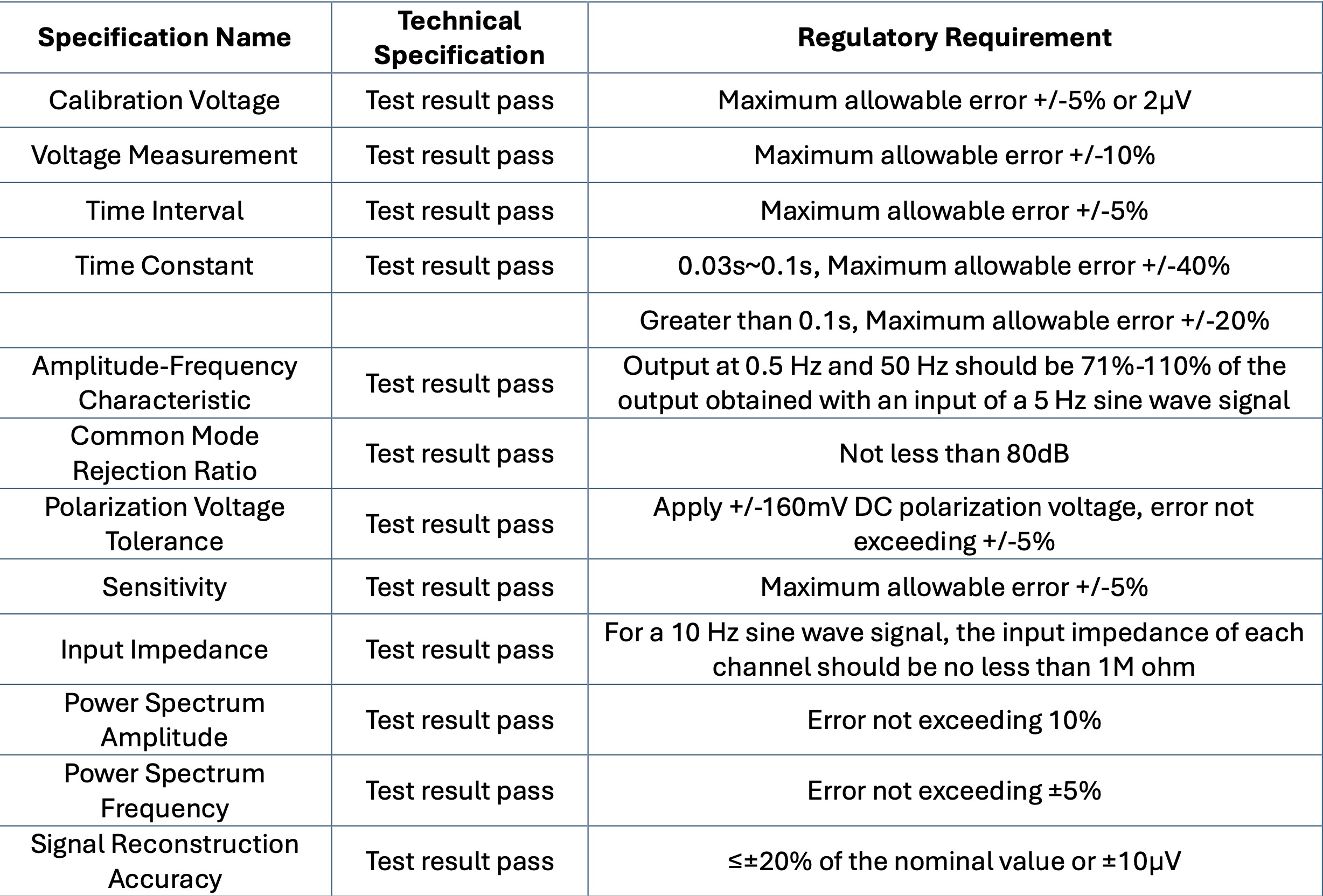
&#x20;

<figure><img src="/files/QKZ1amwzWMRaW5CNsWGx" alt=""><figcaption></figcaption></figure>

#### 2.3 Software Functions

#### 2.3.1 Patient Management

Create, delete, modify, and store patient-related information, and manage the corresponding data files.

#### 2.3.2 Device Connection Function

Check the connection status of the EEG device via software.

#### 2.3.3 EEG Data Acquisition Function

Real-time acquisition and display of EEG signals.

#### 2.3.4 Video Data Acquisition Function

Real-time acquisition and display of video signals from cameras.

#### 2.3.5 Filtering Module

Measure the maximum and minimum values of physiological acquisition signals. Perform filtering on the acquired signals.

#### 2.3.6 Data Export Function

Record, delete, query, and export the acquired data.

#### 2.3.7 User Management

User login function, with options to modify the password and recover the password after login.

#### 2.3.8 Notification and Alarm Function

Low battery notification and Bluetooth connection status notification.

#### 2.3.9 Data Storage Function

After recording begins, the data collected by the device is saved in a specified format.

#### 2.3.10 Playback of Recorded Data

Replay and display recorded EEG data and video data.

#### 2.4 Data Interface

* Wireless Protocol: Bluetooth® low energy, Bluetooth 5.0 or above protocol
* Storage Format: Electrical signal acquisition data is stored in CSV format. Video signals are stored in mp4 format.

#### 2.5 User Access Control

* User Authentication Method: Login using username and password.

#### 2.6 Safety Requirements

Should comply with the JJF 1388-2013 Outline for Type Evaluation of Digital Electroencephalographs and EEG Mapping Instruments and GB 9706.226-2021 Medical Electrical Equipment—Part 2-26: Particular Requirements for the Basic Safety and Essential Performance of Electroencephalographs.

#### 2.7 Electromagnetic Compatibility

Should comply with "YY 9706.102-2021 Medical Electrical Equipment—Part 1-2: General Requirements for Basic Safety and Essential Performance Parallel Standard: Electromagnetic Compatibility Requirements and Tests".

#### 2.8 Environmental Testing

Should comply with the requirements of Group II climate environment and Group II mechanical environment in GB/T 14710-2009.

&#x20;

&#x20;

### 3 System Safety

The safety of the frontal lobe EEG acquisition system is ensured through the following measures:

1. The device operates with a battery voltage of 3.7V, which is well within the safe voltage limit for the human body (36V).
2. The connection between the electrodes and the device uses insulated cables for encapsulation.
3. The parts of the device that come into contact with the human skin are ordinary electrode pads made from medical-grade materials, all of which meet biocompatibility requirements and are harmless to human skin.


# Algrithm

### Overview

In the NeuraMATRIX platform, algorithms play a crucial role in filtering, processing, and optimizing raw EEG data captured by hardware. EEG signals are inherently complex and prone to interference from external environments, equipment noise, and biological signals. Therefore, precise and effective data processing is key to ensuring the success of various applications. The platform offers a range of pre-configured algorithms and allows developers to create custom algorithms tailored to specific use cases, making the platform adaptable to various scenarios.

***

### Core Functions

The algorithms in NeuraMATRIX primarily focus on several core tasks for data processing:

1. **Noise Filtering and Removal**

* **Background:** During EEG signal acquisition, environmental noise, electromyographic (EMG) interference, and ocular artifacts can degrade the quality of the signals, making the raw data unreliable or unusable.
* **Algorithm Functionality:** The platform provides advanced noise filtering algorithms that effectively remove these interferences. Through adaptive filtering, frequency domain analysis, and other techniques, the algorithms can accurately identify and filter out artifacts, leaving behind clean, reliable EEG signals.

2. **Signal Enhancement and Feature Extraction**

* **Background:** EEG signals are generally weak, requiring enhancement and feature extraction before analysis and application. This process is crucial for complex applications like cognitive state monitoring and emotion recognition.
* **Algorithm Functionality:** The platform’s signal enhancement algorithms amplify and extract relevant features from the brainwave signals according to specific application needs. Common feature extraction methods include time-domain and frequency-domain analysis, effectively analyzing alpha, beta, theta waves, and more.

3. **Real-Time Data Processing**

* **Background:** Many BCI applications require real-time EEG processing, such as brain-computer control, neurofeedback, and emotion detection. These applications are latency-sensitive and demand quick data processing.
* **Algorithm Functionality:** The platform integrates low-latency data processing algorithms to ensure minimal delay from data acquisition to output. By optimizing the processing pipeline, these algorithms enable real-time decoding and feedback for complex EEG signals, ensuring the fluidity and reliability of real-time applications.

4. **Multi-Channel Signal Processing and Synchronization**

* **Background:** EEG data is often captured through multiple channels, requiring complex multi-channel synchronization and joint analysis. This is critical for extracting features and making comprehensive assessments across different channels.
* **Algorithm Functionality:** NeuraMATRIX’s multi-channel signal processing algorithms ensure synchronized analysis across all channels, consolidating data for combined processing. Developers can analyze brain activity across multiple regions simultaneously, enabling more advanced applications like cognitive load monitoring or brainwave pattern classification.

***

### Advantages of Pre-Built Algorithms

NeuraMATRIX provides a set of optimized and extensively validated pre-built algorithms designed specifically for EEG data processing and analysis. These pre-set algorithms significantly reduce the workload for developers while ensuring standardized and reliable data processing. The main advantages include:

1. **Ease of Use:** Developers can quickly call pre-configured filtering, noise reduction, and feature extraction algorithms to begin the data processing workflow without the need to build complex signal processing routines from scratch.
2. **Efficiency: T**he platform’s algorithms have been tested and optimized in numerous real-world scenarios, enabling efficient EEG data processing while maintaining precise signal interpretation, which is ideal for applications requiring real-time performance.
3. **Flexibility:** While the platform offers mature pre-configured algorithms, developers can adjust parameters as needed to fine-tune the algorithms for specific scenarios. Additionally, developers can create custom algorithms tailored to their application needs, seamlessly integrating them into the platform’s core framework.

***

### Custom Algorithm Support

Beyond offering ready-to-use algorithms, NeuraMATRIX provides robust support for customization. Developers can design their own data processing algorithms based on specific application requirements and integrate them into the platform. Whether building more sophisticated filtering techniques or developing machine learning models for specific scenarios, the platform’s algorithm framework is flexible enough to accommodate various needs.

* **Machine Learning Model Integration:** Developers can deploy trained machine learning models in real-time EEG data streams via NeuraMATRIX. These models can perform classifications and predictions in applications like emotion recognition and user intent interpretation, enhancing the intelligence of applications.
* **Personalized Data Processing:** For specific user groups or application scenarios, developers can use custom algorithms to optimize the data processing flow. For example, in cognitive research, personalized algorithms can more accurately capture and process activity from specific brain regions, providing deeper insights.

***

### Application Examples

1. **Emotion Recognition and Cognitive State Monitoring**

* Using the platform’s feature extraction algorithms, developers can capture emotional signals within EEG data, enabling real-time emotional analysis. This has important applications in mental health management and neurofeedback training.

2. **Mind-Controlled Interfaces and Brain-Computer Interaction**

* The platform’s real-time processing algorithms can convert EEG signals into control commands for smart devices, virtual reality, or gaming environments. With noise filtering and feature extraction, these signals maintain precision and responsiveness in real-time interactions.

3. **Medical Monitoring and Neurological Diagnosis**

* In medical contexts, the platform’s multi-channel synchronization algorithms help clinicians monitor patients’ brain activity in real-time. Based on the processed results, customized treatment plans and diagnoses can be made.

***

### Conclusion

The NeuraMATRIX platform’s algorithmic system provides robust support for filtering and processing EEG data, ensuring high-quality data and efficient handling. Whether utilizing the platform’s pre-configured algorithms or developing custom solutions, developers can leverage these tools to build complex BCI applications. With powerful real-time data processing, multi-channel synchronization, and feature extraction capabilities, NeuraMATRIX lays a solid technical foundation for innovative brain-computer interface solutions.

### Overview

In the NeuraMATRIX platform, algorithms play a crucial role in filtering, processing, and optimizing raw EEG data captured by hardware. EEG signals are inherently complex and prone to interference from external environments, equipment noise, and biological signals. Therefore, precise and effective data processing is key to ensuring the success of various applications. The platform offers a range of pre-configured algorithms and allows developers to create custom algorithms tailored to specific use cases, making the platform adaptable to various scenarios.

***

### Core Functions

The algorithms in NeuraMATRIX primarily focus on several core tasks for data processing:

1. **Noise Filtering and Removal**

* **Background:** During EEG signal acquisition, environmental noise, electromyographic (EMG) interference, and ocular artifacts can degrade the quality of the signals, making the raw data unreliable or unusable.
* **Algorithm Functionality:** The platform provides advanced noise filtering algorithms that effectively remove these interferences. Through adaptive filtering, frequency domain analysis, and other techniques, the algorithms can accurately identify and filter out artifacts, leaving behind clean, reliable EEG signals.

2. **Signal Enhancement and Feature Extraction**

* **Background:** EEG signals are generally weak, requiring enhancement and feature extraction before analysis and application. This process is crucial for complex applications like cognitive state monitoring and emotion recognition.
* **Algorithm Functionality:** The platform’s signal enhancement algorithms amplify and extract relevant features from the brainwave signals according to specific application needs. Common feature extraction methods include time-domain and frequency-domain analysis, effectively analyzing alpha, beta, theta waves, and more.

3. **Real-Time Data Processing**

* **Background:** Many BCI applications require real-time EEG processing, such as brain-computer control, neurofeedback, and emotion detection. These applications are latency-sensitive and demand quick data processing.
* **Algorithm Functionality:** The platform integrates low-latency data processing algorithms to ensure minimal delay from data acquisition to output. By optimizing the processing pipeline, these algorithms enable real-time decoding and feedback for complex EEG signals, ensuring the fluidity and reliability of real-time applications.

4. **Multi-Channel Signal Processing and Synchronization**

* **Background:** EEG data is often captured through multiple channels, requiring complex multi-channel synchronization and joint analysis. This is critical for extracting features and making comprehensive assessments across different channels.
* **Algorithm Functionality:** NeuraMATRIX’s multi-channel signal processing algorithms ensure synchronized analysis across all channels, consolidating data for combined processing. Developers can analyze brain activity across multiple regions simultaneously, enabling more advanced applications like cognitive load monitoring or brainwave pattern classification.

***

### Advantages of Pre-Built Algorithms

NeuraMATRIX provides a set of optimized and extensively validated pre-built algorithms designed specifically for EEG data processing and analysis. These pre-set algorithms significantly reduce the workload for developers while ensuring standardized and reliable data processing. The main advantages include:

1. **Ease of Use:** Developers can quickly call pre-configured filtering, noise reduction, and feature extraction algorithms to begin the data processing workflow without the need to build complex signal processing routines from scratch.
2. **Efficiency:** The platform’s algorithms have been tested and optimized in numerous real-world scenarios, enabling efficient EEG data processing while maintaining precise signal interpretation, which is ideal for applications requiring real-time performance.
3. **Flexibility:** While the platform offers mature pre-configured algorithms, developers can adjust parameters as needed to fine-tune the algorithms for specific scenarios. Additionally, developers can create custom algorithms tailored to their application needs, seamlessly integrating them into the platform’s core framework.

***

### Custom Algorithm Support

Beyond offering ready-to-use algorithms, NeuraMATRIX provides robust support for customization. Developers can design their own data processing algorithms based on specific application requirements and integrate them into the platform. Whether building more sophisticated filtering techniques or developing machine learning models for specific scenarios, the platform’s algorithm framework is flexible enough to accommodate various needs.

* **Machine Learning Model Integration:** Developers can deploy trained machine learning models in real-time EEG data streams via NeuraMATRIX. These models can perform classifications and predictions in applications like emotion recognition and user intent interpretation, enhancing the intelligence of applications.
* **Personalized Data Processing:** For specific user groups or application scenarios, developers can use custom algorithms to optimize the data processing flow. For example, in cognitive research, personalized algorithms can more accurately capture and process activity from specific brain regions, providing deeper insights.

***

### Application Examples

1. **Emotion Recognition and Cognitive State Monitoring**

* Using the platform’s feature extraction algorithms, developers can capture emotional signals within EEG data, enabling real-time emotional analysis. This has important applications in mental health management and neurofeedback training.

2. **Mind-Controlled Interfaces and Brain-Computer Interaction**

* The platform’s real-time processing algorithms can convert EEG signals into control commands for smart devices, virtual reality, or gaming environments. With noise filtering and feature **extraction, these signals maintain precision and responsiveness in real-time interactions.**

3. **Medical Monitoring and Neurological Diagnosis**

* In medical contexts, the platform’s multi-channel synchronization algorithms help clinicians monitor patients’ brain activity in real-time. Based on the processed results, customized treatment plans and diagnoses can be made.

***

### Conclusion

The NeuraMATRIX platform’s algorithmic system provides robust support for filtering and processing EEG data, ensuring high-quality data and efficient handling. Whether utilizing the platform’s pre-configured algorithms or developing custom solutions, developers can leverage these tools to build complex BCI applications. With powerful real-time data processing, multi-channel synchronization, and feature extraction capabilities, NeuraMATRIX lays a solid technical foundation for innovative brain-computer interface solutions.

&#x20;


# Manual

### 1. Hardware Integration

#### 1.1 Setting up the MH31306 Wireless EEG Device

The first step in working with the NeuraMATRIX platform is integrating the MH31306 wireless frontal lobe EEG device, a critical component of the platform. Developers need to ensure the device is properly charged, paired with their development environment via Bluetooth, and correctly calibrated to ensure optimal performance. The device's wireless capabilities allow for a significant range of movement, making it ideal for both static and dynamic application scenarios. Developers can then test the EEG signal capture to verify signal accuracy and ensure that real-time data transmission is functional.

&#x20;

#### 1.2 Signal Calibration and Testing

Before fully engaging with development, it’s crucial to conduct calibration and signal testing to ensure accurate electrode placement and optimal signal quality. This process helps eliminate noise and interference, ensuring the collected data is clean and ready for further processing.

&#x20;

### 2. SDK Integration

#### 2.1 SDK Setup

NeuraMATRIX offers a comprehensive software development kit (SDK) designed to simplify the integration of EEG data into applications. Developers can install the SDK and configure it within their chosen development environment. The SDK supports various programming languages and platforms, ensuring compatibility across multiple systems and providing flexibility for developers with different technical backgrounds.

&#x20;

#### 2.2 Data Collection and Visualization

Once the SDK is integrated, developers can begin collecting real-time EEG data from the MH31306 device. The SDK offers features for visualizing the data, allowing developers to monitor brainwave activity and verify that the data collection process is functioning as expected. This visualization is especially useful in the early stages of development to understand how the data flows from the device to the application.

&#x20;

#### 2.3 Data Export and Management

In addition to real-time data handling, the SDK supports exporting EEG data for further analysis or archiving. This functionality allows developers to save the data for offline processing or long-term storage, ensuring that the data remains accessible for future development phases.

&#x20;

### 3. Algorithm Integration

#### 3.1 Pre-Built Algorithms for Data Processing

NeuraMATRIX provides a range of pre-configured algorithms for processing EEG data, including tools for noise reduction, signal enhancement, and feature extraction. These pre-built algorithms help developers quickly handle complex brainwave data, reducing the need to build signal processing systems from scratch. For those new to EEG data handling, these algorithms significantly reduce the learning curve and speed up the development process.

&#x20;

#### 3.2 Custom Algorithm Development

For more advanced users or those with specific needs, the platform supports the development and integration of custom algorithms. Developers can design their own preprocessing, analysis, or machine learning algorithms and seamlessly integrate them with the platform. This allows for personalized and highly specialized BCI applications that are tailored to specific requirements, providing greater flexibility and innovation potential.

&#x20;

#### 3.3 Machine Learning and AI Integration

The platform also supports integrating machine learning models, allowing developers to build predictive models based on EEG data. This is particularly useful for applications like emotion recognition, cognitive state monitoring, and neurofeedback systems. By training models on the collected data, developers can unlock new insights and enhance the functionality of their BCI applications.

&#x20;

### 4. Troubleshooting and Optimization

#### 4.1 Common Issues and Solutions

Developers may encounter various technical challenges during integration. For example, issues like signal loss due to Bluetooth interference or low-quality EEG signals can often be resolved through recalibration, adjusting electrode placement, or ensuring the device is within optimal range.

&#x20;

#### 4.2 Performance Optimization

To ensure the best performance, developers can optimize data collection parameters such as sampling rates and signal thresholds based on the application’s requirements. Custom algorithms may also require optimization for real-time performance, particularly in applications where low latency is critical, such as in neurofeedback or gaming.

&#x20;

### 5. Conclusion

The NeuraMATRIX platform provides a comprehensive ecosystem for building brain-computer interface (BCI) applications, offering powerful EEG hardware, flexible SDKs, and advanced algorithm support. By combining ease of use with high customization potential, the platform enables developers to create a wide range of applications, from medical tools and neurofeedback systems to immersive virtual reality experiences. Whether you're a novice or an experienced developer, NeuraMATRIX offers the tools needed to push the boundaries of BCI technology and bring innovative solutions to life.


# Neura MATRIX: Bridging Brainwaves and Blockchain to Revolutionize the Future of Web3 (3/3)

September 5, 2024

<figure><img src="/files/inkFZFg13l357AfB6pwS" alt=""><figcaption></figcaption></figure>

### Neura Powers the Takeoff of the MATRIX Ecosystem

The launch of the Neura MATRIX platform is poised to have a wide-reaching and profound positive impact on the MAN token and the entire MATRIX ecosystem. These effects will not only enhance the practical utility of the token but also drive the activity and sustainable development of the ecosystem in several key areas:

<figure><img src="/files/azvDceSqKb2eGzrTndzO" alt=""><figcaption></figcaption></figure>

1. **Expanding Use Cases and Demand for the Token** The introduction of the Neura MATRIX platform provides new use cases for the MAN token, particularly in the integration of Brain-Computer Interface (BCI) technology with blockchain. Various operations on the platform, such as data storage, smart contract execution, and application transactions, will require MAN tokens as the primary payment method. This expansion of the token’s usage not only broadens its application within the ecosystem but also increases its demand, thereby promoting greater circulation and usage of the token.
2. **Increasing Ecosystem Activity** The Neura MATRIX platform will attract a wide array of participants, including developers, researchers, and medical institutions, who will develop and use various BCI applications on the platform. As the number of users on the platform grows, the activity level of the MAN token within the ecosystem will also rise. Whether it’s for purchasing applications, paying for services, or trading data, the MAN token will play a crucial role, enhancing its market liquidity and value.

<figure><img src="/files/gw1f0uLSTLx5M2pWo57E" alt=""><figcaption></figcaption></figure>

3. **Strengthening the MATRIX Main Chain Ecosystem** As a significant application platform on the MATRIX main chain, the successful operation of Neura MATRIX will greatly enrich and strengthen the MATRIX main chain ecosystem. With the increase in applications and user engagement on the platform, the MAN token will find broader application scenarios. This virtuous cycle will not only solidify the technical foundation of the MATRIX main chain but also enhance its competitiveness and influence within the blockchain industry.
4. **Promoting Technological Innovation and Ecosystem Development** The innovative nature of the Neura MATRIX platform will spur the development of new technologies and applications, further strengthening the technical support and ecosystem value of the MAN token. As the platform continues to evolve and technology advances, the MAN token will become more deeply integrated into the ecosystem, emerging as an indispensable core element that drives the ongoing development of the MATRIX ecosystem.

&#x20;

### Neura MATRIX: Bridging the Future of Web3 with Brainwaves

The Neura MATRIX platform, by integrating Brain-Computer Interface (BCI) technology with blockchain, is redefining human-machine interaction and bringing revolutionary innovations to the Web3 world. The platform not only drives the diversification of decentralized applications (DApps) but also enhances data sovereignty and privacy protection, infusing new vitality into virtual reality and the metaverse.

1. **Redefining Human-Machine Interaction** Neura MATRIX pushes BCI technology to new heights, making interaction between humans and machines more natural and direct. In the future, people will be able to control computers, smart devices, and even virtual reality environments with their thoughts, fundamentally changing how we interact with technology. This will propel the development of smart homes, virtual reality, gaming, and entertainment. As these technologies become more widespread, the Neura MATRIX platform will make digital experiences globally more immersive and personalized, redefining the relationship between humans and technology.
2. **Fostering Innovation in Decentralized Applications (DApps)** Neura MATRIX brings new decentralized application scenarios to the Web3 world, especially in the BCI domain. Developers can use the platform’s tools and SDKs to create DApps based on brainwave signals, ranging from medical monitoring to emotion recognition, and even mind-controlled smart devices. Neura MATRIX will open up new application fields, enriching the diversity of the Web3 ecosystem and advancing the application of decentralized technology in cutting-edge fields.
3. **Enhancing Data Sovereignty and Privacy Protection** In the Web3 world, data sovereignty and privacy protection are core principles. Neura MATRIX ensures users have full control over their brainwave data by combining blockchain technology. Users can decide how to store, share, and trade their data, with all actions recorded on a decentralized blockchain, ensuring data immutability and transparency. This strengthening of data sovereignty aligns with Web3's core values, fostering a safer and more transparent digital society.
4. **Boosting Interaction and Collaboration in the Web3 Community** Neura MATRIX provides an open innovation environment for the Web3 community, encouraging collaboration and interaction among global developers. Through the platform, developers can share resources, learn from each other, and jointly develop cross-domain applications. This decentralized collaboration model not only promotes technological progress but also accelerates the adoption and popularization of new technologies, enhancing the vitality and creativity of the Web3 community.
5. **Empowering the Metaverse and Virtual Reality** Neura MATRIX can combine BCI technology with Web3's metaverse and virtual reality (VR) domains, allowing users to interact with virtual worlds through thought. In the future, users can control virtual characters, create virtual objects, or engage in virtual social activities within the metaverse using brainwave signals. This deep interaction will greatly enhance the immersion and interactivity of the metaverse, bringing revolutionary changes to the virtual experiences in the Web3 world.

&#x20;

### Conclusion

The Neura MATRIX platform tightly connects the future of the Web3 world through brainwave technology, driving deep integration between humans and technology. This platform not only redefines human-machine interaction but also opens new possibilities for decentralized applications and data sovereignty. With Neura MATRIX, brainwaves will become the core force leading innovation and transformation in Web3, ushering in a smarter, more personalized digital era.

{% embed url="<https://coinmarketcap.com/community/post/339895867>" %}

{% embed url="<https://coinmarketcap.com/community/articles/66e31c94e52199547e4f2784>" %}

{% embed url="<https://matrixainetwork.medium.com/neura-matrix-bridging-brainwaves-and-blockchain-to-revolutionize-the-future-of-web3-3-3-2311594ab8b2>" %}

{% embed url="<https://x.com/MatrixAINetwork/status/1834285053813424625>" %}

&#x20;


# Neura MARTIX——用脑波链接Web 3.0时代 (3/3)

2024/9/12

<figure><img src="/files/Jn4VbyB3lZ7bf3JGEqr6" alt=""><figcaption></figcaption></figure>

### Neura助力MATRIX生态腾飞

Neura MATRIX平台的推出将为MAN代币及整个MATRIX生态系统带来广泛而深远的积极影响。这些影响不仅将增强代币的实际应用价值，还将推动整个生态系统的活跃度和可持续发展，具体体现在以下几个方面：

<figure><img src="/files/gpWpTupHcDzwl0CjnnUK" alt=""><figcaption></figcaption></figure>

**1. 提升代币的应用场景和需求**

Neura MATRIX平台的推出为MAN代币提供了新的应用场景，尤其是在脑机接口（BCI）与区块链技术的结合上，平台上涉及的各种操作，如数据存储、智能合约执行、应用交易等，都将以MAN代币作为支付手段。这不仅拓宽了MAN代币的使用范围，还提升了其在生态系统内的需求，进一步推动了代币的流通和使用。

**2. 增加生态系统的活跃度**

Neura MATRIX平台的引入将吸引大量开发者、研究人员、医疗机构等参与者，他们将在平台上开发和使用各种BCI应用。随着平台用户的增加，MAN代币在整个生态系统内的活跃度也将随之提高，无论是应用购买、服务支付，还是数据交易，MAN代币都将扮演重要角色，从而增强其市场流动性和价值。

<figure><img src="/files/vrQjGvRoOTFSkdkc1aB5" alt=""><figcaption></figcaption></figure>

**3. 强化MATRIX主链的生态体系**

Neura MATRIX平台作为MATRIX主链上的重要应用平台，其成功运营将极大地丰富和强化MATRIX主链的生态体系，随着平台上应用的增多和用户的活跃，MAN代币将在更广泛的场景中得到应用。这种良性循环不仅巩固了MATRIX主链的技术基础，还增强了其在区块链行业中的竞争力和影响力。

**4. 促进技术创新和生态发展**

Neura MATRIX平台的创新性将促进更多新技术、新应用的产生，这些创新将进一步增强MAN代币的技术支撑和生态价值。随着平台的不断进化和技术的不断提升，MAN代币将更加深入地融入到整个生态系统中，成为不可或缺的核心元素之一，推动MATRIX生态系统的持续发展。

&#x20;

### Neura MATRIX：用脑波链接Web3世界的未来

&#x20;      Neura MATRIX平台通过将脑机接口（BCI）技术与区块链技术相结合，正在重新定义人机交互方式，并为Web3世界带来革命性的创新，平台不仅推动了去中心化应用（DApps）的多样化，还强化了数据主权和隐私保护，为虚拟现实和元宇宙注入了新的活力。

**1. 重新定义人机交互方式**

Neura MATRIX平台将脑机接口技术推向新的高度，使得人与机器之间的交互变得更加自然和直接。未来，人们可以通过意念控制计算机、智能设备，甚至是虚拟现实环境，这将彻底改变我们与技术互动的方式，推动智能家居、虚拟现实、游戏娱乐等领域的发展。随着这些技术的普及，Neura MATRIX平台将使全球范围内的数字体验变得更加沉浸和个性化，重新定义人类与技术的关系。

**2. 促进去中心化应用（DApps）的创新**

Neura MATRIX平台为Web3世界带来了全新的去中心化应用场景，特别是在脑机接口（BCI）领域，开发者可以利用平台提供的工具和SDK，创建基于脑电信号的去中心化应用（DApps），从医疗监测到情绪识别，再到意念控制的智能设备，Neura MATRIX将开辟新的应用领域。这不仅丰富了Web3生态系统的多样性，还推动了去中心化技术在前沿科技中的应用。

**3. 强化数据主权与隐私保护**

在Web3世界，数据主权和隐私保护是核心理念之一。Neura MATRIX平台通过结合区块链技术，确保用户对自己脑电数据的完全控制权。用户可以决定如何存储、分享和交易这些数据，所有操作都在去中心化的区块链上进行记录，确保数据的不可篡改性和透明性。这种数据主权的强化符合Web3的核心价值观，推动了更加安全和透明的数字社会的形成。

**4. 增强Web3社区的互动与协作**

Neura MATRIX平台为Web3社区提供了一个开放的创新环境，鼓励全球开发者的合作与互动，通过平台，开发者可以共享资源、互相学习，共同开发跨领域的应用。这种去中心化的协作模式不仅促进了技术的进步，还加速了新技术的落地与普及，增强了Web3社区的活力和创造力。

**5. 赋能元宇宙与虚拟现实**

Neura MATRIX平台可以将脑机接口技术与Web3的元宇宙和虚拟现实（VR）领域结合，使用户能够通过意念与虚拟世界互动。未来，用户可以在元宇宙中通过脑电信号控制虚拟角色、创建虚拟物品或参与虚拟社交活动。这种深度交互将大大提升元宇宙的沉浸感和互动性，为Web3世界的虚拟体验带来革命性的改变。

&#x20;      Neura MATRIX平台通过脑波技术将Web3世界的未来紧密连接在一起，推动了人与技术的深度融合，这个平台不仅重新定义了人机交互方式，还为去中心化应用和数据主权带来了全新的可能性。通过Neura MATRIX，脑波将成为引领Web3创新和变革的核心力量，开启一个更加智能、个性化的数字时代。

&#x20;


# Neura MATRIX: Bridging Brainwaves and Blockchain to Revolutionize the Future of Web3 (2/3)

September 5, 2024

Neura MATRIX Open Platform: The Great Fusion of BCI and Blockchain Technology

In today's rapidly advancing technological landscape, Brain-Computer Interface (BCI) and blockchain technology are two cutting-edge fields that are driving transformation within their respective domains. However, what is truly exciting is the potential unleashed when these two technologies converge on the Neura MATRIX Open Platform, paving the way for future technological advancements and innovative applications.

Blockchain technology, known for its decentralized, immutable, and highly transparent characteristics, offers unique advantages in addressing data management challenges. With blockchain, all data interactions are securely recorded on a distributed ledger, ensuring data integrity and transparency. Users can not only retain control over their data but also share and trade it within a decentralized environment, thus breaking away from traditional data monopolies.

The Neura MATRIX Open Platform is built upon the deep integration of BCI and blockchain technologies, providing a secure, efficient, and innovative development environment for users and developers alike. On this platform, BCI devices can leverage blockchain technology to ensure the security and privacy of data while guaranteeing that users have full control over their own data. Developers can take advantage of the SDKs and development tools provided by the platform to design and create a variety of innovative BCI applications, all while ensuring data security.

This combination of BCI and blockchain on the Neura MATRIX Open Platform not only enhances the potential of both technologies but also opens up new possibilities for secure, user-centric innovation in the rapidly evolving world of tech.

<figure><img src="/files/FA1MUJn9EMtsFx7J2YIE" alt=""><figcaption></figcaption></figure>

&#x20;

### MH31306 Main Unit: The Hardware Core of the Open Platform

Neura MATRIX has successfully completed an upgrade of its system-level chip, unveiling a new hundred-channel chip that is only the size of a small fingernail but boasts powerful integrated functions. This in-house developed chip not only efficiently collects EEG (electroencephalogram) signals but also integrates neural stimulation and wireless interaction capabilities, significantly enhancing the device's multifunctionality and applicability. More importantly, research data shows that Neura MATRIX’s system-level chip excels in key metrics like noise resistance and wireless transmission capability, even outperforming the market-leading Neuralink products.

<figure><img src="/files/nvqHQ9lGZrq31WlyUZsW" alt=""><figcaption></figcaption></figure>

Building on this advanced chip, Neura MATRIX has successfully developed and mass-produced the MH31306 wireless frontal lobe EEG device, designed specifically for medical scenarios. This device features five collection channels that meet the precise EEG signal acquisition needs of the frontal lobe region. As the core collection hardware of the Neura MATRIX open platform, the importance of the MH31306 wireless frontal lobe EEG device is not only reflected in its outstanding technical performance but also in its role as a solid foundation for application development and technological innovation on the entire platform. Its unique design and functionality make it an indispensable component for developing various Brain-Computer Interface (BCI) applications and are crucial to the successful operation of the entire Neura MATRIX ecosystem.

The MH31306 wireless frontal lobe EEG device was designed to provide an efficient and precise EEG signal collection solution for the Neura MATRIX platform. The device integrates five high-sensitivity collection channels capable of accurately capturing brain activity in the frontal lobe region at a sampling rate of up to 1000Hz. The frontal lobe is closely related to various advanced cognitive functions, including decision-making, attention regulation, and emotional control, which are vital for the development of many BCI applications. The quality of the data provided by the MH31306 directly impacts the performance and reliability of these applications.

&#x20;

<figure><img src="/files/B7SRgtsX1ChZNr5yoCao" alt=""><figcaption></figcaption></figure>

<figure><img src="/files/hwK2aQyNYRGMp9xyNROJ" alt=""><figcaption></figcaption></figure>

Not only that, the MH31306 also employs low-power Bluetooth 5.0 technology, enabling efficient wireless data transmission with a range of up to 15 meters. This design ensures that the device excels not only in laboratory settings but also adapts to more complex mobile and dynamic environments, such as real-time monitoring, telemedicine, and dynamic cognitive experiments. This flexibility opens up more possibilities for developers, allowing them to design a broader range of application scenarios, thereby maximizing the potential of the Neura MATRIX platform.

As the core data acquisition hardware of the Neura MATRIX platform, the MH31306 is not only fundamental to the platform's functionality but is also key to driving the development of the entire ecosystem. All BCI applications developed on the Neura MATRIX platform, whether in the fields of medicine, research, or entertainment, rely on the high-quality EEG signals provided by the MH31306. This means that this hardware is not just a tool for data collection but is the starting point of the entire application development chain.

The significance of the MH31306 is also evident in the stable and reliable foundation it provides to developers, allowing them to focus on innovation and development at the application level. By using the MH31306, developers can easily obtain high-quality EEG data and build various BCI applications based on this data, such as neurofeedback systems, emotion recognition applications, and cognitive training programs. These applications not only benefit from the device's high precision and stability but also from its convenient wireless connectivity and lightweight design, enabling developers to turn their ideas into real products in a shorter time frame.

Moreover, the openness and scalability of the MH31306 make it an ideal choice for developing new BCI devices and applications. Developers can build on the MH31306 hardware to create customized acquisition devices or expansion modules, achieving more complex EEG signal acquisition and processing functions. This hardware-level innovation will further enrich the Neura MATRIX platform ecosystem and propel the advancement of BCI technology to higher levels.

### Core Features of the Neura MATRIX Platform

1. **High-Precision EEG Signal Acquisition** The Neura MATRIX platform leverages advanced EEG acquisition hardware, specifically the MH31306 wireless frontal lobe EEG device, to capture users' brainwave signals in real-time with high precision. These signals, processed by the platform, can be utilized in various applications such as neurofeedback, emotion recognition, and cognitive training. The platform supports multi-channel acquisition, ensuring comprehensive and accurate data collection, which provides a solid foundation for complex BCI applications.
2. **Data Security and Privacy Protection** The Neura MATRIX platform employs blockchain technology to encrypt and decentralize user data storage, ensuring the security and immutability of the data. User data is distributed across the blockchain, with every instance of data generation, transmission, and usage being meticulously recorded, guaranteeing transparency and traceability. Additionally, users have full control over their data, with the ability to decide when, where, and how to share it, thereby significantly enhancing the level of privacy protection.
3. **Diverse Development Tools and SDKs** The Neura MATRIX platform offers a wide range of development tools and SDKs, supporting multiple programming languages and development environments. These tools and SDKs enable developers to get started quickly, facilitating the rapid development and deployment of BCI applications. Whether creating neurofeedback systems, medical monitoring applications, or entertainment and educational tools, developers can easily bring their ideas to life on the platform.

{% embed url="<https://coinmarketcap.com/community/post/339711400>" %}

{% embed url="<https://coinmarketcap.com/community/articles/66d9a040bc62357e10512486/>" %}

{% embed url="<https://matrixainetwork.medium.com/neura-matrix-bridging-brainwaves-and-blockchain-to-revolutionize-the-future-of-web3-2-3-a7e9a789648d>" %}

{% embed url="<https://x.com/MatrixAINetwork/status/1831665493767266482>" %}

&#x20;


# Neura MARTIX——用脑波链接Web 3.0时代 (2/3)

2024/9/5

<figure><img src="/files/ewxPdCADMr2QcS8M4QUd" alt=""><figcaption></figcaption></figure>

### Neura MATRIX开放平台：BCI与区块链技术的伟大结合

在科技迅速发展的今天，脑机接口（BCI）技术和区块链技术作为两项前沿科技，正在各自的领域内引领着变革，然而，真正令人振奋的是，当这两项技术在Neura MATRIX开放平台上结合时，它们的潜力被最大化地释放出来，为未来的科技发展和应用创新开辟了广阔的前景。

区块链技术以其去中心化、不可篡改和高度透明的特性，在解决数据管理问题上展现出独特的优势，通过区块链，所有的数据交互都被安全地记录在分布式账本中，确保数据的完整性和透明性。用户不仅能够掌握自己的数据，还可以在一个去中心化的环境中共享和交易这些数据，从而打破传统数据垄断的局面。

Neura MATRIX开放平台正是基于BCI技术与区块链技术的深度结合，为用户和开发者提供了一个安全、高效、创新的开发环境。在这个平台上，BCI设备能够通过区块链技术保障数据的安全和隐私，同时确保用户对自己数据的完全控制。开发者可以利用平台提供的SDK和开发工具，在保障数据安全的前提下，设计和开发各种创新的BCI应用。

<figure><img src="/files/HSwxzOESvGrpriqF8E7Y" alt=""><figcaption></figcaption></figure>

&#x20;

### MH31306主机：开放平台的硬件核心

Neura MATRIX公司已经成功完成了系统级芯片的升级，其最新研发的百通道芯片尺寸仅有半个小指甲盖大小，但却具备了强大的集成功能。这款自研芯片不仅能够高效地采集脑电信号，还集成了神经刺激和无线交互功能，极大地提高了设备的多功能性和适用性。更为重要的是，科研数据显示，Neura MATRIX的系统级芯片在抗噪性能和无线传输能力这两个关键指标上，均表现优异，甚至超越了目前市场上领先的NeuraLink产品。

<figure><img src="/files/7yuvTsB71u5avD9KdjKU" alt=""><figcaption></figcaption></figure>

而目前Neura MATRIX已经基于采集芯片成功研发并量产了面向医疗情景的MH31306无线额叶脑电仪，这款设备采用了5个采集通道，能够满足额叶区域脑电信号的精准采集需求。MH31306无线额叶脑电仪作为Neura MATRIX开放平台的核心采集硬件，其重要性不仅体现在其卓越的技术性能上，更在于它为整个平台上的应用开发和技术创新提供了坚实的基础。这个设备的独特设计和功能使得它成为开发各类脑机接口（BCI）应用不可或缺的组件，对整个Neura MATRIX生态系统的成功运作至关重要。

MH31306无线额叶脑电仪的设计初衷就是为Neura MATRIX平台提供一个高效、精确的脑电信号采集解决方案，该设备集成了5个高灵敏度的采集通道，能够以高达1000Hz的采样率精确捕捉额叶区域的脑电活动。额叶区域与多种高级认知功能密切相关，包括决策、注意力调节、情绪控制等，这些功能对许多BCI应用的开发至关重要，MH31306提供的数据质量直接影响到这些应用的性能和可靠性。

<figure><img src="/files/fqP3vRkwympb9PRu6olT" alt=""><figcaption></figcaption></figure>

&#x20;

<figure><img src="/files/cOBd7nU0TGtB0q3L1DKF" alt=""><figcaption></figcaption></figure>

&#x20;

不仅如此，MH31306还采用了低功耗蓝牙5.0技术，实现了高效的无线数据传输，传输距离可达15米，这种设计使得设备不仅在实验室环境中表现出色，还能够适应更为复杂的移动和动态场景，比如实时监控、远程医疗、动态认知实验等。这种灵活性为开发者提供了更多的可能性，使他们能够设计出更广泛的应用场景，从而最大化地利用Neura MATRIX平台的潜力。

作为Neura MATRIX平台的核心采集硬件，MH31306不仅是平台功能的基础，更是驱动整个生态系统发展的关键，所有在Neura MATRIX平台上开发的BCI应用，无论是医疗、科研还是娱乐，都需要依赖MH31306所提供的高质量脑电信号。这意味着，这款硬件不仅是数据采集的工具，更是整个应用开发链条的起点。

MH31306的重要性还体现在它为开发者提供了一个稳定、可靠的基础，使得他们能够专注于应用层面的创新和开发。通过使用MH31306，开发者可以轻松获取高质量的脑电数据，并基于这些数据进行各类BCI应用的开发，如神经反馈系统、情绪识别应用、认知训练程序等。这些应用不仅依赖于设备的高精度和稳定性，还受益于其便捷的无线连接和轻量化设计，使得开发者能够在更短的时间内将创意转化为现实产品。

此外，MH31306的开放性和可扩展性使其成为开发新型BCI设备和应用的理想选择。开发者可以基于MH31306硬件，进一步开发定制化的采集设备或扩展模块，从而实现更加复杂的脑电信号采集和处理功能，这种硬件层面的创新，将进一步丰富Neura MATRIX平台的生态系统，推动脑机接口技术向更高层次发展。

### Neura MATRIX平台的核心功能

#### 1.     高精度脑电信号采集

Neura MATRIX平台依托先进的脑电采集硬件——MH31306无线额叶脑电仪，能够实时、高精度地捕捉用户的脑电波信号，这些信号经过平台的处理后，可以用于多种应用场景，如神经反馈、情绪识别、认知训练等。平台支持多通道采集，确保数据的全面性和精确性，为各类复杂的BCI应用提供了坚实的数据基础。

#### 2.     数据安全与隐私保护

Neura MATRIX平台通过区块链技术对用户数据进行加密和去中心化存储，确保数据的安全性和不可篡改性。用户的数据被分布式地存储在区块链上，每一次数据的生成、传输和使用都被完整记录，确保了数据的透明性和可追溯性。此外，用户可以完全控制自己的数据，决定何时、何地以及如何共享这些数据，从而极大地提升了用户的隐私保护水平。

#### 3.     多样化的开发工具和SDK

Neura MATRIX平台为开发者提供了丰富的开发工具和SDK，支持多种编程语言和开发环境。这些工具和SDK使开发者能够轻松上手，快速开发和部署BCI应用。无论是神经反馈系统、医疗监测应用，还是娱乐和教育工具，开发者都可以在平台上轻松实现他们的创意。

&#x20;


# Neura MATRIX: Bridging Brainwaves and Blockchain to Revolutionize the Future of Web3 (1/3)

August 29, 2024

<figure><img src="/files/EAl2uGMsZwgA4bUochIi" alt=""><figcaption></figcaption></figure>

#### BCI: The Next Great Era After AI

As technology continues to advance at an astonishing pace, Brain-Computer Interface (BCI) technology is transitioning from a concept found in science fiction to a tangible reality, becoming a focal point for cutting-edge research and applications. BCI technology enables direct interaction between humans and machines by decoding neural signals in the brain and translating them into commands that machines can understand. The uniqueness and potential of this technology are making it increasingly significant across various fields, including healthcare, gaming, communication, and more, with a wide range of applications on the horizon.

In recent years, significant progress has been made in BCI technology, particularly in the medical field. BCI has been applied in neurorehabilitation and assistive devices for people with disabilities, such as brain-controlled prosthetics that help paralyzed patients regain motor function, and brain-controlled devices that assist aphasia patients in expressing their thoughts again. By enabling real-time monitoring of brain activity, BCI technology is also being used in the diagnosis and treatment of mental illnesses, providing unprecedented tools and perspectives for psychiatric research.

<figure><img src="/files/WE6iq91NKDBmsLLp9HCO" alt=""><figcaption></figcaption></figure>

Among the rapid advancements in BCI technology, Elon Musk's company Neuralink stands out as one of the most prominent players. As a tech pioneer, Musk has turned his attention to the field of brain-computer interfaces with the goal of achieving deep integration between humans and artificial intelligence through Neuralink. Neuralink's vision is to significantly enhance human cognitive abilities by implanting tiny electrodes in the brain to facilitate direct communication with computers, ultimately achieving "human intelligence augmentation." Musk's foray into the BCI field has not only garnered widespread attention from the global tech community but also further accelerated BCI research and application. Neuralink's success showcases the immense potential of BCI technology in both healthcare and human capability enhancement, inspiring more companies and research institutions to venture into this cutting-edge field.

#### Challenges in the Development of BCI Technology

Although Brain-Computer Interface (BCI) technology shows immense potential and promises a wide range of applications, its development faces numerous challenges and issues. One of the primary concerns is data security and privacy. BCI technology involves the collection and processing of extremely sensitive brain signals. If this data is misused or leaked, it could pose a significant threat to personal privacy. Unfortunately, existing data protection mechanisms are relatively weak when dealing with such highly sensitive information.

<figure><img src="/files/zchHDMLA42O649VbdPwj" alt=""><figcaption></figcaption></figure>

Another unresolved issue is data ownership and control. In traditional centralized systems, users often lack full control over their data, especially when it is stored and processed by third-party entities. This raises concerns about the protection of user rights. Additionally, cross-platform interoperability presents a technical challenge for BCI technology. The lack of unified standards and protocols among different BCI devices and systems often prevents data from flowing and being shared freely across platforms, thereby limiting the widespread adoption of BCI applications.

The complexity and cost of the technology are also barriers to the widespread adoption of BCI. The development and manufacturing of BCI devices require high-precision hardware and complex signal processing algorithms, which not only raises the technical bar but also drives up the cost of the equipment. This, in turn, hinders large-scale commercialization and adoption. Lastly, user experience and acceptability pose challenges to BCI technology. As the technology is still in its early stages, factors such as the comfort of wearing the devices, the accuracy of signal detection, and the speed of response need further optimization to enhance user experience and acceptance.

{% embed url="<https://coinmarketcap.com/community/articles/66d0589106e5514e04c44399>" %}

{% embed url="<https://matrixainetwork.medium.com/neura-matrix-bridging-brainwaves-and-blockchain-to-revolutionize-the-future-of-web3-1-3-c6214691639b>" %}

{% embed url="<https://matrixainetwork.medium.com/neura-matrix-bridging-brainwaves-and-blockchain-to-revolutionize-the-future-of-web3-1-3-c6214691639b>" %}

{% embed url="<https://x.com/MatrixAINetwork/status/1829112170212163641>" %}

&#x20;


# Neura MARTIX——用脑波链接Web 3.0时代 (1/3)

2024/8/29

#### BCI：AI之后的下一个伟大时代

随着科技的迅猛发展，脑机接口（BCI）技术正逐步从科幻小说中的概念走向现实，成为许多前沿研究和应用的焦点。BCI技术通过解读大脑中的神经信号，将这些信号转化为机器可理解的指令，实现了人与机器之间的直接交互。这种技术的独特性和潜力，使其在医疗、游戏、通信等多个领域展现出日益增长的重要性和广泛应用前景。

近年来，BCI技术取得了显著进展，特别是在医疗领域。BCI技术已经被应用于神经康复和残疾人辅助设备中，例如帮助瘫痪患者恢复运动功能的脑控义肢，以及辅助失语症患者重新表达思想的脑控设备。通过对大脑活动的实时监控，BCI技术还被用于精神疾病的诊断和治疗，为精神病学研究提供了前所未有的工具和视角。

<figure><img src="/files/sNG4DENMh1C49B4o6ZbY" alt=""><figcaption></figcaption></figure>

在BCI技术的飞速发展中，Elon Musk的公司Neuralink无疑是最受瞩目的参与者之一。作为一位科技先锋，马斯克将他的目光投向了脑机接口领域，旨在通过Neuralink实现人类与人工智能的深度融合。Neuralink的愿景是通过在大脑中植入微小的电极来实现与计算机的直接连接，从而大幅提升人类的认知能力，并最终实现“人类智能增强”。马斯克对BCI领域的进军，不仅引起了全球科技界的广泛关注，也进一步推动了BCI技术的研究与应用。Neuralink的成功案例展示了BCI技术在医疗和增强人类能力方面的巨大潜力，也激发了更多企业和研究机构投入到这一前沿领域中来。

#### BCI技术发展所亟需解决的问题

尽管BCI技术展现了巨大的潜力和广泛的应用前景，但在实际发展过程中仍然面临诸多挑战和问题。首先，数据安全与隐私是一个主要的担忧，BCI技术涉及采集和处理用户极为敏感的大脑信号，这些数据一旦被不当使用或泄露，可能会对个人隐私造成严重威胁。然而，现有的数据保护机制在面对如此高敏感度的数据时，显得相对薄弱。

<figure><img src="/files/K47LycBXBa0TEkXe8DUO" alt=""><figcaption></figcaption></figure>

其次，数据的所有权和控制权问题尚未得到妥善解决。在传统的集中式系统中，用户通常缺乏对自身数据的完全控制，尤其是在数据被第三方机构存储和处理的情况下，这引发了对用户权益保护的担忧。此外，跨平台的互操作性也是BCI技术面临的技术性挑战。不同的BCI设备和系统之间往往缺乏统一的标准和协议，导致数据无法在不同平台之间自由流动和共享，从而限制了BCI应用的广泛普及。

技术的复杂性和成本也是当前BCI技术推广的一个障碍。BCI设备的研发和制造需要高精度的硬件支持和复杂的信号处理算法，这不仅提高了技术门槛，也使得设备的成本居高不下，从而限制了其大规模商用和普及。最后，用户体验和可接受性也对BCI技术提出了挑战。由于技术尚处于早期阶段，设备的佩戴舒适性、信号的准确性和响应速度等方面还需要进一步优化，以提高用户的使用体验和接受度。


# FAQ of MATRIX AI Network

This FAQ contains the basic information about MATRIX AI Network, and common questions from communities at different channel. It is a working document and will be updated from time to time.


# 1.	Why does MATRIX exist?

The development of blockchain is held back by three obstacles:

**a)    Slowness:** Take Bitcoin for example. An average transaction takes over an hour to verify. This is a hurdle to the promotion of blockchain;

**)    Security issues:** Whether it’s the DAO attack on Ethereum or the many security issues plaguing DeFi projects, tens of thousands of dollars could be at stake. If security should be an issue for crypto assets, then there is no point investing in them.

**c)    Impact on environment:** Take Bitcoin for example. PoW of Bitcoin is nothing but meaningless hash computing that creates no real value for society. According to statistics, 70% of the world’s computing power is consumed to mine cryptos, which is a million times Google’s computing power. Bitcoin mining also consumed more power each year than 260 countries of the world, creating a huge waste.


# 2.	What is the vision and mission of Matrix?

**Vision:** To build a decentralized auto-functioning AI economy

**Mission：**

**Stage One:** Highly efficient blockchain platform

**Stage Two:** Decentralized cloud computing platform

**Stage Three:** Digital asset authentication platform/Digital asset trading platform


# 3.	What are main features of MATRIX?

**Thanks to fast-growing AI technologies, MATRIX offers unique features as follows.**

**SAFER:** Making blockchains more robust under malicious attacks.

**FASTER:** Enabling faster transactions and higher processing throughput.

**MORE FLEXIBLE:** Seamless integration of public and private chains with the capability of adaptive optimization.


# 4.	How is MATRIX different?

• Matrix Mainnet has a top speed of TPS 12499 beating BTC and ETH by a wide margin.

• Profit from computing: Matrix’s core PoW algorithms include AI algorithms, which means the PoW mining process creates value for society. Secondly, Matrix adopts an election-based PoW mechanism so that the unelected miners of each mining cycle may lease out their spare computing power for profit.

• Distributed storage: Ahead of its competitors, Matrix has integrated IPFS storage protocol into its network. Besides decentralized information exchange and bookkeeping, decentralized storage is also crucial for developing DApps. Matrix is committed to protecting user privacy, giving developing DApps on Matrix a natural advantage.

• Custom functions: Transfer to multiple accounts, pay other people’s bills, and many more custom functions to come.


# 5.	What exactly does MATRIX do?

Matrix is an AI-empowered high-performance blockchain. In Stage One, we use AI to solve problems plaguing traditional blockchain technologies. When the performance and usability of blockchain are brought to the next level, we can build a complete and expandable ecosystem of high-performance AI blockchain.

Matrix is building a multifunctional AI service platform featuring computing power leasing, authentication and transaction of data, algorithm models and digital assets, AI services, et


# 6.	What is Matrix's consensus mechanism?

MATRIX adopts a unique hybrid PoS + PoW consensus mechanism. The PoW is performed in a significantly smaller network of delegates, which are selected with a random distributed voting algorithm. The probability of a node to be selected is proportional to its PoS. The “winner” delegate shares the PoW reward with other nodes in its cluster. This mechanism eliminates the latency issues associated with scaling commonly faced by other blockchains.


# 7.	What problems does the matrix solve?

With a very secure, easy to use, fast blockchain and decentralized artificial intelligence supported platforms built on this blockchain;

• Waste of energy

• Waste of computing power

• Data Security concerns

• Recover from large volume, single size and low quality data

• High computing power price

• Problems created by a central structure


# 8.	What makes The Matrix different? Why is it better?

• It has a new generation blockchain powered by high performance AI, which is secure, fast and flexible.

• It has created a decentralized AI ecosystem based on an efficient blockchain and platforms that are useful for everyone.

• The Matrix is building a truly decentralized network.

• Since DPoS+PoW has a consensus mechanism, it is more advantageous than many consensus mechanisms with the AI algorithms it uses in DPoS.

• Hybrid PoW/PoS design is both secure and environmentally friendly, as it significantly increases the cost of attacking the network.

• It is better at collecting the spare computing power of ordinary users and companies.

• Better for time-insensitive tasks that require a high level of privacy.

• Its decentralized nature makes computing power more affordable.

• Matrix is not limited to computing power, but also aims to build a trading platform with a data platform, an algorithm and service platform.

• Focuses on building new technologies and platforms, developing features.

• Provides API and SDK to anyone with customer resources or a business enterprise experience to build their own AI cloud computing/AI service platform using their own AI cloud computing/AI service platform.

• High-quality source materials (computing power and data) for algorithm scientists; provides.

• With AutoML, AI algorithm provides fewer barriers to creation, thus providing better and more diverse services.

• Creates an open platform with endless possibilities.


# 9.	Can the Matrix be hacked?

The MATRIX AI Network team takes cybersecurity very seriously and uses all means necessary to prevent attacks. With the help of Artificial Intelligence, the cybersecurity feature of the MATRIX AI Network identifies potential loopholes and malware and intents, while at the same time providing security even under high-intensity attack using a generative competitive network. Additionally, MATRIX AI uses simulated attacks over the encounter network for enhanced network security. And, an AI-powered GAN security system and a fair consensus mechanism also help counter these attacks.

While it is always important to be mindful of the realities of cybercriminal activity, at the same time, as blockchain features evolve, existing security measures will also be put in place to protect you or your business.

MATRIX AI Network is at the forefront of this with the added benefit of complex AI mechanisms.


# 10.	Is the old team still alive? How many people work in the team?

It is common people come and go. But the key person of the project stays, including Chief AI Scientist Steve Deng, CEO Owen TAO, Product Director Ethan Tian, Dev Director Huawei Yuan, Marketing Director Ken MA, CMTO Eric CHOY, and also Network Maintenance Manager, KaiXuan.

{% embed url="<https://medium.com/@matrixainetworktr/matrix-ai-network-artificial-intelligence-chief-scientist-dr-steve-deng-yangdong-deng-and-team-dc0ad71e272e>" %}

Currently 6 AI teams, 3 Blockchain R\&D and maintenance, 3 Smart contracts, 2 website developers, 4 community managers, 1 product, 1 operation and maintenance, 2 to B business development team and some other financial and other about 25 people, including some and administrative managers. This issue is being updated.

Currently, Matrix is recruiting globally. Please refer to

{% embed url="<https://docs.google.com/forms/d/e/1FAIpQLSc8GGCGiCpMBApyVQ7Kc0gJD_bXMewON7ypH1KYGWknZTMCxQ/viewform>" %}


# 11.	What is the ticker?

MAN

**What is the coin used for?**

In the Matrix AI Network, MAN coins are used for rewarding, payment and digital asset authentication.

**REWARDING**

Block-generating miners, transaction validators, and participants in the MATRIX ecosystem have the privilege to earn MAN tokens as a reward

**PAYMENT**

From leasing spare computing power to purchasing AI services, on MATRIX AI Network everything is paid in MAN.

**DIGITAL ASSET AUTHENTICATION**

The process of converting computing power, algorithmic models, or AI artworks into digital assets involves burning a required number of MAN in the forging of NFTs.


# 12.	Where can I buy MAN coins?

**It can be purchased from exchanges that support the Matrix Mainnet;**

**Contracts for Bep20MAN :** 0x772aD4f727aD96eAcab5c5c255576813B680C1D1

**Exchanges Supporting the Matrix Network :**

<https://trade.kucoin.com/MAN-BTC>

<https://trade.kucoin.com/MAN-USDT>

&#x20;

**Exchanges Supporting BSC Network for Bep20MAN;**

<https://www.bitget.com/en/spot/MANUSDT_SPBL>

&#x20;


# 13.	When we look at BSCscan, we see that all coins are kept in a single wallet. Is this true ?

First of all, Matrix has its own Mainnet. The list of wallet holders, their distribution, and the owner of the wallets can be viewed on the blockchain.

&#x20;

**Matrix Blockchain:** [www.tom.matrix.io](http://www.tom.matrix.io/)

**Matrix Holders :** [www.tom.matrix.io/accounts](http://www.tom.matrix.io/accounts)


# 14.	What is the token economy of Matrix? What is the total supply of MAN?

Its accuracy can be verified from Coinmarketcap.

<https://coinmarketcap.com/currencies/matrix-ai-network/>

There can be 1,000,000,000 MAN ever. 15% of the maximum supply was sold in ICO, and 10% is with the foundation for business and community development and will not go directly to market. 25% of tokens are created currently. The rest, 75%, is broken down as 40% is for mining and 35% is for community, hardware development, team. It will take decades for the max amount of tokens to reach circulation. There is a lock period of 2 years on the team tokens.

**Reserved for Mining Rewards:** 400.000.000

**Additional Token Sale (Locked):** 200,000,000

**Initial Coin Offering ICO(Sold)** 200,000,000

**Foundation :** 150.000.000

**Team:** 100.000.000


# 15.	Is MAN still an erc20 token? Where can I store MAN?

**Man is a coin with its own blockchain.** **There are 3 methods you can hide;**

In a web wallet that supports its own blockchain ([https://wallet.matrix.io](https://wallet.matrix.io/))

&#x20;

**How to create a Matrix Wallet ?**

<https://matrixainetwork.medium.com/how-to-create-a-matrix-wallet-f227d6390e57>

In this wallet, you can both store it safely and stake if you want.

&#x20;

**How can I stake?**

<https://matrixainetwork.medium.com/man-staking-guide-3ca5765f353>

Users can store their assets in wallets that support the BSC network from the Wormhole tool, which provides cross-chain asset transfer on the Matrix Mainnet, where they can transfer their assets between Matrix Mainnet and other blockchain platforms. (For example; Metamask, Trustwallet )

&#x20;

**How can I send my Man tokens to Metamask?**

<https://matrixainetwork.medium.com/matrix-mainnet-cross-chain-transfer-guide-bsc-a226ea2960f8>

It supports Ledger Matrix Mainnet. Ledger can also be stored. The team provides a guide where you can move them manually.

&#x20;

**How can I move my man coins to Ledger?**

<https://matrixainetwork.medium.com/how-to-manually-move-man-coins-to-ledger-3a2ba68d617>


# 16.	My man tokens are still an erc20, how do I revert them to mainnet coins?

**There are two methods for this.**

·       The first method; It is easy and fast. Selling your Erc20MAN tokens on the exchange (Huobi) and buying them from exchanges with Mainnet support. (Exchanges like Kucoin and Gate)

·       The second method is; Participating in the manual swap process that the Matrix team completes on the 5th of each month. Manual-swap guide as below :

{% embed url="<https://matrixainetwork.medium.com/monthly-manual-swap-26793676bdb4>" %}

Manual Swap ends on 26 January, 2023. Please see <https://docs.matrix.io/general/announcement-about-manual-swap> for details.


# 17.	Will there be a halving for MAN as in Bitcoin?

There are 400 million MAN tokens in total in the pool of Matrix AI Network. By the time the 3 millionth block is generated (estimated to happen in mid-May), the output will be reduced, and mining profits are expected to drop to 85% percent of the original. Like with Bitcoin and other cryptocurrencies featuring PoW mining, MAN output is designed to gradually decrease in order to bring up production cost and the value of MAN. This will also help boost MAN’s circulation in the market. Meanwhile, compared with Bitcoin, Matrix has adopted a smoother reduction curve and a rising price model for MAN.

<https://matrixainetwork.medium.com/matrix-block-reward-reduction-coming-soon-3350d255401d>


# 18.	From which accounts can I follow Matrix?

**Website :** <https://www.matrix.io/>

**Twitter :** <https://twitter.com/MatrixAINetwork>

**Telegram :** <https://t.me/matrixainetwork>

**Instagram :** <https://www.instagram.com/matrixainetwork/>

**Reddit :** <https://www.reddit.com/r/THEMATRIXAI>

**Medium:** <https://medium.com/@matrixainetwork>

**Youtube :** <https://www.youtube.com/c/MATRIXAINetwork>

**Github :** <https://github.com/MatrixAINetworkMan>


# 19.	What are your platforms and projects based on Artificial Intelligence?

We are building a Decentralized AI ecosystem on our easy-to-use, fast, secure, environmentally friendly and high-performance blockchain [Matrix 1.0](https://www.matrix.io/assets/dropdown/MATRIXTechnicalWhitePaper.pdf) . We started this in [Matrix 2.0](https://www.matrix.io/dropdown_paper_cn.html).

&#x20;

**MANTA – MAN Training Assistant**

MANTA is an auto-machine learning platform built on MATRIX Mainnet. It enables anyone with no technical knowledge in AI to perform machine learning on a MATRIX node and get the AI models they need.

**Related Links:**

<https://matrixainetwork.medium.com/matrix-catalyst-for-the-ai-big-bang-part-1-7e76f7af9525>

<https://matrixainetwork.medium.com/matrix-catalyst-for-the-ai-big-bang-part-2-a96ba3ea739c>

<https://matrixainetwork.medium.com/matrix-catalyst-for-the-ai-big-bang-part-2-a96ba3ea739c>

<https://matrixainetwork.medium.com/intro-to-automl-23183178900b>

<https://matrixainetwork.medium.com/manta-front-end-c68e2ec082c>

&#x20;

**MANAS - MAN AI Service**

MANAS is a distributed AI Service Platform built on MATRIX Mainnet. Its functions include AI model training, AI algorithmic model authentication, algorithmic model transaction, paid access to algorithmic models through API, etc. We aim to build a distributed AI network where everyone can build, share, and profit from AI services.

**Related Links:**

<https://matrixainetwork.medium.com/manas-empower-ai-with-blockchain-e8d49682e009>

<https://matrixainetwork.medium.com/manas-empower-ai-with-blockchain-e8d49682e009>

<https://matrixainetwork.medium.com/manas-empower-ai-with-blockchain-part-2-946ce5f96fc0>

<https://matrixainetwork.medium.com/manas-empower-ai-with-blockchain-part-4-94b5fa76e4c7>

<https://matrixainetwork.medium.com/manass-business-model-and-proxy-promotion-mechanism-25f6b8f726>

&#x20;

**MANART—MATRIX NFT Marketplace (aka AIRTIST)**

MANART is a platform dedicated to AI-related NFT asset generation and authentication. It has two key elements: 1. the “Big Threes” of AI (Computing Power, Data, and Algorithmic Models), and 2. AI art.

**Related Links:**

<https://matrixainetwork.medium.com/mania-a-new-world-of-the-integration-of-nft-and-ai-1-4-2129e243a94e>

<https://matrixainetwork.medium.com/mania-a-new-world-of-the-integration-of-nft-and-ai-2-4-fc3f1e92e2ea>

<https://matrixainetwork.medium.com/mania-a-new-world-of-the-integration-of-nft-and-ai-3-4-c77f9b44c556>

<https://matrixainetwork.medium.com/mania-a-new-world-of-the-integration-of-nft-and-ai-4-4-86f2d325b6ce>

<https://matrixainetwork.medium.com/introducing-airtist-5d139f5e4a8e>

<https://matrixainetwork.medium.com/airtist-man-1ccd8c71f6d2>

&#x20;

**MANITO – MAN Industry Tech Open-Platform**

MANITO is an industrial network service platform built on MATRIX leveraging the high-performance blockchain. By incorporating AI, Big Data, IoT and blockchain technologies, it will be a powerful tool for implementing Industry 4.0.

**Related Links:**

<https://matrixainetwork.medium.com/matrix-and-the-belt-and-road-95b645104728>

<https://matrixainetwork.medium.com/matrix-and-the-belt-and-road-part-two-fdbcddd7e789>

<https://matrixainetwork.medium.com/matrix-and-the-belt-and-road-part-three-c23e4a2c7cae>

<https://matrixainetwork.medium.com/matrix-and-the-belt-and-road-part-4-f7aabc622d0a>

<https://matrixainetwork.medium.com/matrix-and-the-belt-and-road-part-5-8c086ec0c382>


# 20.	How can I contact you for more questions?

You can email us at [**community@matrix.io**](mailto:community@matrix.io) or join the **Matrix Official Global Telegram group**.

&#x20;


# 21.	What specs you using for Matrix node?

It is recommended to have a machine with at least:

·      8-core CPU (or more)

·      16 GB of RAM (or more)

·      Approximately 500 GB of disk space per Masternode (anticipating large storage space as it keeps increasing with time)

·      At least 1MB/s internet bandwidth per MasterNode

Key points:

a)    To launch a Mining Masternode, you must stake at least 10,000 MAN.

b)    To launch a Validation Masternode (used for pools), you must stake at least 100,000 MAN.

c)     Each Masternode must have 2 Wallets A and B associated with it (which you will therefore need to create).

d)    Wallet B will be configured on the machine and will serve as a secure bridge to wallet A where your staking will be located and where you will also receive your MAN rewards.

e)    There are two types of rewards generated:

\- Staking rewards

\- Mining rewards

Both types of rewards will be sent to Wallet A of each node. However the staking rewards will remain locked as long as the staking is also locked, while mining rewards will be available and transferable at all times.

f)     Synchronizations with the blockchain are particularly long. We will use a file called snapshot so that we don’t have to synchronize everything from scratch.


# 22.	What makes Matrix different from other artificial intelligence projects and companies?

a)    A high-performance, high-performance AI-enhanced blockchain.

b)    It is a blockchain that is quite secure, fast, can reach 50k transaction speeds per second with AI technology, and offers ease of use, preventing large energy waste. In general, it can reach 14K TPS.

c)     With the increase of computing power, it prevents large energy waste and excessive cost with the Hybrid POW+POS consensus mechanism with AI.

d)    Building a decentralized network.

e)    It facilitates the exchange of decentralized data, computing power and algorithms in combination with AI technology.

f)     MANTA provides scientists with cost-effective computing power; and helps scientists validate their work with MANIA

g)    It helps AI scientists improve the efficiency of their workflows, creating more and better algorithms and services for the same cost.

h)    It provides high-quality source materials, namely computing power and data for algorithm scientists.

i)     With AutoML, it offers fewer barriers, better and more diverse services for AI algorithm creation.

j)      It has open platforms with endless possibilities.

k)    Decentralized AI maintains the ownership of data by aiming to transform the data it owns into users' personal assets with its platforms, and has a computing power distribution platform to provide affordable computing power as well as provide high-quality large data to businesses.

l)     It provides an API and SDK to enterprises to build their own decentralized AI cloud computing/AI service platform using AI service platform.

m)  Unlike many projects, it has a Decentralized distributed storage system.

n)    In addition to these, there are many projects as the reason for preference.

o)    So with a recently growing MATRIX network, it's quite possible to see the ecosystem."


# 23.	What is the Matrix Bio-Wallet?

Bio-wallets are devices that use biometric information as identifiers. The Matrix BioWallet is a hardware wallet that revolves around finger vein recognition. It supports the unlocking of your wallet as well as the signing of transactions using one’s finger vein, thus saving people from the stress of having to remember a password/PIN, and more. In theory, you would never lose access to the Bio-Wallet by forgetting your password.

For more information, please visit :

<https://matrixainetwork.medium.com/matrix-ai-network-bio-wallet-part-1-228a83424760>


# AIRTIST


# AIRTIST—Matrix’s Great Venture into AI Art

**What is AI art?**

In recent years, as a novel form of art, AI art has caught more and more mainstream attention. AI is short for artificial intelligence. If computer-generated imagery can be called digital art version 1.0, and art created by people on the Internet is version 2.0, then the emerging AI art may bring us into the third iteration of digital art. From 1.0 to 3.0, digital art is constantly upgrading and revolutionizing itself. As we have witnessed, CGI-based digital films, anime and online games are some of the most powerful driving forces of digital art. Internet art based on various interaction mechanisms are also gaining huge traction.

AI is the technology that makes machines capable of performing cognitive tasks as humans do. These include playing chess, image recognition, translating, searching for the best candidate among heaps of resumes, etc. We can extend this concept to art by having computers learn the techniques and styles of classical artists and create works that pass as from the same period in the eyes of art history scholars.

In fact, this is similar to the idea behind the famous Turing test. If artworks created by AI after training can pass as works from a certain historical period in the eyes of art history scholars, and these works are not simple modifications of their source data, then these AI artists have passed the “Turing AI Art Test”. All this sounds simple enough, so we can use it as our fundamental definition of AI art. Under this definition, AI art is any artworks considered legitimate classical or contemporary art by experts in the relevant academic fields.

!\[A picture containing text, drawing

Description automatically generated]\(<https://www.matrix.io/gitbook/AIRTIST/AIRTIST%E2%80%94Matrix%E2%80%99s%20Great%20Venture%20into%20AI%20Art.fld/image001.jpg>)

In today’s world technologies are developing at a breakneck speed, and the definition and boundary of AI art are also changing and becoming clear. On the one hand, people are beginning to try using AI as a tool to assist humans in art creation. On the other hand, people are also using the latest technologies, such as generative adversarial networks to help AI understand art in order to enhance their mastery.

**Portrait Of Edmond de Belamy: A Milestone of AI Art**

In October 2019, Portrait Of Edmond de Belamy (2018) the first-ever AI artwork was sold for 350,000 USD after a heated six-minute auctioning, smashing previous estimations. This transaction was settled at 432,500 USD including commission, which was more than 43 times the estimated price.

!\[A picture containing text, book, indoor, picture frame

Description automatically generated]\(<https://www.matrix.io/gitbook/AIRTIST/AIRTIST%E2%80%94Matrix%E2%80%99s%20Great%20Venture%20into%20AI%20Art.fld/image002.jpg>)

Starting from this, more and more AI artworks have entered the global spotlight. In March 2019, Sotheby’s sold Mario Klingemann’s Memories of Passersby I for 51,012 USD. In the spring of 2018, HG Contemporary Art Center held the first gallery exhibition dedicated to AI artists in Chelsea, Manhattan. Among the exhibits was a work called Faceless Portraits Transcending Time, a collaborative work between AI and Ahmed Elgammal, professor of computer science at Rutgers.

Renowned art institutions and collectors alike are closely following this new form of art. Marisa Kayyem, director of Continuing Education at Christie’s Education, said: If we look at what is happening in the art world from a broader perspective, instead of just fixing our attention on sales, we will realize the things that are happening are powered by strong momentum and backed by large institutions. More and more collectors are getting used to AI art.

Many professionals in art-related industries still hold a degree of suspicion towards AI art, thinking that the word could be misleading or has too narrow a reference. Like other artists who are also programmers, Klingeman prefers to use the word generative art, which refers to all works created using algorithms. Klingeman’s works have been put on the auction block at Sotheby’s, while the origin of generative art can be traced to the late 1950s.

Jason Bailey, founder of Artnome, said: AI art is actually a word made up by media in the recent three to five years. He thinks that using this word will mislead people into thinking these are art created by machines. The majority of artists I know don’t like being called AI artists, he said, but like it or not, the word is quite commonly used.

!\[A picture containing text, colorful, painting, fabric

Description automatically generated]\(<https://www.matrix.io/gitbook/AIRTIST/AIRTIST%E2%80%94Matrix%E2%80%99s%20Great%20Venture%20into%20AI%20Art.fld/image003.jpg>)

Although Edmond de Belamy is the most well-known AI artwork, for people getting to know this art form for the first time, the work might be a bit distracting. Edmond de Belamy was created using generative adversarial networks (GANs), which was trained using a set of artworks to learn to create a similar style and use all the knowledge to create something new while retaining certain elements from the original images.

**NFT and the Metaverse: New Opportunities for AI Art**

2021 was the year NFT gained serious traction along with everything related to the Metaverse. Top-notch teams from all over the world have entered the scene, and the Metaverse also saw the very first influx of new users. Although the hype has died down a bit since then, this doesn’t change the fact NFT is getting increasingly accepted by the general public, especially with the setting up of infrastructure such as Opensea, Huahe, Jingtan, etc. The enthusiasm with which people can accept something revolutionary like NFT is beyond expectation, while profile picture NFTs are leading the industry in terms of creativity and growth speed.

!\[A picture containing text, indoor, several

Description automatically generated]\(<https://www.matrix.io/gitbook/AIRTIST/AIRTIST%E2%80%94Matrix%E2%80%99s%20Great%20Venture%20into%20AI%20Art.fld/image004.png>)

Some eye-catching success stories of NFT include Mike Winkelmann’s Everydays: The First 5000 Days, which sold for an astonishing 69.3 million USD, setting a record for digital artworks. Jack Dorsey sold his very first tweet for more than 2.9 million USD. Even more insanely, British contemporary artist Banksy’s Morons was bought at 95,000 USD, and the original work was destroyed intentionally after being converted into an NFT version, which sold for 380,000 USD.

Most people would find it difficult to make sense of all this. But the fact that NFT can attract so much hot money is all thanks to the hype about the Metaverse. In March last year, Roblox was listed on New York Stock Exchange and immediately favoured by market capital. This incident popularized the concept of the Metaverse like never before, and as the fundamental technology of the Metaverse, NFT has come to be known as the key to the digital world. If the Metaverse is a parallel universe to ours, then NFT is the bridge between the real and the virtual worlds.

AI art is a fast-growing new industry with limitless potential. The popularity of the Metaverse and NFT will create more opportunities for everyone involved.

**What is AIRTIST?**

AIRTIST is the combination of two words: AI and artist. As the name suggests, AIRTIST is an AI artist, a distributed program that uses AI algorithms for art creation. We use deep neural networks to create AIRTIST, and every AIRTIST is operated by an independent deep neural network. To guarantee AI artists and their works are decentralized, these deep neural networks will be deployed on the blockchain.

![](https://www.matrix.io/gitbook/AIRTIST/AIRTIST%E2%80%94Matrix%E2%80%99s%20Great%20Venture%20into%20AI%20Art.fld/image005.jpg)

After an AI artist has been created, users can use distributed computing power to run the DNN corresponding to the AI artist to create artworks.

Depending on the type of art, AIRTIST will create four kinds of AI artists: PAINTER, MUSICAIN, DESAIGNER and WRAITER. AI artists will branch out into more art forms in the future.

**Why do people need AIRTIST?**

AIRTIST will transform the current art NFT market in three ways:

1\. Solving the problem of trust between online and offline parties which troubles conventional art NFTs:b Conventional art NFT are created by human artists in the real world. Therefore, both the digital artworks and their artists are centralized. The transactions of these artworks invariably take place at centralized exchanges, which is at odds with the ideal of decentralization that blockchain represents. On the contrary, AI artists’ works, from their creation to their storage and transaction are all decentralized, which perfectly solves the problem of trust during NFT trading.

2\. Lowers the entry barrier for the NFT market: In the current art NFT market, artworks are created by a minority of people, while the average person has no way to own an artwork except by paying the costly price to buy one. The arrival of AIRTIST allows everyone to own his/her independent artist. Besides buying and selling, oridinary users can create their own art NFTs, which will find their way into the market. This is expected to make the current market size many times larger.

3\. Bringing deceased masters back to life: Through machine learning, AIRTIST can master the styles of deceased artists such as Van Gogh or Monet. The world will marvel at new masterpieces from these deceased giants.

!\[A picture containing mountain, nature, surrounded

Description automatically generated]\(<https://www.matrix.io/gitbook/AIRTIST/AIRTIST%E2%80%94Matrix%E2%80%99s%20Great%20Venture%20into%20AI%20Art.fld/image006.jpg>)

Work by an AI Artist trained using Vincent van Gogh’s works

**AIRTIST and Matrix**

AIRTIST has three core components: AI artist, art creation and art circulation (minting NFTs, buying and selling). Among these, AI artists and art creation will happen on the Matrix Mainnet, while the circulation part will take place on Ethereum.

!\[Diagram

Description automatically generated]\(<https://www.matrix.io/gitbook/AIRTIST/AIRTIST%E2%80%94Matrix%E2%80%99s%20Great%20Venture%20into%20AI%20Art.fld/image007.png>)

**Why choose Matrix?**

Matrix AI Network is a highly efficient blockchain empowered by AI. Here are some of Matrix’s features that will benefit AIRTIST as well as AI art creation.

1\. Compatibility with IPFS: Distributed storage is the fundamental storage facility for NFT, and the Matrix Mainnet is already perfectly compatible with IPFS. Through future protocol updates, Matrix will also support Filecoin and other distributed storage platforms.

2\. Distributed Computing Power Platform: Matrix provides a distributed computing power platform, which will guarantee sufficient high-quality computing power for the creative work of AI artists.

3\. Algorithm Authentication Platform: The Matrix Mainnet supports algorithm authentication and minting algorithms into NFTs, which protects the intellectual property of AI artists who train DNN.

**How to create an AI artist?**

To create an AI artist is essentially to train a DNN, which uses the same methods as training generative adversarial networks. Here we need two deep neural networks. One is called AIRTIST-DNN and imitates the creative process of artists. The other is called Discriminator and serves to improve the quality of the art. The relationship between the two networks is illustrated below. On the bottom left corner is AIRTIST-DNN, and Discriminator is in the middle. An AI artist needs to be trained before it can create art. The two networks are deployed on the Matrix Mainnet using distributed computing, and we need a group of artworks of a certain style. Before training begins, the weighting of the two networks are set to random. AIRTIST-DNN is built using a generative model, which can mirror a set of random numbers onto an artwork. Of course, in the beginning, the results may not look like art by any means. But in the meantime, Discriminator will also start training, using preselected art samples and works created by AIRTIST-DNN as sample data. The target of training is to be able to tell which one is the real artwork and which one is generated by AI. In the process, the weighting of the two networks is constantly readjusted to get the statistical distribution of AIRTIST-DNN-generated data as close as possible to that of real art. This training process can be seen as a game where two players compete with each other. The quality of generated works will match up to real ones when Nash equilibrium is reached.

!\[Diagram

Description automatically generated]\(<https://www.matrix.io/gitbook/AIRTIST/AIRTIST%E2%80%94Matrix%E2%80%99s%20Great%20Venture%20into%20AI%20Art.fld/image008.png>)

**How to create AI artworks using AI artists?**

Let’s use the process of AI artists creating a painting as an example to illustrate how AIRTIST works.

A fully trained AIRTIST deep neural network will have multiple layers of neurons, each with large quantities of weighting parameters, which reflects the statistical distribution of specific artworks. To create an artwork, first, we need to enter a theme. After semantic analysis, the theme will be converted into a group of preliminary parameters to be sent to AIRTIST-DNN. After the data input, neurons of the hidden layer will calculate the data and weighting parameters level by level. Finally, the output layer will receive the final result, which is the end product of the AI artwork. In fact, a deep neural network is an all-powerful tool that can mirror data input onto any data output. The process of training is to adjust the mirroring function of the network to match the target art style, and the creative process is to generate a set of data (i.e. the artwork) based on the distribution style reflected by network topology and weighting parameters. As a deep neural network will have millions of weighting parameters, there will be a degree of randomness in the reflection of specific distributions. This randomness is a manifestation of the artist’s free will.

!\[Diagram

Description automatically generated]\(<https://www.matrix.io/gitbook/AIRTIST/AIRTIST%E2%80%94Matrix%E2%80%99s%20Great%20Venture%20into%20AI%20Art.fld/image009.png>)

After a work has been created, it is authenticated through blockchain and saved on the distributed storage to be a digital asset.

!\[Chart, waterfall chart

Description automatically generated]\(<https://www.matrix.io/gitbook/AIRTIST/AIRTIST%E2%80%94Matrix%E2%80%99s%20Great%20Venture%20into%20AI%20Art.fld/image010.png>)

**Why is AIRTIST important for Matrix?**

Both AI art and NFT are practical use scenarios for Matrix. Before the AIRTIST team joined, Matrix had already been planning to build its own AI art platform, which attests to how important AIRTIST is for the Matrix ecosystem.

**1. The First Important Use Scenario for MANIA**

Every AI artist is an independent AI algorithm model, and AI artists themselves can be minted into NFTs to go into the market. All these are thanks to MANIA’s innovations. As the first major application of MANIA, AIRTIST’s impact on the AI art scene and the NFT market will likely create more use scenarios for MANIA. The integration of AI models and NFT will spark more innovations in the whole industry.

**2. More Demand for MANTA**

Whether it’s training AI artists, or creating art using these AI artists, distributed computing power will be necessary. AIRTIST will be one of the earliest projects to be granted access to computing power from MANTA. AIRTIST will create more demands for the distributed computing power produced by Matrix, and this in turn will make it more profitable for Matrix miners to output computing power.

**3. More Liquidity for MAN**

Matrix services and products offered through MANIA and MANTA will be paid for in MAN, so the popularity of AIRTIST will create more liquidity for MAN.

**4. A More Mature Matrix Ecosystem**

The integration of AI and NFT plus the introduction of AIRTIST under DAO will diversify the Matrix ecosystem and bring about more opportunities. Creations of artists on AIRTIST could be packaged into an AI service offered on MANAS. There could even be professional AI art critics trained by MANTA.

**The Future of AIRTIST**

NFT is being accepted by users at an unprecedented speed. OpenSea’s daily active users hit a new high at the beginning of this year. According to Dappradar, the volume of transactions on OpenSea reached 4.491 billion USD in January 2022, up 102% month on month. The number of transactions rose to 2.8163 million, a 95% increase month on month. Its daily active users registered 46,800, achieving a historic high and a 86% increase month on month. This data shows that more and more users are starting to not only accept NFTs as digital assets but also trade and hold them.NFT is being accepted by users at an unprecedented speed. OpenSea’s daily active users hit a new high at the beginning of this year. According to Dappradar, the volume of transactions on OpenSea reached 4.491 billion USD in January 2022, up 102% month on month. The number of transactions rose to 2.8163 million, a 95% increase month on month. Its daily active users registered 46,800, achieving a historic high and a 86% increase month on month. This data shows that more and more users are starting to not only accept NFTs as digital assets but also trade and hold them.

!\[Graphical user interface, text, application, email

Description automatically generated]\(<https://www.matrix.io/gitbook/AIRTIST/AIRTIST%E2%80%94Matrix%E2%80%99s%20Great%20Venture%20into%20AI%20Art.fld/image011.png>)

After over a year’s fast growth, the NFT application ecosystem has developed into six main areas: collectibles, artworks, game equipment, virtual lands, practical NFT and financial NFT. Of them, collectibles, artworks, game equipment and virtual lands account for the largest market share.

Based on data about all NFT-related niches, collectible NFT has become the predominant use scenario. The transaction volume of collectible NFT this March has reached 995 million USD, and the volume for the first quarter registered 4.134 billion USD, up 67% from the 2.461 billion USD of the previous quarter. The hot collectible NFT market is the primary force in helping the NFT industry recover since the beginning of the year. Starting from July last year, the turnover of collectible NFTs has been sharply on the rise, and its proportion in the entire NFT market rose from 28% to 84% by March.

AIRTIST will effectively lower the entry barrier to NFT and greatly expand its market size. Thanks to AIRTIST, the NFT market will welcome a new round of explosive growth, and AIRTIST will benefit from being the pioneer of a new age.

!\[A picture containing person

Description automatically generated]\(<https://www.matrix.io/gitbook/AIRTIST/AIRTIST%E2%80%94Matrix%E2%80%99s%20Great%20Venture%20into%20AI%20Art.fld/image012.jpg>)

Users will have diverse demands for art in the Metaverse, and the majority of these artworks will be created by AI. This will mean huge demands and growth potential for AIRTIST.

The arrival of AIRTIST could mean a crisis for the current art market as well as some artists, but in the eyes of many event organizers, institution managers and academics of the art industry, AI will create countless opportunities by being a new player in the game. Human artists may engage in a battle of imitation and counter-imitation. Some human artists will begin to use AIRTIST as an innovative art creation tool to achieve unique styles, just like skilled photographers are able to get creative visual effects in their photos by adjusting the technical parameters of their equipment. Who is to say this won’t be the beginning of a dozen new schools of art?

&#x20;


# Introduction of AIRTIST

As part of Stage 3 Roadmap, We have the AIRTIST (aka, MANART) as an ecosystem project to be delivered. In order for the Community to understand what it is and why it is so, below is an article providing insightful information to all. Please read in connection with articles at [**https://www.matrix.io/blog/AIRTIST\_and\_MAN\_110.html**](https://www.matrix.io/blog/AIRTIST_and_MAN_110.html), and [**https://www.matrix.io/blog/Matrix\_Ecosystem\_Naming\_Competition\_101.html**](https://www.matrix.io/blog/Matrix_Ecosystem_Naming_Competition_101.html)

For centuries, humans have created arts to convey their imaginations. New technologies and artificial intelligence (AI), in particular, are dynamic in transforming the creative industry. AI-enabled software programs are rapidly contributing to sectors such as science, architecture, arts, and much more.

The recent Christie’s auction on the generative adversarial network (GAN)-based portrait of Edmond has reengineered the contemporary perception of AI-based arts. AI is giving rise to a new universe of digital arts beyond human creativityand imagination. An AI-based art is beneficial to artists and the entire creative sector because it can allow creators to think in new directions.

For example, deep neural networks (DNNs) can create new software that resembles an AI artist from famous contemporary or deceased painters such as Pablo Picasso and Van Gogh by leveraging datasets from their existing art pieces. Paintings, music, and poetry are genres of arts that can take advantage of these AI based technologies. The digital artworks generated by these robotic software artists can probably help us understand specific themes and concepts that some of these greatest artists could create during their lifetime.

However, despite the novelty of AI-based arts, provenance and authenticity remain key challenges facing the creative industry. Even today, provenance and authenticity of digital arts have largely been handled by centralised entities(middlemen) such as individual experts or institutions like online marketplaces and auction houses.

At **AIRTIST**, we believe that Blockchain is a vital solution to address provenance, authenticity, and ownership problems in the digital art space. Blockchain has already made its presence felt across various industries, and the creative industry is no exception.

With distributed ledger technology (DLT), the digital arts sector can now tackle many issues related to transparency, ownership, intellectual property (IP) rights, and forgery. **AIRTIST** is a Blockchain-powered AI-based art platform. The platform will enable users to create their own digitalartists and artworks with AI tools by leveraging GAN and deep neural networks.

Once users have created their own digital artists and artworks, they can then mint them on the Blockchain. The platform leverages non-fungible tokens (NFTs), which can represent both the robotic artist in the format of software codes as well as the digital artworks created by these software artists.Because each NFT represents the software artist or individualdigital artwork with the creator’s signature on the ledger, any user within the **AIRTIST** ecosystem can easily track the asset to determine its authenticity and ownership information.

**AIRTIST** will be developed atop two Blockchains: MATRIX and Ethereum. As an AI-focussed Blockchain, MATRIX can significantly boost transaction speeds during training of deep neural networks with decentralised processing and offercompatibility with the interplanetary file system (IPFS) protocol as an essential storage component for NFTs.

On the other hand, most NFTs use either ERC-721 or ERC-1155 token formats, which are Ethereum standards. Ethereum Blockchain is the most popular blockchain that allows digital asset creators and owners to create and monetise their NFTs in a transparent, secure, and immutable manner with its smart contract capabilities. As such, **AIRTIST** will use the Ethereum network mainly for monetisation purposes for minting and trading of NFTs.

To create an open and incentivised ecosystem, **AIRTIST** will leverage its own **MAIN** coin as a native token. **MAIN** is an ERC-20-based utility token that provides governance mechanisms and incentivises positive behaviours among participants on the **AIRTIST** network.

Our mission is to democratise the digital art landscape, allowing both experienced and novice participants in digital art to create and monetise their investments.


# The Past and Present of AI Art

Let’s take a look at a work of art.

\[ Archive Dreaming ]

!\[A screenshot of a video game

Description automatically generated with medium confidence]\(<https://www.matrix.io/gitbook/AIRTIST/The%20Past%20and%20Present%20of%20AI%20Art%20.fld/image001.png)![Diagram>

Description automatically generated with low confidence]\(<https://www.matrix.io/gitbook/AIRTIST/The%20Past%20and%20Present%20of%20AI%20Art%20.fld/image002.png)![Diagram>, engineering drawing

Description automatically generated]\(<https://www.matrix.io/gitbook/AIRTIST/The%20Past%20and%20Present%20of%20AI%20Art%20.fld/image003.png>)

This is a work by Refik Anadol using machine learning to go through and sort out 1.7 million files. The interactive relationship of all their multidimensional data was actualized into an immersive media format. This experiment was done as part of a Google project called Artists and Machine Intelligence, which gathers artists and engineers together to explore the possibilities of machine intelligence. This new collaborative way of art creation could pioneer brand new use scenarios for AI systems.

When art meets big data, we are sure to witness the birth of new ways of artistic expression no one could ever dream of. Are technologies tools for artists, or are they part of the art? History might shed some light.

**The Creative Power of AI**

Despite all the hype about AI, it is still far from being capable of thinking and learning on its own as depicted in sci-fi novels. But in the past several decades, AI has already integrated into every aspect of our lives. For one reason or another, more and more artists have decided to incorporate AI into their works.

\- Some like to try out the most futuristic technologies;

\- Some experiment with AI to explore new ways to create art;

\- Some believe that AI can greatly enhance their current workflow.

**Can AI truly have creative power？**

\- Opinion One

Machines can’t truly possess creative power.

There is a stereotypical belief about creativity thinking that it is unique to human beings. In the Origins of Creativity, Edward Wilson proposed that creativity is born from an impulse. Machines are lesser than humans in terms of creativity, because machines don’t ever make mistakes. Even by introducing chance into AI, it won’t deviate much from the input value, provided that the program is running as it’s supposed to do. Humans, on the other hand, are totally different. After all, to err is human.

\- Opinion Two

Whether AI can be creative actually depends on what we mean by creativity.

In Minds, Brains, and Programs, John Searle introduced a thought experiment: the Chinese Room. A native English speaker who doesn’t know Chinese at all sits in a room with only two windows. He has an English instruction manual with him in the room, as well as a bunch of written Chinese characters. Someone outside the room keeps passing in questions written in Chinese, and the guy in the room tries to arrange the Chinese characters in the room into an answer to give back, using the instruction manual for guidance.

John thinks that in the ideal situation the guy in the room can totally pass as a Chinese native, even though he doesn’t understand Chinese. In this thought experiment, the guy outside the room is like a programmer, and the guy inside is like a computer, while the manual is like a computer program.

Just as the guy in the room doesn’t have to truly understand Chinese, but only relies on the manual to complete tasks. Computers won’t truly understand human thoughts, but they might appear to humans as if they did.

Therefore, it’s actually pointless to require machines to be creative in a true philosophical sense. As long as machines can “fake” a semblance of that, it would make no difference.

If by creativity we mean the ability to constantly improve, then with adequate access to quality data, AI will be able to self-improve.

**A Brief History of AI Art**

AI wasn’t born out of nothing in the 21st century. It grew from a number of roots.

**3000 BC - the Talking Nodes of Quipu**

Quipu is a method for keeping and passing information used by the Inca people in ancient times. Quipu uses nodes of different colours and materials. Sometimes there can be hundreds of nodes that were tied in different ways and at different heights to express differences in meaning. Quipu can not only record date, number and account balance but also serve as the medium for abstract thoughts and record the folklore and poetry of local cultures.

!\[A picture containing fireworks, outdoor object, plant

Description automatically generated]\(<https://www.matrix.io/gitbook/AIRTIST/The%20Past%20and%20Present%20of%20AI%20Art%20.fld/image004.png>)

Without resorting to an alphabetic writing system, Quipu can record large amounts of information with decent accuracy and flexibility. When nodes of different colours are added to make even more combinations possible, the potential is limitless.

**1842 - Poetical Science**

Analytical engines can execute mathematical calculation orders on punctured cards. In 1836, a portrait of Joseph Marie Jacquard, inventor of the first weaving machine, was woven using 24,000 punctured cards. In a sense, this portrait is the world’s first digital image.

In 1842, Ada Lovelace wrote the first computer program in history. Her friend Charles Babbage designed the very first system of algorithms for his analytical engine inventions.

!\[Diagram

Description automatically generated]\(<https://www.matrix.io/gitbook/AIRTIST/The%20Past%20and%20Present%20of%20AI%20Art%20.fld/image005.png>)

The first published computer algorithms are Charles Babbage’s Analytical Engine Sketches (1842).

The way analytical engines weave algebraic patterns is just like how a weaving machine weaves flowers and leaves. Ada called this poetical science. Imagine if a computer can do more than computing. Can computers be used to make art? At a time when art and science are in two totally separate camps, her goal was to integrate the accuracy of science and the flexibility of art.

!\[A picture containing indoor

Description automatically generated]\(<https://www.matrix.io/gitbook/AIRTIST/The%20Past%20and%20Present%20of%20AI%20Art%20.fld/image006.png>)

The basis of this belief is that our world is built upon mathematical laws. Here is an example:

Rose curve formula: ρ=a\*sin(nθ), a being a fixed length, n being an integer. We can use this formula to draw a rose.

!\[Shape

Description automatically generated with medium confidence]\(<https://www.matrix.io/gitbook/AIRTIST/The%20Past%20and%20Present%20of%20AI%20Art%20.fld/image007.png>)

Mathematics holds the key to a lot of visually pleasing shapes and patterns. Since AI is based on mathematics, the beauty it can create is limitless.

**1929 - A Machine That Could See**

In 1929, Austrian engineer Gustav Tauschek invented the photoelectric reading machine.

!\[Diagram

Description automatically generated]\(<https://www.matrix.io/gitbook/AIRTIST/The%20Past%20and%20Present%20of%20AI%20Art%20.fld/image008.png>)

This contraption has letter/number-shaped holes on a wheel. When light reflecting off a letter or number passes through a lens and hits the wheel, the wheel will receive the most amount of light if the shape of the letter/number matches that of the hole. When this happens, the photosensitive module on the wheel will send a signal, and the reading machine will register the correct letter or number.

The photoelectric machine is human beings’ first attempt at giving machines the power to recognize things. The method it adopted is called “template matching”, which is also the first practical recognition method.

!\[A picture containing text, device, miller

Description automatically generated]\(<https://www.matrix.io/gitbook/AIRTIST/The%20Past%20and%20Present%20of%20AI%20Art%20.fld/image009.png>)

What does it mean for humans to see through the eyes of a machine? And what does the machine actually see?

**1950 - The Imitation Game**

In 1943, the concept of an AI neural network was first raised. Combining algorithms and mathematics, it uses “threshold logic” to simulate the thought process of human beings. The gate to AI was thus pushed open.

Alan Turing developed the Turing test, also called the imitation game. This is a benchmark test used to show that machines can conduct intelligent behaviour indistinguishable from humans. Can machines think? Under the influence of Turing, many artists began designing similar “games” during this period of time.

!\[Diagram, venn diagram

Description automatically generated]\(<https://www.matrix.io/gitbook/AIRTIST/The%20Past%20and%20Present%20of%20AI%20Art%20.fld/image010.png>)

Turing Test

!\[A picture containing text, black, old, projector

Description automatically generated]\(<https://www.matrix.io/gitbook/AIRTIST/The%20Past%20and%20Present%20of%20AI%20Art%20.fld/image011.png>)

Self-destructive Art

Jean Tinguely used one piano, two electric power engines, one balloon and over 20 bicycle wheels to make a chaotic structure. This contraption is capable of a series of unpredictable actions that will eventually lead to its own destruction.

**1953 - Reactive Machines**

Gordon Pask was one of the early pioneers of cybernetics. As a psychologist and educator, his research involved bio-computing, AI, cognitive science, logic, linguistics, psychology and artificial life. He incorporated information from various media sources into his cybernetic theories and expanded the scope of the study.

In a famous exhibition: Surprising Discoveries of Cybernetics, Gordon Pask displayed a work titled The Colloquy of Mobiles. This is a type of reactive machinery capable of emitting lights in response to sounds made by human performers.

!\[Text, timeline

Description automatically generated]\(<https://www.matrix.io/gitbook/AIRTIST/The%20Past%20and%20Present%20of%20AI%20Art%20.fld/image012.png>)

!\[A picture containing indoor, floor, ceiling

Description automatically generated]\(<https://www.matrix.io/gitbook/AIRTIST/The%20Past%20and%20Present%20of%20AI%20Art%20.fld/image013.png>)

In 2020, a duplicate of Gordon Pask’s 1968 The Colloquy of Mobiles was displayed at Center Pompidou Gallery.

**1968 - Cybernetic Serendipity**

In the 1960s, under the influence of cybernetic art, many artists started creating “artificial life” artworks drawing their inspiration from animal behaviour, or viewing the system itself as art.

The exhibition Cybernetic Serendipity was held in the Institute of Contemporary Arts in 1968. In the exhibition, Jean Tinguely displayed two of his drawing machines. These are dynamic sculptures. Visitors can choose a pen of any colour or length and at any location, and the machines can create a brand new piece of abstract art with it.

!\[A close-up of a computer screen

Description automatically generated with low confidence]\(<https://www.matrix.io/gitbook/AIRTIST/The%20Past%20and%20Present%20of%20AI%20Art%20.fld/image014.png>)

!\[A picture containing text, gallery, room

Description automatically generated]\(<https://www.matrix.io/gitbook/AIRTIST/The%20Past%20and%20Present%20of%20AI%20Art%20.fld/image015.png>)

!\[A picture containing text

Description automatically generated]\(<https://www.matrix.io/gitbook/AIRTIST/The%20Past%20and%20Present%20of%20AI%20Art%20.fld/image016.png>)

!\[A picture containing text, newspaper, document

Description automatically generated]\(<https://www.matrix.io/gitbook/AIRTIST/The%20Past%20and%20Present%20of%20AI%20Art%20.fld/image017.png>)

Cybernetic Serendipity (1968)

**1973 - An Autonomous Picture Machine**

More artists began to try using machines to create art. Some of their ideas still influence present-day art.

!\[Chart, box and whisker chart

Description automatically generated]\(<https://www.matrix.io/gitbook/AIRTIST/The%20Past%20and%20Present%20of%20AI%20Art%20.fld/image018.png>)

Picture: Untitled 1972, an early example of computer art, made by the first code-based drawing program developed by Vera Molnar

In 1973, Harold Gohen developed an algorithm named AARON, which allowed machines to draw irregular drawings like the human hand. Although AARON is only limited to a certain drawing style coded by Cohen, the fact that it can create a limitless number of works in this style makes its works the first-generation computer art.

!\[A picture containing text

Description automatically generated]\(<https://www.matrix.io/gitbook/AIRTIST/The%20Past%20and%20Present%20of%20AI%20Art%20.fld/image019.png>)

040502 by AARON (2004)

**The Age of Deep Learning**

By the late 20th century, thanks to the popularization of personal computers, this industry began its fast development. More and more artists started using software programs. Into the 21st century, the availability of free learning materials for programming in combination with open-source projects on Github helped the industry grow.

In addition, researchers are building and publishing large databases, such as ImageNet, which can be used for training algorithms in categorizing and recognizing images. AI visual programs such as DeepDream are easily available to artists and the general public so that everyone can experiment with how well computers can understand different forms of visual expressions.

With all these innovations, AI art to this day has gone through three stages:

\- Chatting bots

\- Generative art

\- Beyond generative art

**Chatting bots**

1995 - A.L.I.C.E

Released in 1995, Richard Wallace’s famous chatting bot A.L.I.C.E was able to learn how to speak from a corpus of natural human language gathered from the Internet.

2001 - Agent Ruby

Lynn Hershman Leeson created Agent Ruby.

!\[Graphical user interface, application

Description automatically generated]\(<https://www.matrix.io/gitbook/AIRTIST/The%20Past%20and%20Present%20of%20AI%20Art%20.fld/image020.png>)

agentruby.sfmoma.org

**2020 - Expanded Art**

Since then, many more artists have created chatting bots. Martine Rothblatt modelled his bot Bina48 after his wife’s personality. Martine Syms developed an interactive chatting bot to be her digital avatar. The bot is named Mythicbeing and was designed to be a black, upward, violent, solipsistic, anti-social and gender neutral woman.

!\[A picture containing person, indoor

Description automatically generated]\(<https://www.matrix.io/gitbook/AIRTIST/The%20Past%20and%20Present%20of%20AI%20Art%20.fld/image021.png>)

A virtual friend in your iPhone

**Generative Art**

Artists can collaborate with AI in various ways, using neural networks and machine learning to create artworks. Examples of this include Neural Style Transfer, Pix2Pix, CycleGAN and Deep Dream. So far generative adversarial network is the technology most relevant to AI art.

**2014 - Generative Adversarial Network**

Generative adversarial network is a term coined by Ian Goodfellow in a 2014 thesis. He believes that GAN will be the next step for neural network, as the technology can be used to create visual effects that were possible before.

!\[Background pattern

Description automatically generated]\(<https://www.matrix.io/gitbook/AIRTIST/The%20Past%20and%20Present%20of%20AI%20Art%20.fld/image022.png>)

Anna Ridler, Tulips from Mosaic Virus (2018)

!\[A picture containing colorful, bedclothes

Description automatically generated]\(<https://www.matrix.io/gitbook/AIRTIST/The%20Past%20and%20Present%20of%20AI%20Art%20.fld/image023.png>)

GAN used to generate landscape paintings

**2017 - GANism was born**

Around 2017, artists began testing this technology.

!\[Graphical user interface, text, application, chat or text message

Description automatically generated]\(<https://www.matrix.io/gitbook/AIRTIST/The%20Past%20and%20Present%20of%20AI%20Art%20.fld/image024.png>)

GANism Is The New Art Trend

**2018 - A Milestone of Auctioning**

The most well-known example of GAN-generated art is a portrait by Obvious which sold for 432,000 at Christie’s in 2018.

!\[Two people looking at a painting on a wall

Description automatically generated]\(<https://www.matrix.io/gitbook/AIRTIST/The%20Past%20and%20Present%20of%20AI%20Art%20.fld/image025.png>)

Obvious Art’s \[ ())] + \[( − (()))], Portrait of Edmond de Belamy, Generative Adversarial Network print on canvas (2018).

!\[Timeline

Description automatically generated]\(<https://www.matrix.io/gitbook/AIRTIST/The%20Past%20and%20Present%20of%20AI%20Art%20.fld/image026.png>)

Two types of algorithms are used here to create these high-resolution artworks: GAN and super-resolution algorithms. More interestingly, the authors have used arithmetic functions to sign their works.

**Beyond Generative Art**

In recent years, more and more artists see the purpose of AI as not merely to create images, but also to put an end to the innate prejudice people hold against AI. How this movement is carried forward will have long-lasting influences on social justice, equality, tolerance and many other important issues.

&#x20;


# APEX


# APEX: AI-Algorithmic-Stablecoin-to-Foreign-Currency Exchange Protocol

APEX (AI-Powered Exchange) is a decentralized protocol based on Matrix’s AI technology, supporting the minting and cross-chain exchange of multiple algorithmic stablecoins. By integrating AI with algorithmic stablecoin, APEX will create scalable decentralized stablecoins suited for the specific needs of different countries and regions, and support the free exchange among all types of stablecoins. Here are five core features of APEX:

**Smart Stabilization Algorithm:** Users need to stake a certain number of assets to mint algorithmic stablecoins. Smart stability adjustment is dependent on both stakes and stabilization algorithms. When the ratio between algorithmic stablecoins and the currency it is pegged to is bigger than 1 on APEX, the weight of stakes will decrease, and the weight of algorithms increase. When this ratio is smaller than 1, the weight of staking will increase, and that of algorithms decrease;

**DAO:** autonomous community, featuring decentralized management;

**Cross-chain Transaction:** Since APEX supports the exchange among algorithmic stablecoins on different blockchains pegged to different fiat currencies, the platform’s cross-chain functions are fully capable of facilitating the transactions of different types of assets;

**On-chain Oracle Machine:** APEX has direct access to the real-time data of DEXs and reads the real-time exchange rates of currencies through Chainlink;

**AI-powered Currency Exchange:** AI algorithms will help find the best exchange rates for different asset types on APEX. Users may also choose to ignore these AI recommendations and use any currency exchange service they want;

There are two types of tokens on APEX: 1. the algorithmic stablecoin ASC, and 2. the governance token AX, which grants voting power in matters related to governing APEX.

**APEX’s System of Algorithmic Stablecoins**

APEX is essentially a service that provides each country, region or institution with an algorithmic stablecoin pegged to the fiat currency that the group is most accustomed to using. This is to say that, APEX will host quite a number of algorithmic stablecoins, which sets it apart from other stablecoin projects.

When APEX plans to enter a new market, a voting round will start in its community. If there are enough votes, an algorithmic stablecoin will be created. (This doesn’t describe the first algorithmic stablecoin). Each stablecoin will be named after the fiat currency to which it is pegged plus the letter A as a prefix, e.g. AUSD, ASGD, etc.

If a new stablecoin is passed, APEX will release the contract for minting it, and users can stake the designated type of asset to start minting. In the original state, the percentage of stakes on APEX will be 100%. After algorithmic stablecoins are created, APEX will enter a mixed stage, where the percentage of stakes is calculated and updated hourly through functions contained in the stablecoins’ contracts. Each adjustment will be within 0.25%. Take AUSD as an example. When its price is higher than $1, the contract functions will reduce the staking rate by 0.25% every hour. When the price of AUSD is lower than $1, the same rate will be raised by 0.25% hourly.

**APEX’s Smart Price Stabilization Mechanism**

By supporting the free minting and redemption of algorithmic stablecoins, APEX has created a system where arbitrageurs can help balance the supply and demand of algorithmic stablecoins in open-market transactions.

Again take AUSD as an example. If the market price of AUSD is higher than $1, this creates an opportunity for arbitrage. To do so, people can mint an AUSD by depositing $1 in the contract, and then sell the AUSD for higher than $1 in the market. At any time, to mint a new AUSD, one US dollar’s worth made up of stakes and AX must be deposited into the system. When AUSD is in a state of 100% stakes, then the value deposited into the system for minting AUSD is 100% stakes. As the contract enters a mixed stage, AX will start to make up part of the value that goes into minting stablecoins and afterwards be burnt in circulation. For instance, at 98% stakes, it will take stakes worth $0.98 and burn AX worth $0.02 to mint an AUSD. While at 97% stakes, to mint an AUSD will consume $0.97 worth of stakes and burn $0.03 worth of AX.

When the market price of AUSD is lower than $1, this also presents an opportunity for arbitrage by simply buying AUSD in the market for less than $1 and exchanging it for one dollar. Users can redeem the one-dollar value in an AUSD at any time from the system. The difference is only in the percentage of stakes and AX that people get through redemption. When AUSD is made up of 100% stakes, people will get 100% stakes through redemption. In a mixed stage, part of the value people redeem will be AX (newly created for redeemers). For instance, at 98% stakes, every AUSD can be exchanged for a combination of stakes worth $0.98 and AX worth $0.02. While at 97% stakes, every AUSD can be exchanged for stakes worth $0.97 and AX worth $0.03.

No matter what price AUSD is at, there will always be chances to arbitrage. This will motivate arbitrageurs to mint or redeem stablecoins, thus helping AUSD to remain stably in a range close to $1.

**Smart Stake Percentage Adjustment**

Generally speaking, stablecoins on APEX go through two cycles: the inflationary cycle and the deflationary cycle. In an inflationary cycle, APEX will reduce the percentage of stakes but raise the percentage of AX required to mint an algorithmic stablecoin. While in a deflationary cycle, APEX will raise the percentage of stakes, and people redeeming their AX will get more AX and fewer stakes.

The functions contained in stablecoin contracts will calculate and update the smart adjustment process on an hourly basis, and the percentage of stakes will be adjusted by 0.25% each time. Take AUSD for example. When its price is higher than $1, the percentage of stakes will be adjusted down 0.25% for each passing hour; and when its price is higher than $1, the stake percentage will go up by 0.25% every hour. If the price of AUSD should stay under $1 for a long time, the percentage of stakes will gradually move close to 100%.

**Minting**

Every type of algorithmic stablecoins has its independent contract and staking pool on APEX. Stablecoins of the same type are interchangeable and have an identical stake percentage regardless of what percentage they had at the time of minting.

APEX’s functions for minting are as follows.

!\[Diagram, text, schematic

Description automatically generated]\(<https://www.matrix.io/gitbook/APEX/APEX01.fld/image001.jpg>)

Definition of Symbols

**N** is the number of target algorithmic stablecoins minted;

**X** is the number of AX that are burnt for minting stablecoins;

**P\_AX** is the current price of AX;

**∑\_1^n〖(Y\_n\*P\_(coll-n))〗** is the total value of the assets staked for minting;

**Y\_n** is the number of the nth type of stakes required for minting;

**P\_(coll-n)** is the current price of the nth type of stakes;

**C** is the current stake ratio.

Take AUSD for example. If we have C=97%, then to mint an AUSD requires $0.97 worth of stakes and burns $0.03 worth of AX.

Note that on APEX minting algorithmic stablecoins costs a minting fee, which is charged in AX at 0.2% of the total value of the minted stablecoins.

**Redemption**

The functions for redemption are as below.

!\[Text

Description automatically generated]\(<https://www.matrix.io/gitbook/APEX/APEX01.fld/image002.jpg>)

Definition of Symbols

**N** is the number of target algorithmic stablecoins redeemed;

**X** is the number of AX that people would receive as a result of redemption;

**P\_AX** is the current price of AX;

**Y\_n** is the number of the nth type of stakes in the redemption process;

**P\_(coll-n)** is the current price of the nth type of stakes;

**C** is the current stake ratio;

**∑\_1^n〖(Y\_n\*P\_(coll-n))〗** is the total value of the stakes users would receive as a result of redemption.

Note that on APEX redeeming algorithmic stablecoins costs a fee, which is charged in AX at 0.45% of the total value redeemed.

**Governance Token—AX**

AX is APEX’s governance token. It grants voting power regarding 1. the addition of a new algorithmic stablecoin, 2. the increase or decrease of staking pools and the adjustment of stake percentage, and 3. the extent and frequency of stake percentage adjustments in inflationary and deflationary cycles.

In the genesis stage, a total of 100 million AX will be issued, and for every new algorithmic stablecoin added, an extra 30 million AX will be issued. As the demand for algorithmic stablecoins grows, AX will be on a deflationary trend.

AX’s market value is bolstered by APEX seignorage as well as the cash flow from minting and redemption fees. An increase in net value also will happen when unused stakes are used. At the same time, AX plays an important role in stabilizing the market. As the market value of AX increases, so does the stability of the system get strengthened.

**Cross-Chain AI Transaction**

A cross-chain router hub supports the exchange of algorithmic stablecoins on APEX or between APEX and other blockchain platforms. When a transaction request is launched, the oracle machine will snatch real-time price information from the liquidity pools on different blockchains. Combining all information, Matrix’s AI stablecoin exchange protocol will help users find the best price and pick the optimal transaction route. Once a transaction is confirmed, users pay with stablecoins they have on one blockchain and receive stablecoins on the target blockchain.

**AI Quantitative Trading**

As APEX hosts multiple algorithmic stablecoins whose price movements create opportunities for arbitrage in a market that is open 24/7, a quantitative trading strategy tool based on Matrix AI will be provided for users.

APEX’s AI quantitative trading works through trial and error to track the price movements of different algorithmic stablecoins. It helps users take control of trading by making strictly followed strategies and monitoring their results.

**APEX Derivative Platform**

**ETF**

By the time there are at least five different algorithmic stablecoins on APEX, the platform will launch APEX ETF, an investable asset whose price follows a composite index tracking the market value of every stablecoin traded on APEX. This index will reflect the stablecoin market’s overall trend.

**APEX Perpetual Swap**

Perpetual swap is a decentralized perpetual contract that supports all types of assets. It is made possible through virtual AMM. Like with Uniswap, traders can trade with virtual AMM when there are no counterparties. Virtual AMM is market neutral and adopts a full-stake mechanism. It sets the predictable price of an underlying using constant product to guarantee liquidity onchain.

Perpetual Swap allows users to

long or short any type of asset;

make trades with up to 10 times leverage;

trade 100% onchain;

make 100% non-custodial transactions.


# AI + ASC: The Future of DeFi

**The Development of and Challenges to ASC**

DeFi and cryptocurrencies are inseparable from each other. As DeFi develops and matures, the cryptocurrency industry could experience a new round of growth driven by stablecoins. As a medium of exchange between fiat currency and crypto assets, stablecoins play a critical role in the crypto world. Currently, the market is craving for a way to make “stablecoins” truly stable. Generally speaking, price stability is achievable when there exists a mechanism to deplete the number of a stablecoin when it’s in excess and replenishes it when it’s in short supply. Today, people have invented a new type of stablecoins which use computer algorithms to stabilize supply and demand. This new invention is called algorithmic stablecoin (ASC).

There are three categories of stablecoins: 1. centralized stablecoins backed by fiat currencies, e.g. USDT, USDC, GUSD, PXX, etc. (This type of stablecoins has the most liquidity in the crypto market); 2. decentralized stablecoins backed by cryptocurrencies (over-collateralized), e.g. DAI, sUSD, etc.; 3. decentralized ASC based on DeFi, e.g. AMPL, BAC, ESD, etc.

!\[A picture containing text

Description automatically generated]\(<https://www.matrix.io/gitbook/APEX/APEX02.fld/image001.png>)

**The Essence of ASC**

As its name suggests, ASC is a novel type of stablecoins that utilize algorithms to adjust its supply and demand in the market. When an ASC is worth more than the fiat currency that it is pegged to, the algorithm will increase its supply, and when the ASC is worth less than the fiat currency, the algorithm will reduce supply or rebalance its price through certain market manoeuvres.

Take AMPL for example. To achieve price stability, AMPL has adopted a flexible supply mechanism, adjusting supply based on demand with the help of preset algorithms in its protocol. This is to say that Ampleforth has preset rebase points for price and supply. When the price touches the upper or lower rebase point, a rebase mechanism will trigger to affect the AMPL held by all users. Rebase takes place at 10:00 a.m. (GMT+8), and it takes into consideration the volume-weighted average price (VWAP) of the past 24 hours. When this VWAP is higher than 1.05 USD, the balance in all AMPL user wallets will simultaneously increase. When the VWAP is lower than 0.95 USD, the balance in all AMPL user wallets will simultaneously decrease.

**The Limitations of ASC**

Similar to the consensus mechanisms of various consensus algorithms, ASC has advantages and limitations. ASC has created an alternative to traditional collateralized stablecoins. It utilizes algorithmic mechanisms to realize the decentralized issuance and circulation of currencies for the DeFi market. This arrangement does away with the inefficient supply-demand balancing of fiat-collateralized stablecoinsdue to centralization and regulatory troubles, as well as the capital waste that over-collateralized stablecoins necessitates. However, ASC still faces a “stable value paradox”, as the “rationality” of algorithms contends with the “subjectivity” of market capital. On the other hand, if, in order to achieve stability, we artificially peg the price of ASC to fiat currencies at its infancy stage, ASC will lose its natural volatility, and macro-control will get in the way of the free market.

**New Opportunities for ASC**

Conventionally, currencies serve three purposes: a unit for keeping account, a medium of exchange and a medium to store value. Without a doubt, ASC also fulfills all these three functions too. Popular ASCs available in the market today have drawn inspiration from the way traditional central banks work. They are priced based on the supply and demand of the market, with fixed rules substituting subjective judgment, and algorithms taking the place of centralized institutions. Algorithms determine how many stablecoins will be issued, and the price is determined by supply. This is to say that as long as we can control the number of stablecoins issued, we can control its price, and that is the core advantage and value of ASC.

Given all this, to promote the application of ASC, we need to start from its intrinsic nature and purpose.

1\. Innovation of mechanisms: We should not only pay attention to innovative staking mechanisms but also to innovative algorithm adjustment mechanisms;

2\. Fundamental innovations: Currently, the issuance and management of stablecoins mostly depend on Ethereum. In addition to the Ethereum Mainnet, a layer-2 network can be added to accelerate the circulation and expand the use scenarios of ASC. Liquidity and a large number of application scenarios are the only guarantee for stability for any type of stablecoins;

3\. Innovation of underlying assets: USD doesn’t have to be the only underlying asset that ASCs are pegged to. Using the local currencies of different markets will make ASCs easier to use for local people. This will help expand the application scenarios and user base of ASC, thus boosting its liquidity.

**APEX: Fresh Blood for the Matrix DeFi Ecosystem**

APEX (AI-Powered Exchange) is a decentralized protocol based on Matrix’s AI technology, supporting the minting and cross-chain exchange of multiple algorithmic stablecoins. By integrating AI with algorithmic stablecoin, APEX will create scalable decentralized stablecoins suited for the specific needs of different countries and regions, and support the free exchange among all types of stablecoins. Here are five core features of APEX:

a. Smart Stabilization Algorithm: Users need to stake a certain number of assets to mint algorithmic stablecoins. Smart stability adjustment is dependent on both stakes and stabilization algorithms. When the ratio between algorithmic stablecoins and the currency it is pegged to is bigger than 1 on APEX, the weight of stakes will decrease, and the weight of algorithms increase. When this ratio is smaller than 1, the weight of staking will increase, and that of algorithms decrease;

b. DAO: autonomous community, featuring decentralized management;

c. Cross-chain Transaction: Since APEX supports the exchange among algorithmic stablecoins on different blockchains pegged to different fiat currencies, the platform’s cross-chain functions are fully capable of facilitating the transactions of different types of assets;

d. On-chain Oracle Machine: APEX has direct access to the real-time data of DEXs and reads the real-time exchange rates of currencies through Chainlink;

e. AI-powered Currency Exchange: AI algorithms will help find the best exchange rates for different asset types on APEX. Users may also choose to ignore these AI recommendations and use any currency exchange service they prefer.

Essentially, APEX is about two things: 1. algorithmic stablecoins geared towards individual markets, and 2. an AI-algorithm-stabilized exchange built on Matrix AI Network.

**APEX: A Better Solution for DeFi**

**A Smart Oracle Machine**

The Oracle Machine is an integral part of DeFi. It is a one-way digital proxy capable of searching for and verifying real-world data and sending them as encrypted information to smart contracts. Without the Oracle Machine, DeFi contracts will be incapable of obtaining the necessary data for operation. The Oracle Machine is mainly responsible for processing requests from smart contracts and bringing information and data from outside onto the blockchain. Therefore, the Oracle Machine can be seen as the bridge between decentralized protocols and offchain data, and it will play a crucial role in supporting the wide variety of ASCs on APEX.

However, a centralized oracle machine can create all kinds of problems. Firstly, its source of price information won’t be diversified enough, and information from a centralized source may easily be replicated, altered or intercepted. Therefore, using a single centralized data source for the Oracle Machine is not only unwise but also dangerous. Corrupted or invalid data fed into a centralized oracle machine can cause serious damage to end-users.

Secondly, offchain data are not responsive enough to price fluctuations and thus not smart enough. The reason behind this is that privileged users need to be trusted to neither commit evil on purpose nor be coerced to send corrupted updates. Trusted messages can’t be accessed by any other privileged party, meaning that even when under attack, the system can do nothing to protect itself. Without a solution to this, losses can be devastating. This is not to say, however, that the attackers’ tactics are in any way sophisticated. Such attacks are only difficult to defend against because current oracle machines are not smart enough.

By building a revolutionary AI-powered oracle system based on Matrix AI Network, APEX is hoping to supplement traditional oracle machines with the power of AI. While guaranteeing there are always multiple nodes receiving offchain data, APEX also utilizes an onchain governance program capable of auto-machine learning based on Matrix’s MANTA platform. This program will automatically adjust the weight distribution to nodes and appraise the trust level of each node.

!\[Diagram

Description automatically generated]\(<https://www.matrix.io/gitbook/APEX/APEX02.fld/image002.png>)

This way, the speed and stability of the Oracle Machine will drastically improve, and APEX will be much more secure and versatile enough to handle all scenarios.

**Smart ASC Trading Platform**

Since APEX hosts ASCs for different countries and regions, people will frequently want to exchange one ASC into another just as in a foreign exchange market. Conventional transaction methods will have a difficult time keeping up with the volatility of niche markets, and cross-chain transactions make it even harder to secure the best prices for users.

To solve this problem, APEX will offer a cross-chain router hub to facilitate the exchange of ASCs on APEX or between APEX and other blockchain platforms. When a transaction request is launched, the Oracle Machine will snatch real-time price information from the liquidity pools on the respective blockchains of each underlying asset. The Oracle Machine will send this information to Matrix’s AI exchange protocol. Combining all information, the protocol will help users find the best price and pick the optimal transaction route. Once a transaction is confirmed, users pay with ASCs they have on one blockchain and receive ASCs on the target blockchain.

!\[Graphical user interface, diagram

Description automatically generated]\(<https://www.matrix.io/gitbook/APEX/APEX02.fld/image003.png>)

As APEX hosts multiple ASCs whose price movements create opportunities for arbitrage in a market that is open 24/7, a quantitative trading strategy tool based on Matrix AI will be provided for users who are interested in arbitrage through high-frequency trading.

**Why Is ASC Significant for Matrix?**

**A Diversified DeFi Ecosystem**

Digital assets are a crucial part of a public chain’s worth, and financial tools can boost the use and liquidity of digital assets, thus raising their value.

ASC is a fundamental part of DeFi, and APEX will lay the foundation for Matrix’s DeFi ecosystem.

**Stable Pricing**

AI services and computing power leasing will become Matrix’s core services. All the services on Matrix AI Network will require MAN for payment, which is expected to boost MAN’s liquidity. However, it will be difficult to commercialize these services, not to mention promote them to clients outside the crypto industry, if the services are priced in a volatile currency. The fluctuating price of MAN could become a barrier for ordinary corporate clients or individual users who may otherwise be interested in the services and computing power Matrix offers.

Therefore, to provide users a streamlined experience, Matrix will need to introduce stablecoins to price its services. Although USDT could be a good choice, it is a centralized stablecoin and thus at odds with our ideal for a decentralized platform. There may also be unforeseen risks associated with centralized assets, and truly decentralized stablecoins are the solution.

!\[Diagram

Description automatically generated with medium confidence]\(<https://www.matrix.io/gitbook/APEX/APEX02.fld/image004.png>)

Take the Indian market as an example. Services on MANAS will be priced in AINR in India. When users want to buy services on MANAS, they pay in AINR, and the system will automatically convert the AINR into MAN through DEX. This payment will go into the accounts of all providers of algorithms and computing power necessary for running this service. This solution removes the entry barrier for users and guarantees the liquidity of MAN.

**A Broader Market**

APEX sets precedence by offering country/region-specific ASCs suited for local users’ needs. By adopting APEX ASCs for the pricing and settlement of services on Matrix, we lower the barrier for people in different markets to take advantage of what Matrix has to offer.

!\[Diagram

Description automatically generated with low confidence]\(<https://www.matrix.io/gitbook/APEX/APEX02.fld/image005.png>)

**Fresh Blood for Matrix**

The broad market access of APEX is a strength in building a global community and user base, and the partnership with APEX will also channel fresh blood into Matrix’s ecosystem. This will not only be limited to user growth, but APEX’s influence in different countries and regions may bring more side benefits for Matrix. For instance, with the promotion of AINR in India, the country’s reservoir of AI scientists could add to MANAS’s pool of AI talents and services.

**AI + DeFi = Endless Possibilities**

The integration with APEX will fill up a gap in Matrix’s DeFi ecosystem. While thanks to Matrix, APEX too will gain unprecedented momentum from the synergy of AI and DeFi.

This ecosystem will have the potential of spawning many unique and flexible DeFi products.

For instance, an AI-based ETF:

!\[Chart

Description automatically generated]\(<https://www.matrix.io/gitbook/APEX/APEX02.fld/image006.png>)

Or an AI-based modularized DeFi derivative platform:

!\[Diagram

Description automatically generated with low confidence]\(<https://www.matrix.io/gitbook/APEX/APEX02.fld/image007.png>)

Starting from the integration of AI and DeFi, Matrix and APEX will pioneer the next round of explosive growth of the DeFi market.


# Energy Friendliness


# Matrix AI - the solution for sustainable crypto mining

**Bitcoin—A Great Financial Product**

As news of Bitcoin price hitting 60,000 USD took financial media headlines by storm, the world was once again surprised by the growth potential of this novel financial asset. At the same time, crypto started attracting investment from mainstream financial institutions and tech visionaries. When the SEC announced it would approve Bitcoin ETFs, no one could deny anymore that Bitcoin had earned its place in mainstream institutions’ portfolios.

!\[Chart, histogram

Description automatically generated]\(<https://www.matrix.io/gitbook/Energy%20Friendliness/Energy%20Friendliness01.fld/image001.jpg>)

Picture: Bitcoin Price Chart

**The Original Sin of Crypto Mining**

Despite being hailed as the greatest invention of the 21st century, Bitcoin carries two original sins: energy waste and computing power waste. It is a global consensus that a green economy is the future of mankind, but with its heavy consumption of energy and computing power, crypto mining sits on the opposite side of our carbon-neutral future.

Energy Waste

At the core of Bitcoin lies the PoW consensus mechanism, which guarantees the security and fairness of blockchain networks, but this comes at the cost of energy waste. If Bitcoin were a country, it would rank before Argentina as the 29th largest energy consumer in the world, and the resources spent in mining could have been used for socially beneficial causes instead.

!\[Chart, histogram

Description automatically generated]\(<https://www.matrix.io/gitbook/Energy%20Friendliness/Energy%20Friendliness01.fld/image002.jpg>)

**Computing Power Waste**

70% of the world’s computing power is used for mining cryptos, and Bitcoin mining consumes a million times the computing power available to Google. This is a huge waste because hash calculation in PoWmining is for encryption only. It guarantees Bitcoin transactions are accurate and immutable but does not create any other social value whatsoever. If this much computing power were used for scientific research, quantum leaps could have been taken.

**Government regulations**

China was the largest crypto mining country, taking up 65% of the total computing power for crypto mining, and in this sense, also was the biggest victim of energy waste. Meanwhile China has issued governmental orders to ban all types of Bitcoin mining in top mining regions, such as Inner Mongolia, Xinjiang and Sichuan. This round of banning is not only a heavy blow to Bitcoin mining, but it also shook people’s faith in crypto’s value.

Under such unfavorable circumstances, Bitcoin along with the rest of the crypto industry is desperately searching for a way out for stable long-term growth, and the question how to make mining compatible with carbon neutrality is now the industry’s top concern.

**Matrix Holds the Key**

The issue of sustainable growth is the greatest hurdle to the rise of crypto and blockchain to the central stage of the financial world. To solve this problem, crypto enthusiasts and developers have experimented with countless solutions. For example, Ethereum plans to replace PoW with PoS, and Gryphon Digital Mining has announced they will mine Bitcoin using renewable green energy.

One of the most promising solutions is Matrix’s AI-empowered blockchain. Its solution is threefold: 1. to build a PoW algorithm that can generate social value; 2. to design a consensus mechanism where only some of the miners do PoW mining; 3. to create carbon neutral mining by using mining farms for central heating.

**1. PoW Algorithm That Creates Social Value**

As security is one of the central benefits of PoW, we can’t do without an encryption algorithm. How do we guarantee the same level of security while making PoW mining useful to society? Matrix has the solution.

By adopting a PoW mechanism that integrates AI algorithms (image recognition) with hash algorithms, Matrix can minimize energy waste and at the same time create social value with AI computing. This way, the value foundation of MAN is not only anchored by the value of the energy spent in mining but also the computing power used for AI computing. This socially beneficial way of mining is clearly ahead of the competition.

!\[A picture containing timeline

Description automatically generated]\(<https://www.matrix.io/gitbook/Energy%20Friendliness/Energy%20Friendliness01.fld/image003.jpg>)

Picture: How Matrix AI Network Generates a Block

**2. A Hybrid PoW Consensus Mechanism That Minimizes Computing Power Waste**

Besides designing more socially beneficial mining algorithms, Matrix further reduces the energy consumption of mining by adopting a hybrid PoW consensus mechanism, which is essentially a combination of DPoS and PoW. Statistically speaking, election-based PoW has roughly the same long-term expected return as global full-time PoW, which is to say that the introduction of election-based PoW does not affect miners’ profits, the only concern being that the fairness of result may be compromised.

With the help of random clustering algorithms (RCA), Matrix is able to design a hybrid PoW that is truly fair and secure. Matrix doesn’t require all the miners in its network to do PoW mining in every mining cycle, and only nodes randomly chosen by RCA are involved in PoW computing. This way the energy consumption of mining is greatly reduced.

!\[Diagram

Description automatically generated]\(<https://www.matrix.io/gitbook/Energy%20Friendliness/Energy%20Friendliness01.fld/image004.jpg>)

Picture: The Mechanism of RCA

Meanwhile, unelected miners can lease their idle computing power for other people and companies to use just like cloud computing platforms do.

!\[Chart

Description automatically generated with medium confidence]\(<https://www.matrix.io/gitbook/Energy%20Friendliness/Energy%20Friendliness01.fld/image005.jpg>)

Picture: Matrix’s Computing Power Output Workflow

As miners already get a decent return from mining, selling computing power is a side income for them. For this reason, Matrix will be able to provide computing power at more competitive costs than conventional cloud computing platforms. In addition, Matrix has two more tricks up its sleeves.

As the team will not run this distributed computing platform themselves, but instead provide open API and SDK for anyone to use building his/her own distributed cloud computing center, this platform will be highly efficient.

In the future, Matrix will also be capable of utilizing computing power from all types of devices, like your laptop or gaming console. When idle, these devices will export their computing power to AI companies for profit.

!\[Timeline

Description automatically generated with medium confidence]\(<https://www.matrix.io/gitbook/Energy%20Friendliness/Energy%20Friendliness01.fld/image006.jpg>)

Picture: Cost Comparison Between Computing Power from Consumer Devices and Traditional Cloud Computing Providers

**3. Mining Farm for Central Heating—Carbon Neutral Mining**

Matrix welcomed a third breakthrough: heat from mining farms will be used to warm up cities. The mechanism behind this is to use insulating liquid to collect heat emissions from the Apocalypse miners, and then send the energy to where it’s needed with the help of an AI-assisted Heat Exchange System.

!\[Diagram

Description automatically generated]\(<https://www.matrix.io/gitbook/Energy%20Friendliness/Energy%20Friendliness01.fld/image007.jpg>)

Picture: Apocalypse Mining Central Heating Mechanism

Most of North China utilizes central heating during winter, which obviously could harm the environment. Matrix’s new method will help not only to lessen the harmful impact on nature, but also pioneers a less wasteful mining solution with environmental protection as a top priority. Dadamutu Village School in Ghulja, Xinjiang was the first to experience this new innovation. For the entire winter of 2020, heat from Matrix’s Apocalypse mining machines kept those classrooms and dorms at a temperature above 24 degrees, using only a third of the energy compared to furnaces.

!\[A picture containing indoor, computer, gate

Description automatically generated]\(<https://www.matrix.io/gitbook/Energy%20Friendliness/Energy%20Friendliness01.fld/image008.jpg>)

Picture: The Apocalypse Miner Central Heating Setup

Matrix’s Carbon Neutral Mining is the solution to the difficulties Bitcoin mining farms are facing. If Matrix’s innovation is adopted on a massive scale, the tremendous social value this creates will make crypto mining relevant for China again. Already a number of Bitcoin mining farms have approached the Matrix team hoping to get the help of this technology to meet carbon neutrality standards.

!\[Diagram

Description automatically generated with low confidence]\(<https://www.matrix.io/gitbook/Energy%20Friendliness/Energy%20Friendliness01.fld/image009.jpg>)

Picture: Matrix’s Heat Recycling Serving Different Mining Farms

According to Matrix, besides adapting existing mining farms for heat recycling, the team is also seeking to apply its innovative technologies in Internet data centers, supercomputing centers and other scenarios where cooling is needed to help reduce emissions.

**Conclusion**

Sustainable development is the theme of our time, and carbon neutrality is a trend that cannot be reversed. Therefore, blockchain and crypto projects have to adapt. Matrix not only realizes the importance of socially beneficial mining but also has a practical way to implement it, which is very rare within the crypto industry.

China’s ban on Bitcoin mining has given Matrix just the right opportunity to shine, and Matrix will carry through with its promise of “More Public Benefit” and pioneer a greener crypto economy. Matrix’s solution takes advantage of the trend and turns it into an opportunity for the long-term growth of its ecosystem.

As Matrix integrates more computing power providers including PoW-based public chains into its network, the original sins of crypto mining will become history, and by that day blockchain will truly become a powerful tool for scientific research and the development of society.


# Matrix——More Public Benefit for Crypto Mining

**Bitcoin—A Great Financial Product**

As news of Bitcoin price hitting 60,000 USD took financial media headlines by storm, the world was once again surprised by the growth potential of this novel financial asset. At the same time, crypto started attracting investment from mainstream financial institutions and tech visionaries (such as Elon Musk) alike. When the SEC announced it would approve Bitcoin ETFs, no one could deny anymore that Bitcoin had earned its place in mainstream institutions’ portfolios.

!\[Graphical user interface, chart, histogram

Description automatically generated]\(<https://www.matrix.io/gitbook/Energy%20Friendliness/Energy%20Friendliness02.fld/image001.jpg>)

Picture: Bitcoin Price Chart

People call Bitcoin the greatest invention of the 21st century. This novel asset class invented by Satoshi Nakamoto has disrupted the financial sector and promises people a freer, fairer and more transparent financial life based on blockchain technology and PoW consensus mechanism.

**The Original Sin of Crypto Mining**

Despite being hailed as the greatest invention of the 21st century and a price skyrocketing 70 million times since its birth in January 2009, Bitcoin carries two original sins: energy waste and computing power waste.

**Energy Waste**

We all know that at the core of Bitcoin is the PoW consensus mechanism. This mechanism guarantees the security and fairness of blockchain networks, but this comes at the cost of energy waste.

!\[Chart

Description automatically generated]\(<https://www.matrix.io/gitbook/Energy%20Friendliness/Energy%20Friendliness02.fld/image002.jpg>)

Picture: Country Energy Consumption Compared with Bitcoin

If Bitcoin were a country, it would rank before Argentina as the 29th largest energy consumer in the world, and all the resources spent in mining could have been used for other socially beneficial causes instead.

**Computing Power Waste**

If we use floating-point operations per second (FLOPS) to calculate computing power, then Bitcoin mining consumed a total of 8.3×〖10〗^22 FLOPS in 2018.

Putting this in perspective, we have:

The total computing power available to Google: \~80P FLOPS = 8×〖10〗^16 FLOPS

The computing power output of 500 supercomputers: 672P FLOPS = 6.72×〖10〗^17 FLOPS

The total computing power available to the world: 1.2×〖10〗^23 FLOPS

As we can see, 70% of the world’s computing power is used for mining, and Bitcoin mining consumes a million times the computing power available to Google.

This is a huge waste because hash calculation in PoW mining is for encryption only. It guarantees Bitcoin transactions are accurate and immutable but does not create any other social value whatsoever. If this much computing power were used for scientific research, we might have already invented the artificial brain, which would be a quantum leap in science.

**Controversy and Negative Impact**

Although Bitcoin is getting accepted as a mainstream asset class, there are also criticisms. While Bitcoin bulls view energy wasteful mining as Bitcoin’s price anchor, bears argue that the waste is pointless and that Bitcoin doesn’t really have a price anchor. We can see this from Elon Musk’s attitude change towards Bitcoin.

!\[Graphical user interface, text, application

Description automatically generated]\(<https://www.matrix.io/gitbook/Energy%20Friendliness/Energy%20Friendliness02.fld/image003.jpg>)

Picture: Elon Musk Suspends Tesla Purchase Using Bitcoin

From Tesla buying 1.5 billion USD worth of Bitcoin to Musk announcing the suspension, merely three months have passed, and the news shocked crypto investors, causing Bitcoin price to halve in days.

&#x20;

**Matrix Holds the Key**

The issue of sustainable growth is the greatest hurdle to the rise of crypto and blockchain to the central stage of the financial world. To solve this problem once and for all, crypto enthusiasts and developers have experimented with countless solutions, and Matrix’s AI-empowered blockchain stands out as one of the most promising.

Matrix’s solution is twofold: 1. to build a PoW algorithm that can generate social value; 2. to design a consensus mechanism where only some of the miners do PoW mining.

**PoW Algorithm That Creates Social Value**

As security is one of the central benefits of PoW, we can’t do without an encryption algorithm. How do we guarantee the same level of security while making PoW mining useful to society? Matrix has the solution.

By adopting a PoW mechanism that integrates AI algorithms (image recognition) with hash algorithms, we can minimize energy waste and at the same time create social value with AI computing. This way, the value foundation of MAN is not only anchored by the value of the energy spent in mining but also the computing power used for AI computing. This socially beneficial way of mining is clearly ahead of the competition.

!\[A picture containing timeline

Description automatically generated]\(<https://www.matrix.io/gitbook/Energy%20Friendliness/Energy%20Friendliness02.fld/image004.jpg>)

Picture: How Matrix AI Network Generates a Block

**A Hybrid PoW Consensus Mechanism That Minimizes Computing Power Waste**

Besides designing more socially beneficial mining algorithms, Matrix further reduces the energy consumption of mining by adopting a hybrid PoW consensus mechanism.

Hybrid PoW is essentially a combination of DPoS and PoW. Statistically speaking, election-based PoW has roughly the same long-term expected return as global full-time PoW, which is to say that the introduction of election-based PoW does not affect miners’ profits, the only concern being that the fairness of result may be compromised. This is the problem for most DPoS election mechanisms, while Matrix, through random clustering algorithms (RCA), is capable of truly random elections.

!\[Diagram

Description automatically generated]\(<https://www.matrix.io/gitbook/Energy%20Friendliness/Energy%20Friendliness02.fld/image005.jpg>)

Picture: The Mechanism of RCA

With the help of RCA, Matrix is able to design a hybrid PoW that is truly fair and secure. Matrix doesn’t require all the miners in its network to do PoW mining in every mining cycle, and only nodes randomly chosen by RCA are involved in PoW computing. This way the energy consumption of mining is greatly reduced. Meanwhile, unelected miners can lease their idle computing power for other people and companies to use just like cloud computing platforms do.

!\[Chart

Description automatically generated with medium confidence]\(<https://www.matrix.io/gitbook/Energy%20Friendliness/Energy%20Friendliness02.fld/image006.jpg>)

Picture: Matrix’s Computing Power Output Workflow

**Conclusion**

Most public chains with a PoW consensus mechanism do not consider the energy waste it causes. Matrix, on the other hand, not only realizes the importance of socially beneficial mining but also has a practical way to implement it. This is especially rare.

As Matrix integrates more computing power providers including PoW-based public chains into its network, the original sins of crypto mining will become history, and by that day blockchain will truly become a powerful tool for scientific research and the development of society.


# New Direction for Public Chains in the Carbon Neutral Future

**Opportunities and Challenges of the Carbon Neutral Era**

An important theme of the global economy this year is carbon neutrality. Ironically, this year also saw more people than ever investing in crypto, which has long been criticized for its energy waste.

In the 2021 Global Blockchain Computing Power Conference, economist, president of the Cryptocurrency Academic and Technical Committee, Zhu Qiming said, “The circumstances surrounding the computing power industry and green energy mean that carbon emission is an issue we have to solve. This poses serious challenges for the computing power industry and yet also holds opportunities for the next round of growth.”

!\[A picture containing text

Description automatically generated]\(<https://www.matrix.io/gitbook/Energy%20Friendliness/Energy%20Friendliness03.fld/image001.jpg>)

This year, many countries have started implementing varying degrees of regulative policies to bring the development of crypto and blockchain in line with carbon neutrality. As a response, crypto and blockchain projects have experimented with many solutions. For example, Ethereum plans to replace PoW with PoS, and Gryphon Digital Mining has announced they will mine Bitcoin using renewable green energy.

Of all these solutions, Matrix has presented one that seems the most promising. On the software level, Matrix has adopted an AI-hash mixed algorithm together with a non-global hybrid PoW. On the hardware level, Matrix has invented a system that conveys heat emission from mining farms to nearby cities for central heating.

What does this all mean for the future of the Matrix ecosystem? The short answer: this will be a case study for all crypto projects to learn from.

**The Potential of Carbon Neutral Mining**

Matrix has always held More Public Benefit as its motto, and guided by this principle, Matrix has come up with a brand new hybrid PoW. The core of this design is to use random cluster algorithms to elect representative nodes to carry out PoW computing, thus avoiding the energy and computing power waste of a global PoW consensus mechanism.

Besides minimizing energy waste, this design also comes with the side benefit of huge commercial potential. As there will be many unelected miners in each mining cycle, they can lease out their idle computing power for profit just like cloud computing platforms do.

!\[Chart

Description automatically generated with medium confidence]\(<https://www.matrix.io/gitbook/Energy%20Friendliness/Energy%20Friendliness03.fld/image002.jpg>)

Picture: Matrix’s Computing Power Output Workflow

As miners already get a decent return from mining, selling computing power is a side income for them. For this reason, Matrix will be able to provide computing power at more competitive costs than conventional cloud computing platforms. In addition, Matrix has two more tricks up its sleeves.

As the team will not run this distributed computing platform themselves, but instead provide open API and SDK for anyone to use building his/her own distributed cloud computing center, this platform will be highly efficient.

In the future, Matrix will also be capable of utilizing computing power from all types of devices, like your laptop or gaming console. When idle, these devices will export their computing power to AI companies for profit.

!\[Diagram

Description automatically generated with medium confidence]\(<https://www.matrix.io/gitbook/Energy%20Friendliness/Energy%20Friendliness03.fld/image003.jpg>)

Picture: Cost Comparison Between Computing Power from Consumer Devices and Traditional Cloud Computing Providers

This innovative business model will bring a lot of life to the Matrix ecosystem. Firstly, when leasing idle computing power, all transactions will be made in MAN, thus boosting its liquidity. Secondly, when people apply to become a third-party vendor of idle computing power, Matrix will require them to stake a number of MAN, which limits the total number in circulation causing MAN to appreciate. Lastly, as an AI giant of the future, Matrix is in the perfect spot to utilize the cheap computing power to facilitate the work of AI scientists on its platform.

**The Advantage and Business Potential of Heat Recycling**

Matrix’s mining farm heat recycling technology is already implemented in some shopping malls and schools at one-third of the cost of conventional heating. After China banned Bitcoin mining due to energy waste concerns, this innovation is the key to the long-term development of farms mining MAN.

Even better, a number of Bitcoin mining farms are already approaching the Matrix team hoping to get the help of this technology to meet carbon neutrality standards.

**Conclusion**

Sustainable development is the theme of our time, and carbon neutrality is a trend that cannot be reversed. Therefore, blockchain and crypto projects have to adapt. Matrix’s solution takes advantage of the trend and turns it into an opportunity for the long-term growth of its ecosystem. This will pay off over time.


# Unmanned Mine by Matrix and TBEA: Ushering in the Era of Energy 4.0 (1/3)

On Oct. 30th 2020, a mine owned by TBEA located in southern Changji County, Xinjiang was authorised by the Ministry of Industry and Information Technology to be a “5G + Industrial Internet public service platform” project. The project plans to build a total of 55 5G stations with Matrix providing AI algorithms and tech support for around 30 use scenarios including 5G AI robot patrol, 5G auto-pilot, 5G AI hazard sensing and 5G AI drone patrol.&#x20;

![](https://www.matrix.io/assets/img/blog/Ushering_in_the_Era_of_Energy_01.png)

The project creatively integrates AI, 5G and Industrial Internet technologies with open-pit mining to pioneer innovations in traditional sectors. Since the completion of Phase Two in August 2021, the platform has been in test run for one year with stable performance.

![](https://www.matrix.io/assets/img/blog/Ushering_in_the_Era_of_Energy_02.png)

Smart Control Centre of Unmanned Mine

**An Overview of the Project and Its Technologic Structure**

The Matrix team’s main role in the project is to provide AI solutions, which involves collecting data through live cameras, sending the data through 5G networks to control centres for AI algorithm training and assigning computation tasks to different edge computing terminals that work together in distributed collaboration. The overall goals are

1\. To mechanise and automate labour-intensive tasks and reduce dependence on human workers;

2\. To build a smart collaboration platform based on 5G networks for industrial production;

3\. To construct a high-performance deep learning model for secure coal mining, supporting the smart and automated monitoring of the production process;

4\. To deploy AI models on the local servers of Unmanned Mine and connect to servers, sensor networks, control terminals as well as the central monitoring and alarm platform, providing real-time smart video analysis.

![](https://www.matrix.io/assets/img/blog/Ushering_in_the_Era_of_Energy_03.png)

To achieve these goals, Matrix has deployed its own TDetNet and TCNet deep neural networks as basic recognition models and introduced adversarial generative networks, graphic processing and transfer learning to support small-sample-sized machine learning under various scenarios.

![](https://www.matrix.io/assets/img/blog/Ushering_in_the_Era_of_Energy_04.png)

The Structure of the Unmanned Mine AI Algorithm Platform


# Unmanned Mine by Matrix and TBEA: Ushering in the Era of Energy 4.0 (2/3)

**Use Scenarios**

**Job Safety Clothing Detection**

1\. This feature automatically detects if workers have complied with safe clothing standards, which involves properly wearing helmets, masks, reflective work suits, etc.

2\. Matrix has deployed its own high-performance object detection network: TDeNet. The system will monitor the condition of workers on site and trigger an alarm at the control centre when safe clothing standards are not complied with.&#x20;

![](https://www.matrix.io/assets/img/blog/Unmanned_Mine_by_Matrix_01.jpg)

Automatic Analysis of Whether Workers Have Worn Helmets, Masks and Reflective Work Suits Correctly

**Missing Bucket Teeth Recognition**

This feature can detect when excavators working in a coal mine have missing bucket teeth.

1\. Object detection algorithms will analyse input from live cams installed on the front of an excavator. An alarm will trigger once a missing bucket tooth is detected.

2\. Object detection models are deployed on the edge computing hardware (Nvidia Jetson Xavier Nx) installed on all excavators.

![](https://www.matrix.io/assets/img/blog/Unmanned_Mine_by_Matrix_02.jpg)

Missing Bucket Teeth Recognition and Alarm

**Conveyor Belt Congestion Recognition**

When AI detects the conveyor belt has ceased working, or that the coal storehouse entrance is stuck while the conveyor belt is still running, an alarm will trigger warning the workers on duty to take immediate action.

![](https://www.matrix.io/assets/img/blog/Unmanned_Mine_by_Matrix_03.jpg)

The left photo shows when the conveyor belt is functioning normally.

The right photo shows when the conveyor belt is stuck.

**Magnet Condition Detection**

To remove useless substances mixed with coal, the first step is to use a magnet to extract iron. The surface of the magnet needs to be regularly cleaned to guarantee its effectiveness. Matrix algorithms can assess if the magnet surface needs cleaning by analysing live camera feeds. Once unwanted matter is discovered on the magnet surface, an alarm will trigger causing the attention of workers on duty.

![](https://www.matrix.io/assets/img/blog/Unmanned_Mine_by_Matrix_04.jpg)

The left photo shows a magnet whose surface is clear.

The right photo shows a magnet whose surface is covered with iron objects.

**Return Surface Detection**

Coal from the mine is transported using conveyor belts, whose surface must be kept clean on the return journey so that the belt won’t be damaged by sharp objects. Matrix algorithms can analyse the condition of the returning belt surface using live camera feeds and trigger an alarm for workers on duty once anomalies are discovered.&#x20;

![](https://www.matrix.io/assets/img/blog/Unmanned_Mine_by_Matrix_05.jpg)

The left photo shows when the return side is clear.

The right photo shows when the return side is covered with some unwanted matter.


# Unmanned Mine by Matrix and TBEA: Ushering in the Era of Energy 4.0 (3/3)

**Economic Benefits**

The Unmanned Mine integrates 5G, auto-patrol, big data, smart alarm and other industry-leading equipment and technologies to monitor the whole mining process, making open-pit mining more efficient, less hazardous and less labour-intensive. In 2020, it was granted “the first group of exemplary smart mines” by the Chinese government. In November 2021, Unmanned Mine’s comprehensive predictive alarm platform for open-pit mines based on Industrial Internet was chosen by the Ministry of Industry and Information Technology to be an exemplary case of tech innovation.

Since the system’s completion, the efficiency of the mine is vastly improved thanks to Matrix’s AI algorithms.

● The number of workers on site is reduced by 47%, and production efficiency has increased by 19%;

● Smart ventilation and annular water system optimisation have reduced energy consumption by 8%;

● Through fine management, ore recovery rate has risen to 87% and waste rate fell to 13%. The grade of excavated ore is up by 0.5%, and the annual output of beneficiated ore is up by 10%;

● The introduction of comprehensive computing has raised annual net profit by 18%.

After the optimisation and fine-tuning of algorithms, the results will still improve.

**What does this mean for the Matrix ecosystem?**

The successful delivery of the collaborative project with TBEA is a milestone for MANITO. Matrix will continue to optimise certain core algorithms and solutions created for this project and convert them into general-purpose solutions available on MANITO. In the future, clients can visit MANITO and directly benefit from these services, which will of course all be powered by computing power from the Matrix Mainnet.

![](https://www.matrix.io/assets/img/blog/Unmanned_Mine_by_Matrix_913.png)

As Industry 4.0 and Smart Energy continue to revolutionise the industrial, manufacturing and energy sectors. Society will be more dependent on AI than ever before, and all this will create countless opportunities for MANITO.


# General


# Release of Upgraded Web Wallet and Bounty Event

May 29, 2023

Dear Matrixian,

&#x20;

We are excited to announce the release of our upgraded web wallet today. This upgrade is aimed at improving user experience and enhancing the security of the wallet.

<figure><img src="/files/nq5gn21XXDFXnycDKuFe" alt=""><figcaption><p>Upgraded Version</p></figcaption></figure>

<figure><img src="/files/RBZTbknH535ZOKvujJzg" alt=""><figcaption><p>Previous Version</p></figcaption></figure>

We understand that the security of digital assets is of utmost importance to our community. The recent news about the security measure of certain top tiered cold wallet even causes global concern. That is why we prioritize and release this upgraded web wallet.

&#x20;

To access our upgraded web wallet, simply visit https\:/wallet.matrix.io and follow the instructions provided. Alternatively, you can get to Matrix.io, and cliclk dApps then Web Wallet is there. Our web wallet is user-friendly and easy to navigate, making it accessible to both novice and experienced users.

&#x20;

We welcome suggestions from our community on how we can further improve our web wallet. Please send your suggestions or bug reports with details showing the problem to <EricChoy@Matrix.io>. Each valid suggestion or bug report approved by the Team will have a reward of 250 MAN. The bug hunting event will last till 4 June.

&#x20;

While we have taken every precaution to ensure a smooth transition, we understand that minor issues may occur during the upgrade process. We ask for your patience and understanding as we work to resolve any issues that may arise.

&#x20;

Into the Matrix.

\ <br>


# Important Announcement on ERC-20 Swap

The four-year swapping from ERC-20 to Native MAN service will come to an end. Further to our announcement, <https://docs.matrix.io/general/announcement-about-manual-swap>, last week, please be advised that there are about 3 days remaining to take action with your ERC-20. Deadline is 26 January, 2023.

If you possess ERC-20 tokens,

1\. You can sell it at your exchange, such as Gate or Huobi. You obtain your USDT or other coins, depending on trading pairs avaialble, from your exchange and trade Native MAN from KuCoin. This requires the least amount of effort and might be completed quickly. You may suffer a small loss, the price at the exchange is not under our control, but you may recover given the low market cap at the moment. However, we do not offer investment advice.

2\. You can send an email by following the instructions at <https://www.matrix.io/assets/dropdown/Matrix_AI_Network_Token_Swap_Manual_V1.4.pdf>, which were released before. Please make sure you read the manual carefully and fully. The team will evaluate the validity of your request and make a swap for you.

Please keep in mind that after you send your ERC20 token to the burn address, it will not be retrieved. Moreover, as much as we would like to help and expedite, the period to swap for valid requests can range from days to months, and the amount to be converted to Native MAN can be done in phases, depend on the volume.

This is the most effective strategy to protect those who trade or have traded Native MAN. There can be, and likely, speculators who obtained ERC-20 tokens at a lower price elsewhere will sell a large volume of Native MAN after the swap. This will result in a huge negative influence on pricing and that affects everyone in the market.

3\. The Team does not profit anything from swap. Instead, we strive to assist and balance. If you have any problems, please contact your exchange and explain why you were not given Native MAN for trading but only ERC-20.

{% embed url="<https://coinmarketcap.com/community/articles/63ce42abf0505b3c909ac395>" %}

{% embed url="<https://twitter.com/MatrixAINetwork/status/1617434398046945280>" %}


# Announcement about Manual Swap

<figure><img src="/files/DRtZsg6kXQ2TfArBlPYD" alt=""><figcaption></figcaption></figure>

> Dear Matrixians,
>
> &#x20;
>
> Please be advised that the monthly manual swap has been finished today. We appreciate your patience.
>
> &#x20;
>
> In 2019, Matrix has its own native token. Ever since then, the Team has been kind providing swap service for those who possess ERC-20 tokens, mainly those who participated in ICO, until today. Additionally, swap requests have also been made to partners. This swapping service is a good will from the Team providing additional supports to those who genuinely forgot to swap. Sadly, speculators have taken advantage of this noble intention. Such abuse harms each and every Matrixian, including you. We shouldn't and won't permit such things to occur any more.
>
> &#x20;
>
> Given that the Team has provided more than enough time for swapping and that the abuse is still occurring, it has been decided that the swapping service will end on January 26, 2023 (23:59 HK Time). We will continue consider swap requests from ICO participants during this 7-day, but speculators will be responsible for their own risks of abuse. We will not publish another announcement when this last swap is completed. Essentially, please use only KuCoin for trading the native token, MAN.
>
> &#x20;
>
> We believe that this is in Matrix's and the Matrixians' best interests. Let's stop this abuse together.
>
> &#x20;
>
> Into the Matrix.

{% embed url="<https://twitter.com/MatrixAINetwork/status/1616321539237888004>" %}

\ <br>


# 从霍金到黑客帝国——让科幻电影照进现实 (4)

### 让《黑客帝国》走进现实

脑机接口也是一个很有争议的话题，和“脑控”等话题一起常常被批评。其实这和“克隆人”、“基因编辑”等技术发展初期碰到的伦理问题类似，今天我们讨论的技术，完全没有达到读取和操控思维的水平，当前任何一种脑机接口技术都需要使用者非常主动的配合，才能把一定程度的思维活动信息读取出来。至于思维活动信息的写入，更是加倍的难。我们的思维活动在时间上是连续的，在可预见的未来还无法像基因信息那样编辑。即使如此困难，仍有勇敢者不断尝试，比如MIT的Tonegawa实验室在过去三年中先后在转基因小鼠身上，通过光遗传技术实现了一个比特恐惧信息的删除、修改和写入。他们希望用这种技术帮助人们消除病理性的恐惧，甚至治疗老年痴呆症患者的记忆障碍。这种技术在人脑上的应用，还有很多难以逾越的技术障碍，并非如媒体所宣传那样近在眼前。

<figure><img src="/files/jUdmbmpeSdlfU6bPSpjW" alt=""><figcaption></figcaption></figure>

也许有人会问，脑机接口技术最终会发展成什么水平？我们知道，脑机接口是一种很有未来感的技术，和外星探索一样常常成为科幻电影的主题。在电影《黑客帝国》中，人类的思维活动直接通过脑机接口上传到计算机网络，在上面创造一个自己思维的分身，而这也是MATRIX一直追求的终极目标。

{% embed url="<https://twitter.com/MatrixAINetwork/status/1613098107071303680>" %}

{% embed url="<https://matrixainetwork.medium.com/from-stephen-hawking-to-matrix-making-science-fiction-come-true-4-8a38a29b8ef3>" %}

{% embed url="<https://coinmarketcap.com/community/articles/63be79b103805255e3b2eb78>" %}

{% embed url="<https://coinmarketcap.com/community/articles/63be79b103805255e3b2eb78>" %}


# From Stephen Hawking to Matrix: Making Science Fiction Come True (4)

### Making Matrix Come True

BCI is also controversial, often criticised as being a form of brain control. In fact, our society used to experience similar ethical dilemmas with human cloning and gene editing. The technology we are talking about today has not reached the level of reading and manipulating minds. Only with the unbroken cooperation from users can this technology decipher their thoughts, not to mention implant any new ideas. To further complicate things, our thoughts are continuous in time and thus won’t not be editable like genetic information at least in the foreseeable future. Even though it is difficult, there are still people who keep trying. For example, after three years’ research, the Tonegawa Laboratory of MIT is already capable of deleting, modifying or writing one bit of fear information in transgenic mice though optogenetic technology. They hope to use this technology to remove people’s pathological fears or help Alzheimer's patients treat memory impairment. There are still obstacles to this technology though. It’s not as close at hand as the media has made it appear.

<figure><img src="/files/4fm9rvooqLU7ciIwxrlX" alt=""><figcaption></figcaption></figure>

People may ask: what will BCI be like in its ultimate form? We know BCI is a futuristic technology that, just like space exploration, has been depicted in many sci-fi films. In the Matrix trilogy, human thoughts are directly uploaded to the Matrix through BCI, and people will have their own digital avatars in the Matrix as well. This is what we are ultimately aiming for.

{% embed url="<https://twitter.com/MatrixAINetwork/status/1613098107071303680>" %}

{% embed url="<https://matrixainetwork.medium.com/from-stephen-hawking-to-matrix-making-science-fiction-come-true-4-8a38a29b8ef3>" %}

{% embed url="<https://coinmarketcap.com/community/articles/63be79b103805255e3b2eb78>" %}

{% embed url="<https://coinmarketcap.com/community/articles/63b7a0ddf076d05bd1e9b07a>" %}


# 从霍金到黑客帝国——让科幻电影照进现实 (3)

### 侵入式脑机接口：神经芯片解读精细运动信号

既然脑电信号不够精准，不够稳定，为什么不把神经传感器放进脑内，去探测和记录每一个运动神经细胞的活动，做一个长期植入“一劳永逸”的脑机接口呢？1998年，美国创业公司Neural Signals的创始人Philip Kennedy开始尝试在人脑中植入微电极，记录运动区的神经细胞放电，希望帮助一位完全丧失运动能力的残疾人恢复与外界的交流。因为电极数目限制，他的实验展示了可能性，但解读信号的准确率远没有达到实用要求。他的初步研究以及60年代Grey Walter医生的勇敢尝试，启发了一批从事运动功能神经电生理研究的学者，其中包括布朗大学John Donoghue、匹兹堡大学Andrew Schwartz、杜克大学Miguel Nicolelis、伯克利大学的Jose Carmena等。他们都曾长期从事灵长类运动神经电生理的研究，对于猴子大脑运动皮层神经细胞控制上肢运动的规律，有着深入的理解。上面我们提到手脚运动是由对侧的感觉运动带控制的，这只是个宏观的规律，进一步的问题是，手脚运动的方向、加速度、力量等这些参数是如何通过感觉运动带的神经细胞活动来编码的？

<figure><img src="/files/w08rzsGgMH5ooH7mSkrG" alt=""><figcaption></figcaption></figure>

这个问题的研究可以一直追溯到现代神经科学的奠基人、1932年诺贝尔奖获得者Charles Sherrington。他发现肌肉的控制是由脊髓中的运动神经细胞协同完成的，并非简单的一对一的控制。这个协同编码( Population Coding )的思想启发了后来的大脑运动皮层神经编码的研究，特别是1980年代初，Apostolos Georgopoulos等人发现运动皮层神经细胞是用一种“民主投票”的方式协同编码手臂的运动方向的。如果把这些神经细胞的放电活动用向量来表示，向量的方向是这个细胞的喜好方向，向量的长度是每秒钟的放电次数（发放率），把所有能记录到的细胞的“放电向量” 用向量求和的方式加起来，得到的向量方向就是手臂要去的目标方向。

### 侵入式脑机接口的诞生

最初的侵入式脑机接口研究是在”训练有素“的猴子身上进行的。2002年Donoghue实验室的猴子可以用自己运动脑区的神经细胞活动控制计算机屏幕上的目标在二维平面自由移动，随后Schwartz实验室的猴子通过类似的脑机接口可以在三维空间做到自由控制，杜克大学Nicolelis实验室的猴子甚至可以遥控远在MIT的机械臂。随着电极植入技术和神经活动解读方法越来越精准，猴子可以通过脑机接口控制的参数个数越来越多。到了2008年，Schwartz实验室的猴子可以做到自如控制机械臂的10个自由度，并且用完全脑控的方式操作机械臂拿到了棉花糖喂自己，这向人们展示了侵入式脑机接口用于残疾人控制假肢的美好前景。

<figure><img src="/files/ODLVfYSSI1as7Di4ODPs" alt=""><figcaption></figcaption></figure>

从灵长类到人类侵入式脑机接口的发展，应该感谢三位勇敢的重度残疾人。第一位是高位截瘫的病人Matthew Nagle，2006年他同意在自己的大脑运动皮层对应手部控制的区域植入了一个100通道的微电极阵列，这个电极阵列连接到Donoghue实验室研发的BrainGate脑机接口系统，实现了用“思维”控制屏幕光标，打开邮件，甚至玩乒乓游戏。不幸的是，第二年Matthew因为感染去世。第二位是Cathy Hutchinson，她因为中风丧失了运动能力，在BrainGate第二代脑机接口系统的帮助下，她在2012年控制机械手端起咖啡送到自己嘴边，开心地喝了一口，这是她中风15年来第一次。第三位是因为车祸截瘫的病人Ian Burkhart， 2016年在BrainGate第二代系统的帮助下，他的运动神经信号被翻译成电脉冲，来驱动他手臂上的肌肉刺激电极，让手臂肌肉按照自己的意愿重新活动起来，完成抓握、转腕、搅拌等动作，甚至可以弹两下吉他。过去15年，侵入式脑机接口取得了从“猴”到“人”的进步，除了神经科学家、生物医学工程师，神经外科大夫也在其中发挥了重要的作用，这三例临床实验涉及的技术细节非常复杂，无一例外都是这三方面研究者的团队合作。

### 侵入式脑机接口的挑战

看到这些激动人心的研究成果，大家也许会觉得侵入式脑机接口技术已经非常完美，临床应用已经近在咫尺，实则不然。到目前为止，已有15-20位重度残疾人参加侵入式脑机接口的临床实验，都碰到了一个难以攻克的问题：植入电极因为神经胶质细胞的包裹而逐渐失效，无法继续记录神经细胞的放电活动。上述临床实验中采用的都是犹他电极阵列（Utah Array)，虽然只有4x4毫米，但上面的100个硅电极微针是要穿透大脑表面，插入神经细胞之间，才能记录到神经放电信号，必然会造成神经胶质细胞的炎症反应。最糟糕的情况下，2-3个月这些电极就会逐渐实效，长一点可以坚持2-3年，但信号质量逐渐下降，脑机接口系统的工作性能也随之下降。如果这个问题不能很好解决，长期植入就无法实现，每2-3年做一次手术更换电极的代价太大。除此以外，神经信号的无线传输也是个难题。以上这些临床研究都在病人头部安装了有线的“插头”，来传送神经信号和供电，这大大增加了感染的风险。针对这两个难题，科学家考虑了很多办法，例如通过在电极表面增加抗炎因子来减轻胶质细胞的反应；无线低功耗的神经芯片也在研制当中，甚至有人提出采用纳米尘埃扩散到神经细胞周围去形成神经尘埃（Neural Dust），通过超声供电来获取神经信号等等。

为了解决这两个难题，2013年提出一种新的微创脑机接口思路：把神经电极只是埋入大脑皮层表面，不穿透皮层，通过少数几个电极的场电位，而不是神经放电活动，来建立脑机接口。这样可以避免神经胶质细胞的炎症反映和包裹，同时因为电极数目少，信号采样率低，可以很容易地实现无线采集和供电。这样的微创方案获取的神经信息要少于电极阵列，但长期可靠性强。为此，我们设计了一种新的脑机接口打字方法，把电极放在视觉脑区处理运动物体的高级区域，用这个区域内60赫兹以上的高频率场电位变化来分辨病人的注意力焦点，从而实现快速准确、长期稳定的脑电打字。

{% embed url="<https://twitter.com/MatrixAINetwork/status/1611216233453522945>" %}

{% embed url="<https://matrixainetwork.medium.com/from-stephen-hawking-to-matrix-making-science-fiction-come-true-3-af78834bcbc6>" %}


# From Stephen Hawking to Matrix: Making Science Fiction Come True (3)

### Invasive BCI: Reading Detailed Motor Signal Through Neural Chips

Since EEG signals are not precise or stable enough, why not insert a neural sensor into the brain to read and record the activities of each motor nerve cell, or insert a BCI that stays in the brain forever? In 1998, Philip Kennedy, founder of an American start-up named Neural Signals, tried implanting microelectrodes in the human brain to record the discharge of nerve cells in the motor area, hoping to help a disabled person who had completely lost his motor ability reconnect with the outside world. Since Philip couldn’t use as many electrodes as he wants, the experiment couldn’t achieve an interpreting accuracy sufficient for practical use. Despite this, his preliminary research and Dr. Gray Walter's brave attempt in the 60s inspired a group of researchers in neuroelectro-physiological motor function, including John Donoghue of Brown University, Andrew Schwartz of the University of Pittsburgh, Miguel Nicolelis of Duke University and Jose Carmena of Berkeley University. They had been in the electrophysiological research of primate motor nerves for a long time and had a deep understanding of the mechanism of the monkey brain motor cortex nerve cells that control upper limb movement. As mentioned above, the movement of hands and feet is controlled by the contralateral sensorimotor band. But the next question is: how is information such as the direction, acceleration, and the force of hand and foot movement encoded through the nerve cell activities of the sensorimotor band?

<figure><img src="/files/OZnks33WmFpX8KHtv0wd" alt=""><figcaption></figcaption></figure>

&#x20;

Research on this question can be traced back to Charles Sherrington, the founder of modern neuroscience and a winner of the Nobel Prize in 1932. He discovered that muscles are controlled by the motor nerve cells in the spinal cord in a relationship more complicated than a simple one-to-one match. The idea behind ​​this population coding inspired future research on brain motor cortex nerve cell coding. In the early 1980s, Apostolos Georgopoulos and others discovered that the neurons of the motor cortex used "democratic voting" to collaboratively code the arms’ direction of movement. If we use a vector to represent the discharges of these nerve cells, the direction of the vector is the preferred direction of the cell, and the length of the vector is the number of discharges per second (discharge rate), then the sum of the recordable "discharge vector" of all the cells is the target direction of the arm.

&#x20;

### The Birth of Invasive BCI

The first invasive BCI studies were conducted on trained monkeys. By 2002, the monkeys in Donoghue’s laboratory could use the nerve cell activities in the motor area of their brains to control the cursor on a computer screen. Then the monkeys in Schwartz’s laboratory could freely control objects in a three-dimensional space through a similar BCI. Now, monkeys in Nicolelis' lab can even remotely control a robotic arm at MIT from Duke University. As electrode implantation and neural activity interpretation become more precise, the number of parameters that monkeys can control through BCI is increasing. By 2008, the monkeys in Schwartz's laboratory could freely control up to ten parameters of a robotic arm’s movement and operate the robotic arm through BCI to fetch marshmallows for themselves. This shows the bright future for disabled people who need invasive BCI to control prostheses.

<figure><img src="/files/nRNvsvakOIBry2eGMe3w" alt=""><figcaption></figcaption></figure>

&#x20;

The development of invasive BCI from primates to humans should be credited to three brave disabled people. The first was Matthew Nagle, a patient with high paraplegia. In 2006, he agreed to implant a hundred-channel microelectrode array in the area of ​​his cerebral motor cortex responsible for hand control. This electrode array was connected to the BrainGate BCI system developed by Donoghue's lab capable of using thoughts to control the cursor, open emails, or play ping-pong games. Unfortunately, Matthew died of an infection the following year. The second test subject was Cathy Hutchinson, who lost her motor ability due to a stroke. In 2012, with the help of BrainGate's second-generation BCI system, she could use a robotic arm to bring coffee to her mouth and take a sip for the first time in 15 years. The third test subject was Ian Burkhart, a paraplegic patient due to a car accident. In 2016, with the help of second-gen BrainGate, his motor nerve signals were translated into electrical pulses to drive the muscle stimulation electrodes on his arms so he could move his arms again to grasp, rotate his wrists and even play a couple of strums on the guitar. Over the past 15 years, invasive BCI has completed its transition from monkey to human. In addition to neuroscientists and biomedical engineers, neurosurgeons have also played an important role in this. The technologies involved in these three clinical trials are very complicated, and without exception, it is the teamwork of researchers from all three fields that made it happen.

&#x20;

### Challenges for Invasive BCI

Seeing these exciting research results, you may think invasive BCI is perfect and that clinical application is close at hand, but you will be disappointed. So far, 15 to 20 severely disabled people have participated in clinical trials of invasive BCI, and they all encountered a problem: the implanted electrodes gradually failed due to the fact glia cells will wrap around  them so they can no longer record nerve cell discharges. The above clinical experiments all used Utah arrays. Although it is only 4x4 mm, the 100 silicon electrode microneedles on it have to penetrate the surface of the brain and insert themselves among nerve cells to record nerve discharge signals. It will inevitably cause inflammatory responses from glia cells. In the worst-case scenario, these electrodes will become ineffective after 2 to 3 months. At best, they can last for 2 to 3 years, but the signal quality will gradually decline, and so will the performance of BCI. If this problem can’t be solved, long-term implantation is impossible, and the cost of replacing electrodes every 2 to 3 years is too high. In addition, the wireless transmission of neural signals is also a problem. All of the above clinical experiments have installed wired plugs in the patient's head to transmit nerve signals and power supply, which would greatly increases the risk of infection. To address these two problems, scientists have considered many solutions, such as reducing the reaction of glia cells by adding anti-inflammatory substances on the electrode surface. Wireless and low-power neural chips are also being developed. Some people  have even proposed to spread nano-dust around nerve cells to form Neural Dust around the cells so that neural signals can be obtained through an ultrasonic power supply.

&#x20;

To solve these two problems, low-invasive BCI was proposed in 2013: the neural electrodes will only be embedded in the surface of the cerebral cortex but not penetrate the cortex. BCI can be established through the field potential of a few electrodes rather than neural discharge activities, which helps avoid inflammatory responses and glia cell overgrowth. Meanwhile, wireless data exchange and power supply are both possible, since the number of electrodes and the signal sampling rate are low. Such a low-invasive solution may capture less neural information than electrode arrays, but it’s reliable in the long run. Under this principle, we have designed a new BCI typing method, placing electrodes in the key regions of ​​the visual brain area that process moving objects, and using high-frequency field potential changes above 60 Hz in the area to distinguish the patient's attention and focus. This way, we can achieve fast, accurate and long-term stable EEG typing.

&#x20;

{% embed url="<https://twitter.com/MatrixAINetwork/status/1611216233453522945>" %}

{% embed url="<https://matrixainetwork.medium.com/from-stephen-hawking-to-matrix-making-science-fiction-come-true-3-af78834bcbc6>" %}


# From Stephen Hawking to Matrix: Making Science Fiction Come True (2)

### The Battle Between Invasive and Non-invasive Technologies

Around 2005, BCI research has once again become the focus of biomedical engineering. In the summer of that year, an international conference on BCI was held in a valley in Albany, New York, with more than 100 attendants. The conference gathered the world’s earliest BCI researchers who had innovative ideas on inducing brain electrical activities, processing brain electrical signals, etc.

&#x20;

The chairman of the conference is Professor Jonathan Wolpaw of Wadsworth Center in New York State. He believes that non-invasive scalp EEG is the future of BCI technology. Patients with motor impairment like Stephen Hawking can type or control his wheelchair by wearing an EEG hat, which can record and recognise simple electrical activities of the brain with the help of pattern recognition programs. Dr. Wolpaw is a compassionate scholar. He noticed that a different type of BCI technology, which was invasive, had also made great progress. This type of BCI embeds silicon electrode arrays into the brain through surgery to access the brain's motor control areas. It can catch the electric discharge of nerve cells, which, after being analysed by computers, can be used to control a cursor or move a mechanic arm. Although this technology allows for more precise control, the damage done by surgery is unavoidable. Professor John Donoghue of Brown University, whom Professor Wolpaw had also invited to the conference, was  a major advocate of invasive BCI. The debate between the two approaches was intense on that day.

![](/files/eS6SI9TgZibfM3c3uKnO)

### Non-Invasive BCI

Imagine you are wearing an EEG cap as you read this article. The EEG cap is covered with a regular array of metal electrodes (usually made of silver and silver chloride), each injected with conductive adhesive (usually of sodium chloride and adhesive substances). Your scalp can communicate with the metal electrodes through the conductive adhesive, to which is attached a bio-amplifier. Now, a weak change of electric potential is detected on the electrodes on your forehead and the back of your head. This potential change reflects your level of concentration, but the words you are reading and your specific thoughts can’t be detected. If we compare your brain to a huge stadium, the audience inside are nerve cells, and they are all "chatting" privately. If you want to hear what everyone is talking about, you need to put a microphone near them. To do this, one has to enter the stadium. What this means to our brains is invasive surgery. Of course, to avoid incision, we can place the electrodes on the scalp surface instead. But this would be like putting a microphone outside the stadium, the result being we won’t be able to listen in on what everyone is chatting about. But if there is a commotion in the stadium, for instance, when everyone is cheering, it can be heard outside of the stadium; The electrodes cannot distinguish the activity of individual nerve cells, but they can detect when a major electrical activity is happening in the brain when many nerve cells are acting in unison, like when half or the entire stadium is cheering.

![](/files/hbVUZ5ldMPuvAsfLyvHv)

This comparison shows that EEG is a low-resolution neural sensing technology. According to the electromagnetic field theory, EEG only has a spatial resolution of about one centimetree, which is to say, nervous activities less than one centimetree in size is undetectable by EEG electrodes. If someone claims he can use non-invasive EEG to interpret mental activities in detail, such as words or numbers in your mind, your memories, etc., you shouldn’t take him seriously.

&#x20;

So, why are there so many researchers specializing in non-invasive BCI at the Albany Conference? Because it doesn’t have to cause an incision so that it is applicable in everyday situations. If we can design sophisticated visual or auditory stimuli to allow BCI users to load their simple thoughts onto their own brain waves through attention or imagination mechanisms, then we can analyse the user's brain wave patterns to extract those thoughts. This is an indirect way to interpret thoughts, which uses EEG as the carrier of information and is somewhat similar to the modulation and demodulation of a communication system. Jonathan Wolpaw's research group made it possible for people to type without touching the keyboard through BCI by studying P300, an attention-related event-induced potential. The P300 potential appears when the brain detects a small probability of external stimuli or a new event in a series of repetitive events. This potential activity is often the strongest in the centre of the head. The voltage is positive, and the peak occurs about 300 milliseconds after the event, hence the name P300 (P for Positive). If the alphabet is shown to you at random, a P300 potential will be detected at the crown of your head when the letter you have in mind appears, but no P300 potential will appear when other unrelated letters appear. If we type the 26 English letters randomly so that each pop up briefly on a computer screen, and measure your P300 through EEG at the same time, we can know the letters you desire to enter. Wolpaw’s research team applied this method and achieved great success. The obvious disadvantage of this method is we have to keep showing the 26 letters to the user to the point the user’s eyes might fatigue. In addition, different individuals might differ greatly in their P300 patterns brain waves are large, which is also challenging for algorithm development.

&#x20;

Maybe you’ll think this type of BCI is not intuitive, as it needs external visual stimulation to work. Can’t EEG simply read your thoughts as they naturally occur in your brain? Due to the low resolution of EEG as mentioned above, more detailed ideas can’t be deciphered, the only exception being “motor imagination”. When we imagine moving our left hand, right hand, or foot, EEG electrodes can be placed on the band-shaped area (sensory motor belt) extending from the top of the head to the ears to detect the difference between these three different states. The physiological basis behind this is that the functional division of the sensorimotor band corresponds to the different parts of the body: your left hand is controlled by the right part of the sensorimotor band, and your right hand by the left part of the sensorimotor band, forming a contralateral cross. The lower limbs and feet are controlled by the middle section of the sensorimotor band. Since the responsible areas of the left and the right feet are both in the middle of the scalp, there is no way to tell the two apart. If you place EEG electrodes on these three areas (left, middle and right of the sensorimotor belt), ideally, by detecting the changes in the intensity of brain electrical activities in these three locations, you can deduce whether a person is imagining moving his left hand, right hand, or feet. Of course, when you are moving your hands and feet, the changes in brain electrical activity in these three areas are clearer and more intense. A simple functional magnetic resonance imaging can demonstrate the correlation between these areas. EEG on the surface of the scalp is weak, measured in microvolts only, and it is buried in a large amount of electrical and physiological noise. To accurately detect the motor imagination of the left and right hands and feet, weak signal processing technologies are required. The dominant energy changes of the EEG in the sensorimotor band range between 10 Hz and 20 Hz, which are the so-called alpha and beta bands of EEG. It is necessary to filter the collected EEG signals and extract the energy changes in the alpha and beta frequency bands which contain key information, before sending them to a trained classification algorithm to complete an accurate translation of the EEG signals.

&#x20;

### The Application of Non-Invasive BCI

If we have good EEG caps, amplifiers and algorithms with high accuracy, we can use brain waves to control screen cursors, prosthetics, wheelchairs and even robots. Since the EEG can only detect the differences between three mental states, it can only control up to three kinds of movement: turn left, turn right or go forward. Through special training and sophisticated programming, a small number of people can control two-dimensional or three-dimensional movements. For example, Professor Bin He of Minnesota University demonstrated an EEG-controlled drone in his lab. But the most memorable demonstration happened at the opening ceremony of the 2014 Brazil World Cup. History will remember the moment when a Brazilian youth with lower limb disabilities used his BCI-controlled robotic leg to kick the opening shot. The way this technology worked was through the motor imagination BCI technology we just talked about.

![](/files/41Iv4gBXimYKH3gMeEbr)

&#x20;

These demonstrations seemed straight out of sci-fi fiction. But why aren’t these technologies applied clinically to help severely disabled patients regain their motor ability? On the one hand, the bottleneck is with brain electrodes. As mentioned earlier, in order to capture high-quality and stable EEG signals, it is necessary to have conductive gel between the electrodes and the scalp. While this gel may be suitable for short-term use, after two hours it will dry out so the movement of ions in it will be blocked. The quality of the EEG signal will drop significantly until the BCI system stops working. On the other hand, the challenge is with the existence of various interferences, such as electromagnetic noise in the surroundings, electrophysiological signals on the user's body surface, etc. The user’s psychological state may also mess up the stability of the system. Many BCI recognition algorithms cannot work stably when they leave the lab environment and move into people’s homes. As new EEG sensors (such as dry electrodes) and recognition algorithms come out, EEG caps will hopefully help patients who have lost motor function enjoy the freedom of movement again.

{% embed url="<https://twitter.com/MatrixAINetwork/status/1606241678196621314>" %}

{% embed url="<https://coinmarketcap.com/community/articles/63a58782d16ae879abc15ebd>" %}


# 从霍金到黑客帝国——让科幻电影照进现实(2)

### 无创与侵入式技术争论的开端

2005年左右，脑机接口研究重新成为生物医学工程的研究热点。那年夏天在美国纽约州Albany的一个山谷里召开了一次脑机接口国际会议，参加人数超过百人。这次会议集中了世界上最早一批进入脑机接口领域的研究者，他们对发现新的脑电诱发方法，开发脑电信号处理方法等等都有独到的创新。

大会主席是纽约州Wadsworth Center的Jonathan Wolpaw教授，他认为没有创伤的头皮脑电是脑机接口技术的未来，像霍金这样的运动残疾的病人只要带上脑电帽，就可以记录和识别一些简单的脑电活动，再加上计算机模式识别的帮助，就可以实现打字、控制轮椅等简单任务了。Wolpaw博士是一位包容的学者，他注意到另一类有创伤的脑机接口技术也取得了很大的进展，这类BCI通过外科手术，把硅电极阵列埋进大脑内部，获取大脑运动区的神经细胞放电，计算机解析后用来控制屏幕光标或机械手移动。这种技术虽然控制精细操作自如，但手术创伤的代价是不可避免的。布朗大学John Donoghue教授是有创脑机接口的主要代表，也被Wolpaw教授邀请来做大会报告。会上的争论非常激烈，有创和无创两种脑机接口技术之间的较量由此开始。

![](/files/v443muQqBdr2xynKOtT7)

### 无创脑机接口

想想一下当你在阅读这篇文章时，如果戴上一个脑电帽，上面规则地排满金属电极（通常是银和氯化银电极），在每个电极位置小心地注入导电胶（通常是氯化钠和胶黏剂的混合物），让你的头皮通过导电胶和金属电极接触，再连接上生物电放大器，这时候就会在你前额和后脑勺的电极上检测到微弱的电位变化。这个电位变化反映你集中注意力的水平，但却无法检测你读到的文字和具体的思维活动。如果把我们的大脑比喻成一个巨大的体育场，那么里面的观众就是神经细胞，他们都在自由地“交谈”。要想听到每个人说话的内容，只能在每个人附近放个麦克风，这种探测只能进入体育场内。对我们的大脑来说，就要通过打开脑袋的外科手术来实现。为了避免手术创伤，我们把麦克风放在体育场外，也就是在脑袋表面贴上电极。体育场外的麦克风当然不能分辨里面每个人的讲话，但如果场内发生了很大的动静，例如大家都在为进球欢呼，场外便能听到；同样道理，贴在头皮表面的脑电电极无法分辨每个神经细胞的活动，但可以探测脑内“非常大的活动”，通常这种活动是很多神经细胞共同的活动，正如体育场里的半场或者全场欢呼。

![](/files/0BXPkNcPCnFumvPzJfvo)

这个比喻说明了脑电是个低分辨率的神经传感技术。依照电磁场理论，脑电的空间分辨率在一厘米左右，也就是说一厘米范围内的神经细胞活动，对于脑电电极来说是不可区分的。如果有人宣称可以用头皮外面的脑电来解读精细的思维活动，例如探测你正在阅读的文字、心算的数字、回忆的内容等，都是天方夜谭。

那么，为什么Albany脑机接口大会上还有那么多人研究基于脑电的非侵入式脑机接口呢？当然是因为它没有创伤，正常人也可以用。如果你能设计出精巧的视觉或听觉刺激，能让脑机接口的使用者把自己的“简单思维”通过注意力或者想象机制加载到自己的脑电波上，你就可以分析使用者的脑电波，提取出他的“简单思维”。这是一种间接的“思维解读”，实际上是把脑电作为信息的载体，有点类似通讯系统的调制和解调制。Jonathan Wolpaw的研究组就是通过研究一种和注意力有关的事件诱发电位P300来实现脑机接口打字的。P300电位是当大脑检测到小概率的外界刺激，或者在一连串重复事件中检测到新奇事件时出现的，这个电位活动最强的位置往往在头顶中央。因为电压是正的，峰值大概在事件发生后300毫秒，所以被称为P300 (P for Positive)。如果把字母表随机重复一遍，当你希望选择的那个字母出现的时候，你的头顶中央就会检测到一个P300电位，而其他不相干的字母出现时，P300电位不会出现。如果我们把26个字母和键盘按键精巧地排列起来，快速地随机在计算机屏幕上闪现，同时检测你的P300脑电，就可以分析出你要选择输入的字母。Wolpaw研究组把P300应用于脑电打字的脑机接口，取得了很大的成功。这种设计的明显的缺点是，屏幕上的字母需要不停闪烁，用户会产生视觉疲劳；另外，P300脑电波的个体差异较大，给检测算法带来挑战。

### 非侵入式技术的扩展

也许你会觉得这样的脑机接口不够自然，还需要外界的视觉刺激来配合。能不能只是想一想，就能通过脑电读出来？由于上面提到的脑电的低分辨率，精细的“想法”是无法解读的。唯一例外是“运动想象”，当想象左手、右手或者脚的运动时，可以在头顶向两耳外侧延展的带状区域（感觉运动带）安放脑电电极，检测出这三种想象状态的差别。背后的生理基础是感觉运动带的功能划分与身体的不同部位相对应：左手的感觉运动由带状区域的右边部分负责，右手则由左边负责，形成对侧交叉，而下肢和脚部由中间区域负责；由于左右脚的负责区域都在头皮中间，所以左右脚是无法区分的。如果在这三个区域（感觉运动带的左中右）分别放上脑电电极，理想情况下，检测这三个位置的脑电活动强度变化，就可以推测你是在想象左手、右手还是脚的运动了。当然，你在真的运动手脚时，这三个位置的脑电活动变化更加清晰强烈。这个简单的对应规律，通过功能磁共振成像可以很清晰地展示出来。因为头皮表面的脑电非常微弱，有效信号只有微伏量级，而且淹没在很大的电学和生理噪声中，要准确地检测出左右手和脚的运动想象，还需要微弱信号的处理技术。感觉运动带的脑电主要能量变化集中在10赫兹和20赫兹附近，即所谓的脑电alpha波段和beta波段。通常需要把采集到的脑电信号进行滤波，把包含关键信号的alpha和beta频段能量变化提取出来，送入一个训练好的分类算法，才能最终完成对脑电信号的准确翻译。

### 非侵入式脑机接口的应用

如果我们有高性能的脑电帽和放大器、识别准确率高的算法，就能让脑电波来控制屏幕光标、假肢、轮椅，甚至机器人。因为脑电只能检测出三种想象状态的差别，所以最多只能控制三个操作：左转、右转和前进。通过特殊的训练和精巧的程序设计，少数人能够控制二维和三维空间目标的移动，例如美国明尼苏达大学Bin He教授实验室演示的脑电遥控无人机飞行。最有戏剧性的演示是2014年巴西足球世界杯开幕式上的开球，这大概是历史上最特别的一次：一位下肢残疾的巴西青年在脑机接口技术的帮助下，用自己的脑电控制一套下肢外骨骼（机械假肢）踢出了第一脚球，其原理就是上面介绍的运动想象脑机接口。

![](/files/L9VxIZs0M5fxRr8q8PMO)

这些演示犹如科幻，让人惊叹。为什么这样的技术还没有应用到临床，帮助哪些重度残疾的病人重新获得运动能力？目前的技术困难一方面在脑电极。前面交代过，要获得高质量、稳定的脑电信号，需要在电极和头皮之间注入导电胶，这种胶体适合于两小时内的短期使用，时间长了就会干结，其中的离子运动受阻，脑电信号质量会大幅度下降，直至脑机接口系统无法工作；另一方面的难点是各种干扰的存在，例如环境中的电磁噪声、使用者体表的电生理信号等，甚至使用者的心理状态也会破坏系统的稳定性，很多脑机接口的识别算法离开实验室到了家居环境就无法稳定工作了。随着新的脑电传感器（例如干电极）和识别算法的不断改进，相信未来的脑电帽一定会帮助一部分丧失运动功能的病人重新体验运动的感觉，提高生活质量。


# Website Update and Bounty Event

<figure><img src="/files/eDsohxQCU31Qc1regoFI" alt=""><figcaption></figcaption></figure>

Hello, Matrix community!

As part of the Matrix 3.0 Blueprint release, our website, [www.matrix.io](http://www.matrix.io), has been re-designed. The design serves to improve the user experience and reflect the theme of our vision. Equally important is that we have consolidated the previous publish into a gitbook, where you can find information easily. A snapshot of the website is provided as below:

<figure><img src="/files/XtS7uHpp4jDBLEY4SgZX" alt=""><figcaption></figcaption></figure>

<figure><img src="/files/3Tu2EKJ38ub8Yf1bMTI1" alt=""><figcaption></figcaption></figure>

<figure><img src="/files/VuGfTTKQgOjvBcZRIWR4" alt=""><figcaption></figcaption></figure>

<figure><img src="/files/tox4ly88AK7gpg3PglnQ" alt=""><figcaption></figcaption></figure>

This website is not the final version, but we keep improving it. You may see some links still go to the previous website. Don’t be surprised.

We are holding an award-winning bug bounty event to celebrate the launch of our new website. Community testing is a critical step for any project and Matrix is excited to open the testing process of our new website to our community. This is a great opportunity for all Matrixians to potentially win prizes.

Thank you for your support and we hope you enjoy our new website!

The Matrix New Website Bug Bounty Event will be launched with the following details:

&#x20;

1\.    Period: 21 December 2022 — 01 January 2023 (UTC+3)

2\.    Winners: Top 10 contributors

3\.    Prize: The 10 people who detect errors and contribute the most will share a pool of 20,000 MAN. Each winner will receive 2000 MAN coins.

4\.    Notes :

Bug Bounty rewards: Suggestions or bugs found can include, but are not limited to:

●      Incorrect UI Scaling; Page Layout; Typos

●      Product Functionality

●      User-experience Improvements

●      UI Design

●      New Functions

●      Critical errors

&#x20;

&#x20;

&#x20;          How to Report a Bug ?

&#x20;Report bugs using this form:  <https://forms.gle/5or9eCAgYjMoJxvC9>

5\.    Misc:

●      Winners will be announced on January 03.

●      The distribution of the prize will be around January 05.

●      Prizes will only be awarded to the [MAN wallet](https://wallet.matrix.io/) you specify on the form. Otherwise, you will not receive any rewards even if you win.

●      If the same defect is reported more than once, only the participant who makes the most complete and timely notification will be rewarded.

●      Matrix AI Network reserves the right, in its sole discretion, to modify, modify or cancel this posting at any time without notice.

●      Before the bug is successfully fixed, please do not disclose any details about the bug to anyone outside of Matrix AI Network.

●      If you have any questions or suggestions, please join our official telegram community, ask our admins or fill out our suggestion form:  <https://t.me/matrixainetwork>

&#x20;

<https://docs.google.com/forms/d/e/1FAIpQLSfAioEUFqwYi_av9DbsT11KXqA0HDzWws8LcwDKnx79vLOb-Q/viewform>

Into the Matrix.


# Block Reward Reduction

<figure><img src="/files/fLY15Z0lXXWBLRuuLgy1" alt=""><figcaption></figcaption></figure>

Hooray! we have reached a milestone and it is time for a re-calculation.

&#x20;

There are 400 million MAN tokens in total in the pool of Matrix AI Network. In the current model, the total mining output will cap at 320 million. The remaining 80 million will be used for rewarding the use of the Matrix Computing Platform, e.g. MANTA. Like with Bitcoin and other cryptocurrencies featuring PoW mining, MAN output is designed to gradually decrease in order to bring up production cost and the value of MAN. This will also help boost MAN’s circulation in the market. Meanwhile, compared with Bitcoin, Matrix has adopted a smoother reduction curve and a rising price model for MAN.&#x20;

&#x20;

Based on current model, the output will be reduced, and mining profits are expected to drop to 85% percent of the original. A detailed calculation can be seen below :

&#x20;

Miner Reward: 4.8\*0.85\*0.85\*0.85=2.9478

Distribution：

| PoW Miner         | 40% |
| ----------------- | --- |
| AI Miners         | 10% |
| Elected Miners    | 40% |
| Foundation Miners | 10% |

<br>

Validator Reward: 8\*0.85\*0.85\*0.85=4.913

Distribution

| Leader Reward        | 25% |
| -------------------- | --- |
| Elected Validator    | 65% |
| Foundation Validator | 10% |

<br>


# From Stephen Hawking to Matrix: Making Science Fiction Come True (1)

Whether it’s science fiction novels or the Matrix trilogy, to “go anywhere with thoughts like a butterfly” or even to attain immortality has long been mankind’s dream. But from a neuroscience and neural engineering perspective, we are still far from this goal, the reason being our knowledge about the human brain, signal transmission and, especially, information coding technologies are rather limited.

The Significance of Brain-Computer Interface (BCI) Technologies

There is a famous memoir titled *Le Scaphandre et le Papillon*, whose author is Jean Dominique Bauby, the editor-in-chief of French ELLE magazine. One day Bauby woke in his bed and found he couldn’t move his body or make a sound. All he could do was to blink his left eye. Language therapist Henriette was taking care of him. When Bauby wants to thank her, he needs to blink his eyes five times while Henriette reads him the French alphabet so that he could spell out the French word Merci. Bauby suffered a sudden stroke and lapsed into a coma. He was physically paralysed with what is known as locked-in syndrome. Blinking his left eye is his only way of communicating with the world, but his brain and mental activities are fully functional. One can only imagine his loneliness and despair. Miraculously, by blinking his left eye Bauby completed his memoir *Le Scaphandre et le Papillon*, the film adaption of which won many awards. This is why BCI technologies can be tremendously useful. One day patients like Bauby will no longer have to like in a diving bell. They will be able to communicate with the world freely through neural activities, and their thoughts can break free of their bodies’ limits and fly like butterflies.

<figure><img src="/files/E5bXffheBPf71idw3EUc" alt=""><figcaption></figcaption></figure>

How Brain Wave Works

Brain wave electrical signal is caused by the electrophysiological activities of the brain’s nervous tissue on the cerebral cortex. Therefore, to better understand how the brain wave works, it will be beneficial to first understand the brain’s anatomy. The cerebral cortex, also known as the cerebral mantle takes up a third of the brain. It is mainly responsible for cognition and emotions. The cerebral cortex is divided by three longitudinal fissures into five parts: frontal lobe, parietal lobe, temporal lobe, occipital lobe and cerebellum.

<figure><img src="/files/GNrJafY0r8KVabDReELh" alt=""><figcaption></figcaption></figure>

The frontal lobe is located in the front of the brain. It is mainly responsible for concentration and short-term memory. To the front of the occipital lobe is the parietal lobe, which is responsible for sensory information, e.g. touch, spatial awareness, etc. Underneath the lateral sulcus of the cerebral hemisphere is the temporal lobe, which is responsible for processing information, e.g. sight, hearing, etc. and plays an important role in long-term memory. The occipital lobe is located in the back of the cranium and functions as a visual processing centre. The insula lobe is folded deep within the lateral sulcus. Research has shown that it is related to not only emotions and awareness but also motor control, self-awareness, interpersonal relationship, etc. At the same time, mental illnesses have also been found to be related to the insula lobe.

Electrical signals during brain activities can be recorded in EEG, which reflects the totality of the activities of nerve cells. The electric signal produced by one single nerve cell is rather weak. Therefore, the cerebral cortex can generate brain waves of different frequencies. The characteristics of these electric activities reflect the different statuses of the brain.

The electrical activities of the cerebral cortex include spontaneous activities and induced activities. Spontaneous electric activities are caused by people’s different emotional states and correspond to different brain wave patterns, while induced electric activities are caused by external triggers.

The Birth of BCI Technologies

Scientific research into BCI dates back to 1963. Doctor Grey Walter of Burden Neurological Institute in the UK used the latest EEG technology of the time to play a joke on his patients. These patients who were suffering from epilepsy had electrodes placed in their brains close to the cerebral cortex to determine the location of their illness by monitoring their nervous activities. Since the electrodes are relatively large, the record resistance is low. Although the electrical activities of a single nervous cell couldn’t be recorded, the field potentials of the collective activities of nervous cells around the electrodes could. These patients will wear the electrodes for a week or two in the hospital. Once on a whim, Dr. Walter secretly connected these electrodes to a field potential converter while the patients were watching landscape photo slides. This field potential converter could use the field potential signals of the motor cortex of a patient’s brain to control the projector. Then a miracle happened: Every time a patient was about to change slides, the projector knows his mind before he put his hand on the button. This is the first time BCI technology happened in the real world. Brain nerve signals were collected and converted into electrical signals to control external devices.

This experiment was truly ahead of its time. Before, such technologies had only appeared in science fiction movies. What lay behind this joke was Doctor Walter’s exploration into the deepest secrets of the brain. He discovered that the electrical activities of the brain are related to brain activities such as attention and expectation. Prior to this, brain electrical activities only referred to the rhythmic fluctuations (Alpha Waves) that happen ten times every second. Through these fluctuations, people could deduce the brain is at a state of alarm but not predict any specific thoughts. Doctor Walter is an excellent engineer. He used multiple averaging and denoising technologies to obtain the purest brain waveform since the invention of EEG: Event-Related Potential (ERP). Since then, scientists have used ERP to conduct quantitive research on not only how the brain reacts to external visual and audio stimuli, but also the cognitive process of the brain. And a new window to brain research has been opened.

<figure><img src="/files/sKmZUnEl24h5TGuaDgFC" alt=""><figcaption></figcaption></figure>

&#x20;


# 从霍金到黑客帝国——让科幻电影照进现实

无论是科幻小说中的描述，还是电影《黑客帝国》中的场景，追求“蝴蝶一样自由的思维”，甚至是所谓“永生”，一直人类美好的梦想。但站在神经科学和神经工程的角度，今天我们离这个目标还很遥远，根本的问题在于我们对大脑内部的工作机制，信号的传播方式，特别是信息编码的规律知之甚少。

脑机接口技术的意义

有一本很著名的回忆录，叫做《潜水钟与蝴蝶》，作者是法国时尚杂志ELLE主编Bauby。一天Bauby从床上醒来，发现自己四肢乃至几乎全身无法动弹，甚至一点声音都发不出，唯一能做的只是眨一眨左眼。语言治疗师Henriette对他尽心照料，Bauby想对她说声谢谢，他需要在Henriette一遍遍复述法语字母表的时候，眨五次眼睛，才能“拼写”出MERCI这个法语单词。经诊断，Bauby患上了突如其来的中风，全身肌肉瘫痪，进入了完全闭锁的状态（Locked-in Syndrome），眨动左眼是他唯一和外界交流的方式，可是他的大脑和思维是完全鲜活而正常的，这种孤独与绝望可想而知。不可思议的是，Bauby竟然靠眨眼睛“写”出了这本回忆录《潜水钟与蝴蝶》，同名电影还获得了2008年的金球奖。这就是脑机接口技术的意义，总有一天脑机接口技术会帮助Bauby这样的病人，让他们不再生活在密闭的“潜水钟”里，通过脑电或者神经活动自由地表达自己，让思想可以像“蝴蝶”一样自由地飞翔。

其实像Bauby这样思维被封闭在瘫痪身体中的病人不在少数，一个更有名的例子就是著名物理学家霍金，他患有肌萎缩性脊髓侧锁硬化症（ALS），也就是2014年夏天流行的“冰桶挑战”提醒公众关注的“神经渐冻症”。 “神经渐冻症”的发病原因还没有研究清楚，目前也没有治疗和康复的办法。病人在发病初期出现肌肉无力萎缩的症状，随着病程发展，逐渐失去运动、说话和吞咽能力，甚至需要呼吸机帮助呼吸。高位截瘫、重症肌无力等疾病也会带来运动和沟通的困难，他们同样需要脑机接口的帮助。

<figure><img src="/files/E5bXffheBPf71idw3EUc" alt=""><figcaption></figcaption></figure>

脑电波的原理

脑电信号是脑神经组织的电生理活动在大脑皮层表面的总体反映，因此分析大脑结构有利于更好地阐述脑电波原理。大脑皮层，也称大脑皮质，是人脑的三大部分之一，主要负责人体的认知以及情感功能。大脑皮层被三条沟壑分成五个大部分，它们分别是额叶、顶叶、枕叶、颞叶以岛叶。

<figure><img src="/files/GNrJafY0r8KVabDReELh" alt=""><figcaption></figcaption></figure>

位于大脑的前部的是额叶，主要负责专注力、短时记忆任务等相关任务。位于枕叶之前的是顶叶，该部分与感觉信息相关，如触感，空间感等。位于双侧大脑半球外侧裂的下方的是颞叶，主要负责处理输入信息，比如视觉、听觉等，同时在长期记忆中发挥重要作用。位于颅骨的后部分的是枕叶，功能约等于视觉处理中心。岛叶是大脑皮层外侧沟，研究表明其与情感和意识有关，还包含运动控制、自我意识、人际交往等功能，同时精神类疾病据大量研究证明也与岛叶有关。

大脑活动时电信号的变化活动数据可以形成脑电图。脑电图反映的是大量神经细胞活动的总和。单个神经细胞产生的脑电信号十分微弱，因此在大脑皮层上可产生多个频率的不同振幅。这些脑电活动的振荡特征描述了不同的大脑状态。

大脑皮质的电活动两种主要形式为自发脑电活动和诱发的电活动。自发电位活动指的是人自主地在不同情绪状态下，表现出的对应的脑电波频率波动。而诱发电位需通过外界刺激产生。

脑机接口技术的诞生

科学家最早尝试脑机接口研究，出现在1963年。当时英国Burden Neurological Institute的Grey Walter医生用当时非常前沿的脑电技术和他的病人开了个“玩笑”。这些癫痫病人因为确定脑内病灶的需要，做了手术，脑内放了电极，贴近大脑皮层，可以获取非常清晰的神经活动。因为电极比较大，记录阻抗低，虽然不能记录单个神经细胞的放电，但能记录到电极周围神经细胞共同活动的场电位(Field Potentials)。这些病人会带着电极在医院生活一两周。Walter医生突发奇想，在病人们欣赏风光幻灯片的时候，偷偷把脑电电极连接到了自己发明的“电位转换器”上，把病人大脑运动皮层的场电位信号，转换成了幻灯机换片的控制信号。于是“心想事成”的奇迹发生了：病人每次打算换片，但还没有按动按钮时，幻灯机就已经知道了他的想法，自动换片了！这是脑机接口技术的第一次完整实现：采集大脑神经信号，翻译转换后控制外部设备。

这个概念在当时非常超前，只有科幻电影中才会出现。这个“玩笑”背后是Walter医生通过对脑电活动的定量测量和深入探索，发现了与注意和期待有关的脑电活动。在此之前，所谓“脑电”仅仅指每秒10次左右的节律性起伏（Alpha波），通过这种起伏可以推测人脑的警觉状态，不能反映精细的思维活动。Walter医生也是个非常优秀的工程师，他采用多次平均技术，去除噪声，得到脑电发明以来最“纯净”的脑内活动波形——事件诱发电位（Event Related Potential , ERP)，从此科学家通过事件诱发电位定量研究大脑对外界视觉听觉刺激的响应规律，以及大脑内部认知过程的展开，从此打开了一扇研究人脑的新窗口。

<figure><img src="/files/sKmZUnEl24h5TGuaDgFC" alt=""><figcaption></figcaption></figure>

​

&#x20;

&#x20;


# What Makes Matrix AI Different?

In today’s world, AI is developing at an unprecedented rate, and new AI services are popping up every day. As a next-generation AI-powered blockchain service, Matrix is also launching its 2.0 blueprint following the successful completion of Matrix 1.0. Therefore, one may wonder: what advantages does Matrix have over its competitors? We are going to explore this in the article that follows.

**Matrix vs Traditional Public Chains**

Matrix is set apart from its competitors in the AI and the blockchain industry in a number of ways.

**Integration of AI and Blockchain**

Different from blockchain projects seeking to ride the AI hype, Matrix is truly dedicated to its ideal of using AI to empower blockchain and blockchain to manage AI, with a view to building an efficient and decentralized AI ecosystem.

To begin with, Matrix has used AI technologies to build an efficient, environment-friendly and secure blockchain platform. Now on top of that, Matrix is taking advantage of this platform to create a decentralized AI ecosystem to facilitate the exchange of decentralized data, computing power and algorithms.

In this ecosystem envisioned by Matrix, AI and blockchain are equally important. The two are fully integrated and interdependent. This is in stark contrast to most competitor projects where either AI or blockchain takes dominance, and the other only plays a secondary role.

**AI Consensus Algorithm**

The security of blockchain is thanks to its distributed accounting mechanism, and maintaining this system consumes a lot of resources. This is why Bitcoin mining is criticized by governments and environmental organizations. This issue can be solved in two ways: 1. optimizing the consensus encryption algorithm to reduce energy waste, and 2. optimizing the consensus mechanism to reduce computing power waste.

Matrix hopes to use MCMC (Markov chain Monte Carlo) to take the place of hash algorithms. Like hash, MCMC is a result convergence algorithm where results can be verified. But different from hash, MCMC is suited for wide adoption by the AI industry. MCMC could be the perfect hash replacement, although there is still a long way to go. But even before that happens, Matrix is already employing an optimized hash solution in its current version. Matrix’s consensus encryption algorithm adopts an AI+hash hybrid algorithm. Although this doesn’t eliminate the energy waste of hash computing, it does make Matrix’s mining and accounting beneficial to society. Current Matrix AI services such as facial recognition and license plate reading are all based on this hybrid algorithm.

&#x20;

In the following part, we will compare Matrix with a few well-known AI projects.

**Matrix vs DeepBrain Chain**

DeepBrain Chain is essentially doing the same thing as Matrix: building an efficient distributed computing power network. But beyond this, there are differences:

**Consensus Mechanism vs Consensus Algorithm**

DeepBrain uses a DPoS consensus mechanism, while Matrix has a DPoS+PoW consensus mechanism. Matrix also employs AI-based random clustering algorithms in its DPoS. Of the two, Matrix's consensus mechanism is more secure, and with AI algorithms in its PoW, Matrix has more thoroughly integrated AI into its consensus mechanism.

**Decentralization**

Currently, DeepBrain is focused on building a computing network made up of multiple powerful computing centers. In contrast, Matrix is building a truly decentralized network. Both arrangements have their advantages. DeepBrain Chain is more suited for large-scale computing centers, while Matrix is better at gathering ordinary users' and companies' spare computing power. By the same token, DeepBrain is better for time-sensitive AI tasks with low privacy requirements, while Matrix is better for non-time-sensitive tasks requiring a high privacy level. At the same time, Matrix's decentralized structure will make its computing power more affordable.

**Ecosystem**

DeepBrain envisions a computing power distribution platform, while Matrix is not limited to computing power but also aims to build a data platform, an algorithm and service platform as well as a trading platform. This complete ecosystem will be to Matrix's advantage in attracting more algorithm scientists.

**Matrix vs Singularity NET**

Singularity NET aims to build a distributed AI platform where AI algorithms are backed up onto every single node on the blockchain. AI scientists can also provide their own AI algorithms and services to Singularity NET’s users, who will pay for the services with the designated token. In this sense, its business model is similar to MANAS of the Matrix ecosystem, although there are differences too.

**Openness**

Singularity intends to use its own platform to host all transactions and has built its own commercialization team. In contrast, Matrix will primarily focus on developing new technologies and platform features, and for the commercialization, Matrix will provide API and SDK for anyone with customer resources or experience operating a business to build his/her own AI cloud computing/AI service platform using our tools. This is an ecosystem where all parties can play to their strengths.

**A Single Algorithm Service Market vs A Complete Ecosystem of Market, Data and Computing Power**

Singularity provides a secure and easy-to-use market for AI scientists to sell their algorithms. Matrix goes one step further by providing computing power and data for AI scientists as well, which makes working on Matrix very convenient for the scientists. Users of algorithm services on Matrix can benefit from cheaper computing power, and Matrix miners are also better rewarded.

**NFT**

Matrix supports minting algorithm scientists’ works into NFTs to protect their intellectual property. This will also create more liquidity for algorithms on Matrix and give algorithm scientists a new way to profit.

**Matrix vs Fetch.ai**

Fetch.ai aims to use AI technologies to bring real-world people, equipment, and even companies into the digital world and build an autonomous economic agent (AEA). Simply put, Fetch.ai is an automated data transaction network. So how is this different from the data platform Matrix is building?

**Storage**

Fetch.ai uses the Sharding technology of DAG for data storage. This is a different type of decentralized storage from Matrix’s more traditional IPFS storage, and only time can tell which one is better.

**Trading & Usage**

Fetch.ai is purely a data trading platform. Its innovative UPOW is advanced in many ways. However, the current design of Fetch.ai makes it relatively easy to duplicate data on its platform. Matrix, on the other hand, has separated the ownership and usage rights of data, making data easier to be traded. Matrix’s distributed machine learning system (federated training) also protects data from being duplicated. This guarantees the value of data so that owners can keep profiting from their data assets into the future.

**Matrix vs Centralized AI Platform**

Having created an high-performance AI-empowered blockchain in Matrix 1.0, Matrix 2.0 will focus on building a decentralized AI ecosystem based on this efficient blockchain. So how is Matrix better compared to traditional centralized AI platforms?

**A Multidimensional Big Data Platform**

Different from a centralized platform, Matrix seeks to transform data into the personal assets of users, as opposed to the assets owned by the platform. Not only do users get rewards for uploading data, but they also keep ownership of the uploaded data and earn returns when the data is used by others. This feature would not be possible on a centralized platform.

Under this notion, we could soon see the world’s first multidimensional big data platforms. Compared to “single dimensional big data” provided by current big data companies and “multidimensional small data” owned by individuals, multidimensional big data will be of a higher quality and serve as the source material for AI development. With the arrival of multidimensional big data platforms, Matrix as well as the entire AI industry will see explosive growth.

**Affordable Computing Power**

Compared to traditional centralized AI computing platforms, another advantage of Matrix is affordable pricing, since computing power providers in Matrix AI Network already earn their investment back through mining, and leasing idle computing power is merely a side income for them. Compared to the expensive computing power which AI companies currently use, Matrix’s cheaper alternative will no doubt benefit the AI industry.

Of course, Matrix’s computing power cannot match centralized computing platforms when it comes to response speed. But affordability still gives Matrix an edge, especially for tasks that don’t require high response speed such as AI model training.

**A Diverse Ecosystem**

Computing power and data are indispensable resources for the development of AI. In the Matrix ecosystem, we will have a multidimensional big data platform to provide high-quality data, as well as a computing power distribution platform to provide affordable computing power. All this will attract more AI scientists to join Matrix in the future, and competition among a large number of AI services will help diversify the Matrix ecosystem and get the AI industry on the fast track.

**An Open Platform**

Matrix does not plan to hold monopoly over the computing power and AI services on its platform. Instead, our team will focus on developing new technologies and platform features, while for the commercialization part we provide API and SDK for anyone with customer resources or experience operating a business to build his/her own AI cloud computing/AI service platform using our tools. This is an ecosystem where all parties can play to their strengths. We will let the world promote our services for us, and this is Matrix’s way for the future.

Matrix will also hold an open attitude towards algorithm scientists. Every scientist can create and launch his/her algorithms and services here. This will mean more options for users, and individualized services can better meet the needs of everyone.

|                       | **MATRIX**                   | **The Average AI Platform**                   |
| --------------------- | ---------------------------- | --------------------------------------------- |
| Data Safety           | Distributed Storage          | Centralized Storage, Data Safety Concerns     |
| Data Type             | Multidimension, High Quality | Large Quantity, Single Dimension, Low Quality |
| Computing Power Price | Low                          | High                                          |
| Openness              | Fully Open                   | Closed                                        |
| Governance            | DAO                          | Centralized                                   |
| Business Model        | C2C/B                        | B2C/B                                         |

&#x20;

**Matrix vs Decentralized AI Platforms**

**A Complete Ecosystem**

Compared with the average decentralized AI platform, Matrix provides a complete ecosystem of solutions for building AI services. The multidimensional big data platform supports AI scientists’ demand for data; MANTA provides scientists with affordable computing power; MANIA help scientists authenticate their works; MANAS delivers their services to businesses and customers for commercial use. All this, combined with an open platform, will create endless opportunities.

**An Easy-to-Use AI Creation Platform**

MANTA, a platform recently launched for beta testing, is the world’s first auto-machine learning platform. Thanks to the platform, the ownership and usage rights of users’ data can now be separated for better protection, More importantly, AutoML will help AI scientists improve the efficiency of their workflow, creating more and better algorithms and services under the same cost. This will attract more AI scientists to the Matrix ecosystem and more AI algorithms and applications onto MANAS.

**AI+NFT**

NFT is a trending topic these days, and Matrix has taken the innovative approach of integrating AI algorithms with NFTs. This way, the works of AI algorithm scientists can be converted into digital assets stored onchain, which can then be used by or traded among community members. This solution guarantees the protection of AI intellectual properties and also boosts the liquidity and value of algorithms. Most importantly, this also marks the first time NFTs with practical value are created.

**Summary**

Matrix has a unique edge over competitors in three ways:

1\. High quality source materials (computing power and data) for algorithm scientists;

2\. Fewer barriers for AI algorithm creation thanks to AutoML, thus better and more diverse services;

3\. An open platform with endless possibilities.

Matrix is pioneering the integration of AI and blockchain, and it will only be a matter of time before Matrix becomes a giant in both industries.

&#x20;


# The Belt and Road Summary

**The Belt and Road**

The Belt and Road Initiative aims to build a platform of multilateral cooperation between China and countries along the Ancient Silk Road. The B\&R consists of three main land routes and two main maritime routes, connecting the vibrant Chinese economy with the South Pacific, Eastern-Africa and the more developed European economy. With an enduring global economic growth in mind, China will leverage its advantage in manufacturing capacity, technology, capital, expertise and advanced industrial models within a broader framework of principles of political trust, economic integration and cultural exchange. China’s B\&R already secured the participation of 171 countries and organizations through 205 cooperation agreements, and will define the 21st-century way of international cooperation.

**Xinjiang**

Thanks to its central position for the exchange of resources and basic materials between China and its neighbors to the west, the Chinese province Xinjiang will play a crucial role as a gateway in the B\&R Initiative. Xinjiang is building itself into the center of transportation, commerce, logistics, finance, culture, education and medical care for the surrounding area, and into the main hub for the three B\&R routes that lead to Central and West Asia, Russia and beyond.

**Smart Maintenance**

The enormous B\&R-related infrastructure works will require large quantities of heavy machinery. A lack of skilled workers and the harsh Xinjiang climate make traditional machinery maintenance challenging, and that’s where Matrix’s predictive maintenance technology comes into play. Matrix is using IoT to construct a predictive failure alarm system for highly advanced maintenance. Properly functioning machinery is crucial for reaching Xinjiang’s infrastructure goals and if Matrix’s predictive maintenance is adopted by all B\&R projects, each year 1.5 billion USD of maintenance costs will be saved. Matrix’s system has achieved great results so far and already won the recognition of many in Xinjiang.

**Smart Energy**

Energy production is one of the major industries of Xinjiang, and its huge reserves of coal, oil and natural gas are crucial for construction projects along the Belt and Road. Xinjiang also has incomparable access to wind and solar energy, but due to the unpredictable nature of weather conditions, it is extremely difficult to fully utilize. In wind power production, oftentimes more electric power is generated than can be consumed or stored up, leading to a waste of 30% to 35% in Xinjiang. Currently, in a cooperative program with China Huadian Corporation, Matrix is using AI modeling to predict wind force for more accurate estimates leading to more efficient planning. Matrix achieves 92% efficiency, cutting energy waste by 70%. In the future, Matrix’s AI prediction will also be applied to solar and hydropower, and help improve the efficiency of coal and natural gas usage. With Matrix’s support, the energy industry in Xinjiang will be of better service to the B\&R Initiative.

**Smart Industrial Park**

Xinjiang suffers from a workforce shortage due to its lack of skilled workers, a high cost of labor and dangerous mining and excavation conditions. For Xinjiang to become the hub of the B\&R, Matrix is offering its AI technology as an alternative to human workers. It will guarantee the smooth operation of manufacturing, infrastructure building, energy generation and many other industries while significantly cutting down costs. In the cooperative project with TBEA (Unmanned Mine), the combination of 5G, IoT, AI and robots enable a completely unmanned coal mine. Matrix’s part revolves around constructing the blockchain network for AI and data collecting. This pilot project started in mid-2020 and is expected to be delivered by early 2022. If successful, it will be promoted across the industry.

**Computing Power Grids**

Under the pressure of the carbon neutrality trend, China is cracking down on Bitcoin mining. Thanks to its cheap energy resources, Xinjiang is home to the largest number of Bitcoin mining farms in China, putting it in a great position to take advantage of this crackdown to develop computing power grids.

In its cooperative projects with large electric power companies (China Huadian, China Guodian, TBEA, etc.) in Xinjiang, Matrix will be providing AI solutions including smart power generation, predictive maintenance, etc. These companies will build their own computing centers and connect to Matrix’s distributed computing power platform.

**How Does This Benefit Matrix?**

Matrix is honored to contribute to the Belt and Road Initiative in Xinjiang, and will benefit in the following ways:

1\) MANITO (MAN Industry Tech Open-Platform) is one of the pillars of MATRIX 2.0. All the B\&R projects that Matrix participates in can be adapted into services that will target clients in the manufacturing and energy industries. These services will operate on Matrix’s computing power and require MAN for settlement. All this will mean more income for miners of Matrix AI Network and more liquidity for MAN.

2\) Matrix is participating in building computing power grids in Xinjiang. In the future, Matrix hopes to connect its mainnet to these grids, which will broaden the revenue streams for companies that have a part in constructing these grids and help them avoid resource waste by increasing temporary demand volatility tolerance. For Matrix, cheap electric power and the takeover of Bitcoin mining farms will benefit its ecosystem, as affordable computing power is at the core of Matrix 2.0.

3\) Matrix envisions a larger market share for MANAS and MANTA, by bringing all its business partners in Xinjiang into its own ecosystem. These are mostly governmental corporations or listed companies of scale, and when they become clients of the AI services on MANAS and MANTA, the liquidity and value of MAN will receive an unprecedented boost.

Matrix’s endeavor to support the Belt and Road in Xinjiang will pave the way for the future success of the company in Central Asia and Europe.

&#x20;


# Matrix——Catalyst for the AI Big Bang

**The Era of AI**

The concept of artificial intelligence was first brought up at a workshop at Dartmouth College in 1956. Since its birth, scientists and engineers have put in decades of research and development work, and numerous ideas and theories have been raised.

Today, AI has found its way into every aspect of our life. The popularity of self-driving cars has changed the transportation and logistics sectors. AI is helping doctors make more accurate diagnoses. AI-powered search engines now help us acquire knowledge and information. We can also train AI to read texts and take over custom service jobs. AI is also seeing ever-growing use in the financial sector, especially in long-term investing, short-term underwriting, undertaking and crediting.

!\[Map

Description automatically generated with low confidence]\(<https://www.matrix.io/gitbook/General/General03.fld/image002.jpg>)

As time goes on, AI will only develop at a faster pace, which we have seen in AlphaGo beating Lee Sedol after merely one year of training. In a recent computer vision experiment, AI algorithms were capable of recognizing over one thousand types of photos. In photo recognition tests, AI algorithms scored a 98% accuracy compared to a 95% by humans. This result is six times better than that of five years ago. Applying the same technology to clinical diagnosis, we have AI outdoing the best human doctors in diagnosing lung and thyroid cancers, and as an assistive tool, AI is already widely utilized in hospitals.

**Blockchain-Empowered AI—AI That Cooperates with Humans**

Will the future be like one of those science-fiction films where AI takes over the world and destroys mankind? This sets us pondering and keeps scientists searching for a solution. Tom Gruber, developer and co-founder of Siri, said, “What is the purpose of AI? To make our devices smarter so they can do jobs no one wants to do. Today, AI has beaten man in chess and weiqi. Maybe in the future, some super-AI will rule over mankind? No, AI shouldn’t compete with man, but we should cooperate. With the help of artificial intelligence, we should all have superhuman powers. For example, maybe people with cerebral palsy will be able to communicate with Siri, and Siri will also help us with a range of things from navigation to answering complicated questions.”

But how do we make sure AI cooperates, and not competes with man? Matrix AI Network has the answer. In its 1.0 version, Matrix uses AI to empower its blockchain, drastically improving its performance, security and social benefit. Now on to Matrix 2.0. This is an AI ecosystem managed using a high-performance blockchain.

!\[Timeline

Description automatically generated]\(<https://www.matrix.io/gitbook/General/General03.fld/image004.jpg>)

Picture: Blockchain-based AI Ecosystem as in Matrix 2.0

In this ecosystem, AI is managed and utilized based on a decentralized blockchain network, and the operation and decision-making of individual AI nodes are done through the consensus mechanism of the entire network. This structure is proof against the possibility of some awakened AI taking over the world. More importantly, AI nodes in this decentralized network can cooperate with each other to better serve us humans.

**In the Era of AI, Everyone Will Own a Personal AI**

To pave the way for the explosive growth of AI, we must lower its entry barrier first. This will bring about more diversity, and like in nature, diversity is always key to a vibrant ecosystem.

For this very purpose, Matrix is launching MANTA, a platform to drastically lower the entry barrier to AI. With its help, everyone can have his/her personal AI in the future. Corporate AI service providers are not the best choice for individualized AI services for two reasons:&#x20;

1\. Companies have the need to control production costs.&#x20;

2\. People will be reluctant to give companies access to their personal data.&#x20;

So the ideal situation is where people train their own AI algorithms to serve their personal needs, and MANTA will help people turn this into a reality.

&#x20;

**The Mechanism of MANTA**

&#x20;     MANT&#x41;**—**&#x4D;ATRIX AI Network Training Assistant is a distributed auto-machine learning platform built on Matrix’s highly efficient blockchain. It is an ecosystem of AutoML applications based on distributed acceleration technology. This technology was originally used in the image categorization and 3D deep estimation tasks of computer vision. It looks for a high-accuracy and low-latency deep model using Auto-ML network searching algorithms and accelerates the search through distributed computing. MANTA will have two major functions: auto-machine learning and distributed machine learning.

&#x20;     &#x20;

**Auto-Machine Learning—Network Structure Search**

Matrix’s auto-machine learning adopts a once-for-all (OFA) network search algorithm. Essentially, it builds a supernet with massive space for network structure search capable of generating a large number of sub-networks before using a progressive prune and search strategy to adjust supernet parameters. This way, it can sample from the supernet structures of various scales but whose accuracy is reliable, and this can be done without the need to micro-adjust the sampled sub-networks for reducing deployment costs.

&#x20;

Take image categorization for example. Below is an illustration of the network structure MANTA adopts. This structure consists of five modules. The stride of the first convolutional layer of each module is set to 2, and all the other layers are set to 1. This means each SU is carrying out dimensional reduction while sampling multi-channel features at the same time. Finally, there is a SoftMax regression layer, which calculates the probability of each object type and categorizes the images.

![](https://www.matrix.io/gitbook/General/General03.fld/image006.jpg)

Picture: Network Structure Module Using Image Categorization as an Example

&#x20;

Meanwhile, the picture below is an illustration of the network structure MANTA adopts for deep estimation. There are six searchable modules in this structure. The first three SUs are mainly used to carry out dimensional reduction and subtract the multi-scale feature image from the left and the right views. There is a correlation layer in the middle for calculating the parallax of the left and the right feature images. The last three SUs are for further subtracting the features of the parallax. Subsequently, the network magnifies the dimension-reduced feature image through six transposed convolutional layers and correlates to the feature image produced by the six former SUs through a U link to estimate deep images of different scales.

![](https://www.matrix.io/gitbook/General/General03.fld/image008.jpg)

Picture: Network Structure Module of Deep Estimation

&#x20;     &#x20;

**Distributed Machine Learning—Distributed Data/Model Parallel Algorithm**

MANTA will use GPU distributed parallel computing to further accelerate network search and training. Distributed machine learning on MANTA is essentially a set of distributed parallel algorithms. These algorithms support both data parallel and model parallel for acceleration. The purpose of distributed data parallel algorithms is to distribute each batch of data from every iteration to different GPUs for forward and backward computing. A GPU uses the same sub-model for each iteration. A model parallel is different from a data parallel in that for every iteration, MANTA allows different nodes to sample different sub-networks. After they each complete their gradient aggregation, the nodes will then share their gradient information with each other.

&#x20;

**Distributed Data Parallel Algorithm Workflow**

１.   Sample four sub-networks from the supernet

２.   Each GPU on each node of every sub-network carries out the following steps:

（1）   Access training data at a number according to the set batch size;

（2）   Broadcast the current sub-network forward and backward;

（3）   Accumulate gradient information that is broadcast backward.

３.   Aggregate and average the gradient information accumulated by all GPUs and broadcast them. (Carry out All Reduce.)

４.   Every GPU uses the global gradient information it receives to update its supernet;

５.   Return to step 1.

&#x20;

**Distributed Model Parallel Algorithm Workflow (Taking Four Nodes for Example)**

１.   GPUs located on the same node sample the same sub-network model. We have four different sub-network models in total.

２.   All GPUs located on the same node carry out the following steps:

（1）   Access training data at a number according to the set batch size;

（2）   Broadcast the sub-network sample from the node forward and backward;

（3）   Calculate the gradient information that is broadcast backward;

（4）   GPUs on the same node aggregate and average the gradient information and store the result in the CPU storage of the node.

３.   The four nodes each aggregate and averages the gradient information it gets in step 2 and broadcast the result to all GPUs;

４.   Every GPU uses the global gradient information it receives to update its super net;

５.   Return to step 1.

![](https://www.matrix.io/gitbook/General/General03.fld/image010.jpg)

Picture: MANTA Task Training Monitor Interface

&#x20;

**New Public Chain of the AI Era**

&#x20;      MANTA will take Matrix one step further towards a mature decentralized AI ecosystem. With the help of MANTA, training AI algorithms and building deep neural networks will be much easier. This will attract more algorithm scientists to join Matrix and diversify the AI algorithms and services available on the platform. Competition among a large number of AI services will motivate them to improve so that users will have more quality services to choose from. All of this will lay a solid foundation for the soon-to-arrive MANAS platform.&#x20;

&#x20;     &#x20;

Secondly, MANTA will lower the entry barrier to AI algorithms. This will no doubt attract more developers and corporate clients to the Matrix ecosystem, which will further solidify its value and boost the liquidity of MAN.

&#x20;

Finally, as more people use MANTA, there will be greater demand for computing power in the Matrix ecosystem. For miners, this will bring them lucrative rewards and in turn attract more people to become computing power providers for Matrix, further expanding the scale of its decentralized computing power distribution platform. All this will help Matrix optimize marginal costs and provide quality computing power at a better price for future clients, and this forms a virtuous cycle.

&#x20;     &#x20;

MANTA is an vital piece in Matrix’s blueprint. It will fuel Matrix’s long-term growth and set the standard for other public chain projects.

![](https://www.matrix.io/gitbook/General/General03.fld/image011.jpg)

Picture: The AI Industry in Rapid Growth

&#x20;

**Market Value of MANTA**

Whether for the burgeoning AI industry or for blockchain, MANTA is an epoch-making product with exceptional creativity and social benefit.

**The Crypto Mining Disruptor**

With the blockchain industry gaining huge traction, some people have claimed blockchain to be the single greatest invention of the 21st century. But despite its luring promises, this industry is also plagued by huge wastes of energy and computing power associated with mining. Forward-thinking individuals and organizations have been crying for “mining with public benefit”, and here comes MANTA to save the day.

Auto-Machine Learning is the core of MANTA. Not only does this AI technology make mining beneficial to the society, its distributed cloud computing also helps to put idle computing power to efficient use, thus saving us a lot of resources. In the future, we expect MANTA to inspire more PoW-based blockchain projects to redesign their consensus mechanism, or they may directly connect to MANTA. Hash computing will be replaced with a more socially beneficial way of mining.

**The Catalyst for the Cambrian Explosion of AI**

Today, most AI algorithms are trained through machine learning, which has two challenges:

High entry barrier. Like with the Internet, the explosive growth of the mobile economy was made possible only by the popularization of programming languages, which brought more software engineers than ever into designing mobile apps;Expensive computing power. Today, most companies and individuals have varying degrees of demand for AI services, but few can afford the high cost. The arrival of MANTA is expected to change this situation.

One core feature of MANTA is machine learning. This will effectively lower the barrier to machine learning and bring people with basic computer knowledge but no sophisticated AI background on board. This way, people with creative ideas will be able to design their own AI applications and services without having to become masters of AI programming. Small companies will be able to launch AI services without recruiting more staff. AI will see a diversity of new uses as more people participate.

The other core feature of MANTA is distributed learning based on idle computing power on Matrix’s network and marketplace. As idle computing power will be cheaper than what centralized providers can offer, companies will no longer need to spend a fortune building their own AI training platforms or renting such services. This cost-efficient way of training AI models will give companies an edge over competitors, and more and more corporate clients will be interested in what the AI market has to offer.

A lower entry barrier, more participants together with diversified algorithms and services, all thanks to MANTA, will pave the way for the Cambrian explosion of AI.

!\[Diagram

Description automatically generated]\(<https://www.matrix.io/gitbook/General/General03.fld/image013.jpg>)

**The Cornerstone for the Digital Society**

The advent of the mobile economy has brought us into an increasingly digitalized society. Maybe in the not-too-distant future, everyone will have a digital version of himself/herself, and AI will be our most trustworthy assistant in the digital world.

Every client will appreciate services customized to his/her individual needs. The same is true when it comes to AI services, but due to cost efficiency limitations, this remains a dream, and MANTA aims to turn this into a reality. Since MANTA can deliver users from data privacy worries and the impossible task of mastering AI programming, it will enable people to train their own AI models and create personalized AI services. This will help us move into a highly efficient future society where everyone has access to personalized services, thus eliminating resource waste caused by service centralization.

&#x20;


# Matrix and The Belt and Road

**The Belt and Road**

The Belt and Road Initiative (or B\&R) is short for the Silk Road Economic Belt and the 21st Century Maritime Silk Road. Upholding principles of political trust, economic inte-gration, cultural exchange as well as common interests, common goals and mutual commitment, the initiative aims to build a platform of multilateral cooperation between China and countries along the Ancient Silk Road.

The Belt and Road spans across Eurasia, connecting the vibrant East Asian economy with the more developed European economy linking many developing economies in between. The Silk Road Economic Belt consists of three routes: 1. China—Central Asia—Russia—Baltic Sea; 2. China—Central Asia—West Asia—Persian Bay—Mediterranean; 3. China—Southeast Asia—India Ocean. The 21st Century Maritime Silk Road consists of two routes: 1. China’s eastern coast—South China Sea—Indian Ocean—Europe; 2. China’s eastern coast—South China Sea—South Pacific.

The Belt and Road Initiative will link major cities on key inland trading routes, building multi-national economic corridors that connect 1. China, Mongolia and Russia; 2. China, Central and West Asia; and 3. China and the Indochinese Peninsula. On sea, it will cre-ate two economic corridors connecting 1. China and Pakistan and 2. China, Bangladesh, India and Myanmar, bringing closer the relations and economic ties of countries along its path.

!\[Map

Description automatically generated]\(<https://www.matrix.io/gitbook/General/General04.fld/image001.jpg>)

Picture: The Belt and Road Initiative Overview

By Jan. 30th, 2021, China had secured the participation of 171 countries and organiza-tions in the Belt and Road Initiative through 205 cooperation agreements.

**The Significance of the Belt and Road**

**Fueling China’s Next Round of Growth**

The Belt and Road Initiative is an ingenious plan for the economic locomotive of the world, China, to leverage its advantage in manufacturing capacity, technology, capital, expertise and advanced industrial models for international influence and market share. China will take this opportunity to open up to the world and carry out dialogues with countries along the Belt and Road in an effort to build multilateral global partnerships for the long-lasting economic growth of the world.

**Rebalancing Globalization**

The Belt and Road will drive the growth of China’s western provinces, as well as Mon-golia and Central Asian countries, thus integrating these inland countries into globaliza-tion. As China exports its manufacturing capacity and leading industries westward, countries along the Belt and Road stand to benefit. Historically, Central Asian countries have only served as the middlemen for the commercial and cultural exchange between the East and the West. The Belt and Road Initiative will raise them from the state of un-derdevelopment and help them narrow the poverty gap caused by globalization. As countries in these regions catch up in economic development, the world will become a more peaceful, prosperous and harmonious place.

**Creating New Regional Partnerships**

An all-encompassing strategic initiative, the Belt and Road will surpass the Marshall Plan by virtue of multilateral dialogues, common goals and shared interests. It will de-fine the 21st-century way of international cooperation.

&#x20;

**Xinjiang and the Belt and Road**

As the Chinese government places a focus on the China—Central Asia—Russia—Baltic Sea route and the China—Central Asia—West Asia—Persian Bay route, we can expect Central Asia to become a vital link for the Belt and Road, and Xinjiang will find itself at a strategic spot connecting China and Central Asia on land.

With a land border of over 5600 kilometers, Xinjiang province is contiguous to Russia, Kazakhstan, Kyrgyzstan, Tajikistan, Mongolia and several other countries. On the Belt and Road, Xinjiang is the gateway for the exchange of resources and basic materials between China and its neighbors to the west.

!\[Map

Description automatically generated]\(<https://www.matrix.io/gitbook/General/General04.fld/image002.jpg>)

Picture: Xinjiang’s Central Position on the Belt and Road

In concordance with the Belt and Road Initiative and in a massive infrastructure construction endeavour, Xinjiang is building itself into the center of transportation, commerce, logistics, finance, culture, education and medical care for the surrounding area. In the future, Xinjiang will be providing medical services for Central Asian countries. According to Xinjiang local officials, the province is ahead of Central Asian countries in medical care, and over 1500 foreign nationals from Central Asian countries had been to Xinjiang to seek medical treatment in 2015. Not only hospitals in Urumqi, the capital of Xinjiang, but also those hospitals on the border of the province received foreign patients. In the future, Xinjiang is looking to offer medical services in one package with tourist programs.

Transportation, commerce and logistics go hand in hand. Central Asian countries are the major trading partners of Xinjiang. Although the province's import and export volume dropped to 19.68 billion USD in 2015 due to shrinking demands from Central Asia, trade with Kazakhstan and Kyrgyzstan still accounted for 46% of the province’s total, while the volume of trade between Xinjiang and Central Asia also accounted for a significant proportion of the total trade volume between China and Central Asian countries. This is to say that although many of China's exports to Central Asia are produced on China’s eastern coast or central regions, they eventually find their way into Central Asia through Xinjiang.

Xinjiang is also building itself into the central hub for the three Economic Belt routes that lead to Central and West Asia, Russia and beyond.

**Smart Maintenance**

All these projects create opportunities for the local manufacturing industry, and needless to say, large quantities of heavy machinery will be deployed for construction work. And while the lack of skilled workers and the harsh climate of Xinjiang province create a challenge for machinery maintenance by traditional methods, it presents Matrix’s predictive maintenance technology a golden opportunity to shine.

Matrix is using IoT to construct a predictive failure alarm system, which consists of three layers:

1\. Data collection and model building: collecting data and information through sensors at different parts of a machine and predicting the speed at which each component is wearing down;

2\. Failure alarm: issuing warnings based on the collected data through machine learning;

3\. Failure prediction through correlation: marking and categorizing the data and using machine learning to correlate them with specific failure types.

If Matrix’s predictive maintenance is adopted by all Belt and Road projects, it will help save 1.5 billion USD of maintenance costs each year. Well-functioning machinery is the key to the completion of Xinjiang’s infrastructure goals.

!\[Graphical user interface, application

Description automatically generated]\(<https://www.matrix.io/gitbook/General/General04.fld/image003.jpg>)

Picture: Matrix’s AI Machine Failure Prediction System

Matrix is already promoting its AI failure prediction system to several industries in Xinjiang. The system has achieved great results and won the recognition of many.

!\[A picture containing text, ground, outdoor, street

Description automatically generated]\(<https://www.matrix.io/gitbook/General/General04.fld/image004.jpg>)

Picture: AI Machine Failure Prediction at Zhundong Coal Mine Predicted the Break of a Bucket Tooth on an Excavator

**Smart Energy**

Energy is one of the major industries of Xinjiang, and the province’s huge reserves are crucial for construction projects along the Belt and Road. By the end of 2015, Xinjiang had reported a known coal reserve of 379.5 billion tons, second only to Inner Mongolia in China. Here the layer of coal lies close to the ground, making excavation easy and cheap. Oil and natural gas are found in abundance in Dzungar, Tarim, Turpan-Kumul and many other basins. The oil reserves of all Xinjiang basins are estimated to total 21.3 billion tons, constituting 20% of the oil reserves of all basins in China combined. Furthermore, the natural gas reserves of Xinjiang basins total 1.03 billion square meters, constituting 32% of the natural gas reserves of all basins in China combined. In addition, Xinjiang also has incomparable access to wind and solar energy, and the development of renewable energy looks promising.

Energy efficiency is an important topic for the Belt and Road. If achieved, it will greatly reduce the costs of construction projects.

Take wind power for example. By June 2021, wind power plants in Xinjiang had ramped up their installed capacity to a total of 290 million kilowatts. Though this is a remarkable achievement, oftentimes more electric power is generated than can be consumed or stored up, causing a huge waste. This is an issue troubling the rest of the world too. Since the generation of renewable energy depends heavily on weather conditions, it is extremely unpredictable and difficult to fully utilize. Roughly 30% to 35% of wind-generated electric power in Xinjiang is wasted in this fashion. With a 290-million-kilowatt installed capacity, that will be 120 billion kilowatt-hours wasted every year.

There are two possible solutions: 1. making the generation of renewable energy more consistent, or 2. making it more predictable so that we can design usage or storage plans accordingly.

Matrix takes the second approach. Currently, in a cooperative program with China Huadian Corporation, Matrix is using AI modeling to predict wind force, based on which we can estimate how much electric power will be generated and plan accordingly. (This same technology is also being tested at the Beijing Capital International Airport by the Air Traffic Management Bureau.) So far, this program has achieved great results. In the test area assigned by Huadian Corporation, Matrix is able to achieve 92% efficiency, cutting energy waste by 70%.

!\[Diagram

Description automatically generated]\(<https://www.matrix.io/gitbook/General/General04.fld/image005.jpg>)

Picture: Wind Power AI Prediction Mechanism

In the future, Matrix’s AI prediction will also work for solar and hydropower, and help improve the efficiency of coal and natural gas usage. With its help, the energy industry in Xinjiang will better serve a supportive role for the Belt and Road Initiative.

&#x20;

**Smart Industrial Park**

Xinjiang suffers from a workforce shortage due to its lack of skilled workers, a high cost of labor and risky working conditions (which mining and excavation work entails). Therefore, for Xinjiang to become the hub of the Belt and Road, this shortage has to be addressed through either policy-making or technological innovation.

Matrix’s AI technology offers a solution by replacing human workers with AI. This will guarantee the smooth operation of manufacturing, infrastructure building, energy generation and many other industries while significantly cutting down costs.

The cooperative project between Matrix and TBEA—the Unmanned Mine—is a good example of this. The combination of 5G, IoT, AI and robots allows us to run a completely unmanned coal mine. If successful, this pilot project will be promoted across the industry. Currently, Matrix’s part revolves around constructing the blockchain network for AI and data collecting.

The project started in mid-2020. It includes 1. a 5G+AI coal mine conveyor belt anomaly detection system; 2. a 5G+AI flame detection and warning system for mines; 3. a 5G+AI worksite supervision system; and 4. a 5G+AI machinery maintenance system. All four systems and ten core functional modules are 60% away from completion and to be delivered by early 2022.

!\[A picture containing text, indoor, dirty

Description automatically generated]\(<https://www.matrix.io/gitbook/General/General04.fld/image006.jpg>)

Picture: The Dangerous Area Worker Detection and Warning Module Designed by Matrix for TBEA’s Unmanned Mine

**Computing Power Grids**

The transition to digitalized and smart manufacturing is a central goal of the Belt and Road. To achieve this, we need massive amounts of computing power and storage space. Cheap energy resources give Xinjiang an incomparable advantage in building computing power grids.

At the same time, under the pressure of the carbon neutrality trend, China is cracking down on Bitcoin mining. Home to the largest number of Bitcoin mining farms in China, Xinjiang is in a great position to take advantage of this crackdown to develop computing power grids.

!\[A picture containing floor, indoor

Description automatically generated]\(<https://www.matrix.io/gitbook/General/General04.fld/image007.jpg>)

Picture: Closed Mining Farm at Shihezi, Xinjiang Waiting to Be Taken over by Matrix

In its cooperative projects with large electric power companies (such as China Huadian, China Guodian, TBEA, etc.) in Xinjiang, Matrix will be providing AI solutions including smart power generation, predictive maintenance, etc. These companies will build their own computing centers and connect to Matrix’s distributed computing power platform. Matrix will also repurpose traditional crypto mining farms and join them into its platform to serve as computing power grids for the Belt and Road.

!\[A picture containing diagram

Description automatically generated]\(<https://www.matrix.io/gitbook/General/General04.fld/image008.jpg>)

Picture: The Structure of Matrix’s Xinjiang Computing Power Grid

**How Does This Benefit Matrix?**

Besides the honor of contributing to the Belt and Road Initiative in Xinjiang, Matrix also stands to benefit in the following ways.

**The Foundation of MANITO**

MANITO (MAN Industry Tech Open-Platform) is one of the pillars of MATRIX 2.0. All the Belt and Road projects that Matrix participates in in Xinjiang can be adapted into services that will target clients in the manufacturing and energy industries in the future. These services will operate on Matrix’s computing power and require MAN for settlement. All this will mean more income for miners of Matrix AI Network and more liquidity for MAN.

**Matrix’s Computing Power Distribution Platform**

Matrix is actively participating in building computing power grids in Xinjiang. In the future, Matrix hopes to connect its mainnet to these grids, which will broaden the revenue streams for companies that have a part in constructing these grids and help them avoid resource waste by increasing temporary demand volatility tolerance. For Matrix, cheap electric power and the takeover of Bitcoin mining farms will benefit its ecosystem, as affordable computing power is at the core of Matrix 2.0.

**Larger Market Share for MANAS and MANTA**

Matrix will be trying to bring all its business partners in Xinjiang into its own ecosystem. These are mostly governmental corporations or listed companies of scale, and when they become clients of the AI services on MANAS and MANTA, the liquidity and value of MAN will receive an unprecedented boost.

**Matrix’s endeavor to support the Belt and Road in Xinjiang will pave the way for the future success of the company in Central Asia and Europe.**

&#x20;


# An Introduction to Wormhole

**1.What is it?**

Wormhole is a cross-chain asset transfer tool built on Matrix Mainnet. Users can transfer their assets between Matrix Mainnet and other blockchain platforms. At this moment, we only support BSC.

&#x20;

**2.What does it mean?**

Take asset transfer from Matrix Mainnet to BSC as an example:

a.      A certain number of MAN tokens will be locked in a contract address on Matrix Mainnet.&#x20;

b.     You will receive the transfer (gas fee deducted) from the corresponding contract address on BSC in BEP20-MAN.&#x20;

c.      You can use BEP20-MAN in various ways on BSC, for instance, mining bCASH by participating in the new collaborative project between Matrix and Bigbang.Cash, or making trades on decentralized exchanges like PancakeSwap.

&#x20;

**3. Why is should I care?**

Most blockchain platforms are isolated from each other, which limits the liquidity of crypto assets. What users have on one platform cannot be transferred to another. To solve this problem, we have crypto exchanges. But these are all centralized institutions and thus the complete opposite of what blockchain is intended for. This explains why DeFi is so popular since 2020. Cross-chain transfer of digital assets is paramount to DeFi, and the introduction of Wormhole will benefit Matrix in four ways:

a.      **Better liquidity**: Liquidity is a big part of the value of any digital asset. By connecting Matrix Mainnet with other blockchain platforms, we are raising MAN’s value. &#x20;

b.     **More interaction with other communities**：As assets go from one platform to another, so do new users join MATRIX from other communities.

c.      **More complete ecosystem**: Since MAN can now be used on other platforms, there will be more usage scenarios for MAN, which further boosts MAN’s value and liquidity.

d.     **Benefits to MANART**: NFT is to become a big part of the Matrix ecosystem. Our AI art platform (MANGA) and compute-data-algorithm platform (MANIA) both stand to benefit from a bigger market and better liquidity. We will see Matrix NFT traded on the best NFT trading platforms. As more users join our ecosystem, more AI-based digital assets will be created, laying a solid foundation for MATRIX and MAN.


# Intro to AutoML

**by Steve Deng**

\ <br>

According to the definition of Wikipedia, “Machine learning (ML) is the study of computer [**algorithms**](https://en.wikipedia.org/wiki/Algorithm) that improve automatically through experience and by the use of data.” Machine learning algorithms typically train a model to make decisions or predictions on the basis of data. Deep learning is a special family of machine learning techniques that use multiple layers of artificial neural networks as the representation of models. In the past decade, ML, especially deep learning, has made unprecedented breakthroughs in various applications such as image processing, face recognition, natural language processing, predictive maintenance, and scientific discovery. Today our daily life heavily depends on intelligent applications empowered by machine learning models.

!\[Graphical user interface

Description automatically generated]\(<https://www.matrix.io/gitbook/General/General06.fld/image001.png>)

Building machine learning models, however, turns out to be challenging. First, data scientists analyze the problem and data samples so as to design the form of models. Second, the parameters in a given model, which amounts to millions or even hundreds of millions, have to be trained with power computing machines. The above two steps typically need to be iterated before a satisfying model can be derived. As a result, the models building process has become the bottleneck of development in many AI applications. The problem is even more pressing in IoT applications where a huge number of models have to be developed.

AutoML, i.e. automatic machine learning, is a series of technologies to build a model with little or even without the need for human intervention. The original ideal of AutoML can be traced back to early 2000’s. The original idea was to incrementally tweak a template consisting of pipelined machine learning modules with adjustable parameters.

With deep neural networks (DNNs) based model representations become more prevalent, now an important part of AutoML is neural architecture search (NAS), which is to automatically search a proper network architecture as well as its parameters (trained by input data) and hyper-parameters (traditionally set by human experts).To do this, we need three key techniques. First, we define a solution space that covers (almost) all possible forms of deep neural networks. An early approach is to represent a deep neural network as a chain of operations, but recent works tend to use directed acyclic graph (DAG) as a unified representation. With such a representation, each DNN is equivalent to a point in the solution space with a specific encoding and an initial solution can be randomly picked up as the starting point of NAS. The second technique is a search strategy, which select the next solution according to the evaluation of the current solution. The essential point is the search strategy can find a sufficiently optimized solution without the need to traverse the whole solution space. Today we use evolutionary algorithm or reference learning as the search strategy. The third technique is an evaluation method that quickly assesses the quality of the current solution. Of course, this objective can be attained by fully training the model corresponding to the current solution and then calculating the error functions. But this would be too slow and thus we are more oriented to exploiting an approximate estimation. With the above techniques, we can build an optimization framework that incrementally searches an optimized DNN model for a give problem.

In the beginning state of NAS, it will take a few days to finish the whole process for a DNN model of medium complexity. Recent technical developments have shortened the time to hours on a reasonable number of GPU cards. State-of-the-art NAS frameworks are capable of generating DNNs models with good qualities in terms of prediction accuracy and computing efficiency on many applications. As a matter of fact, even many researchers already began to design DNNs by taking solutions derived by NAS.

It should be noted that AutoML, especially NAS, is still a computing hungry job. In the search process, we need to train many different solutions and training needs a lot of computing power. In other words, GPU and other high-performance computing platforms are even more critical for the success of AutoML.

&#x20;


# Data, Computing, and Blockchain: The Fate of the Metaverse

The word “Metaverse” can be traced back to Neal Stephenson’s 1992 science fiction Snow Crash. Now three decades later, this word refers to a virtual world enabled by information technologies that is parallel to and co-existent with the physical world. It is a digital space where people live and interact under new social rules, and the migration from the physical world to the digital world is a process to be accompanied by large amounts of content creation, economic infrastructure building, user experience optimization and physical world mirroring.

The popularization of the Internet has made people’s lives increasingly digital. We depend on our smartphones for shopping, entertainment, traveling and ordering food. As we do these things, a digital world parallel to our physical world is slowly taking shape. By bringing together these fragments of data and integrating them into one digital space, we have given birth to the original Metaverse.

The outbreak of Covid-19 was another impetus for people to adopt the digital world. As we spend more time in the virtual world, big tech companies such as Microsoft, Google and Tencent saw opportunities and took the initiative. Facebook even renamed itself to Meta, pushing the Metaverse hype to a new climax.

!\[Chart, bar chart

Description automatically generated]\(<https://www.matrix.io/gitbook/General/General07.fld/image001.png>)

As unicorn companies and venture capitalists all put their eggs in the Metaverse, a brand-new era is peeping around the corner.

**A Projection of the Development of the Metaverse**

In the short term, the use scenarios of the Metaverse will focus on revolutionizing gaming, social media and other traditional entertainment industries. At this stage, immersive content consumption will be what sets the Metaverse apart. As MR technologies and devices become maturer, people’s experience in the Metaverse could see a quantum leap, and the Metaverse will become the primary medium of entertainment for most people. The explosion of Metaverse content due to its social networking nature will ignite the demand for 5G, boosting 5G coverage to an unprecedented level.

In the middle term, the Metaverse will gradually become part and parcel of people’s work and life. Today, digital twin is already a crucial technology in the manufacturing industry. As VR, AR and cloud computing gain wider adoption, the Metaverse will feature smart cities built on virtual networks, a closed-loop virtual economic system, digital services bridging the physical and the virtual worlds as well as maturer financial tools.

In the long term, the Metaverse will bring endless possibilities, revolutionizing the way society works by integrating the virtual and the physical worlds. People today are still debating what society will look like 30 years down the road when the Metaverse has reached its full potential, fundamentally altering the way we produce, organize and connect with each other. But needless to say, technological advances are always accompanied by new situations, problems and challenges.

!\[A picture containing table

Description automatically generated]\(<https://www.matrix.io/gitbook/General/General07.fld/image002.png>)

**Blockchain: The Value Foundation of the Metaverse**

Simply put, the Metaverse is a virtual world that people can migrate into and one that is parallel to the physical world. And since societies, whether real or virtual, are founded on private asset ownership, the Metaverse cannot function without this fundamental issue solved.

The once-popular MMORPG game World of Warcraft was considered by many to be a Metaverse prototype. The game created a closed-loop virtual-world economy where players can not only buy in-game stuff with the gold they farmed, but also cash out the gold and get real-world dollars. But as time went on, one problem become more and more prominent. Blizzard has stated explicitly in its terms that all in-game assets are owned by Blizzard—not the players, which sounds ridiculous considering players have invested their time and money to create these assets in the first place. Today, companies like Facebook and Amazon are building their own versions of the Metaverse, but still, these platforms are centralized and thus cannot guarantee that people truly own their digital assets.

It is therefore clear that a decentralized world enabled by blockchain is the only answer when it comes to building the Metaverse. Blockchain technologies make decentralized settlement and value transfer possible. It guarantees transparent rules and trustworthy execution, thus protecting asset ownership and the smooth transfer of value in society, laying the foundation for an efficient and stable economy. As a mega platform that hosts all the virtual activities of humanity, the Metaverse will naturally hold a monopoly over traffic. If the Metaverse were to be dominated by centralized tech companies, they will possess far greater control over society than the Internet monopoly they currently enjoy. This will hurt the long-term development of the Metaverse, while blockchain is the perfect solution for such concerns.

!\[Diagram

Description automatically generated]\(<https://www.matrix.io/gitbook/General/General07.fld/image003.png>)

Without blockchain, the Metaverse will never amount to anything but a more complex version of World of Warcraft or the Sims. Blockchain is the bridge between virtual and physical worlds, so that the virtual world can truly function like a parallel universe. Thanks to blockchain, people’s virtual assets and identities will be protected, and the exchange of value will be governed by transparent rules.

Blockchain is the perfect tool for this. And to realized the full potential of the Metaverse, we will need a highly efficient blockchain platform powerful enough to host the online activities of millions of people simultaneously. And Matrix AI Network, with its AI-empowered hybrid-PoW consensus mechanism, comes to the rescue. Boasting a mainnet TPS of over 10,000, Matrix is way faster than other unsharded public chains without compromising the security of its platform.

!\[Text

Description automatically generated]\(<https://www.matrix.io/gitbook/General/General07.fld/image004.png>)

**Computing: The Metaverse’s Engine**

As we know, the Metaverse utilizes AI, VR, cloud computing, digital twin, blockchain and other technologies to mirror the physical world into a virtual world made up of data connected through the Internet. Computing power is the blood of this virtual world, where the functioning of all its features and services depend on computing. Therefore, to power a virtual world large enough to accommodate all of humanity, we need huge amounts of computing power.

In the meantime, since the Metaverse needs to be a decentralized society, decentralized computing is also a must so that people’s privacy is not compromised.

Matrix AI Network has presented a perfect system of solutions. The launch of MANTA marks the world’s first decentralized computing platform built on blockchain. This removes people’s security concerns when it comes to personal information in the Metaverse. In addition, Matrix’s open-source computing power distribution platform makes it possible for people to lease out their idle computing power. The huge amount of computing power needed to support the virtual activities of humanity may be beyond any company, institution or country’s ability to provide. But with this technology, each person can use his personal PC, smart phone or iPad to generate enough computing power for his personal use. If this can be done, will a fully immersive virtual reality still be far away?

!\[A picture containing graphical user interface

Description automatically generated]\(<https://www.matrix.io/gitbook/General/General07.fld/image005.png>)

**Data: The Metaverse’s Most Valuable Asset**

As an ecosystem parallel to the real world, the Metaverse needs its own complete economic structure. In the real world, people put a price tag on goods and services to represent their intrinsic value so that people can buy or sell them using money as a way of exchanging value. In the Metaverse, all things are digital, and how the value of things are measured and exchanged must also be suitable for the digital world.

This means the Metaverse will depend on a closed-loop economic system to exist, and people should be able to create value in the Metaverse and build their virtual assets. The question then becomes what will Metaverse assets look like?

What is considered valuable in the Metaverse is decided by community consensus. Bitcoin is a good example. But the Metaverse is still far from maturity. We are still waiting for breakthroughs in technology and VR infrastructure such as brain-machine interface. At the current stage, it’s too early to say what form Metaverse assets will take. But we can assume, with a great degree of certainty, that one thing will still be valuable in the Metaverse in the future, and that is data, which we are already creating and will only become more valuable as time goes on.

For data to be seen as assets, two conditions have to be met first: a. reliable data ownership authentication, and b. data security.

Matrix has already built a mature system of solutions for both issues. First of all, since Matrix is a high-performance public chain, it enjoys a natural advantage in authenticating data ownership. Secondly, Matrix’s IPFS distributed storage safeguards the security of data. Last but not least, Matrix’s unique distributed computing guarantees the separation of the ownership and usage right of data so that data can exchange hands without any concerns of personal information getting leaked. With these advantages, data can truly become an important asset in the Metaverse, and a closed-loop economy will eventually take shape.

!\[Diagram

Description automatically generated]\(<https://www.matrix.io/gitbook/General/General07.fld/image006.png>)

**AI: Indigenous Inhabitants of the Metaverse**

As one of the core pillars of the Metaverse, AI serves to maintains system stability and creates high-quality content to give people an immersive experience.

The Metaverse in turn is also the ideal environment for training AI models. This is because the Metaverse will contain large quantities of data that have been marked. These data are high-quality and directional, making them suitable for deep learning and machine learning. Moreover, the Metaverse is home to an endless variety of digital environments and countless users, which provides AI with instantaneous feedback and direction. In this sense, AI programs are the indigenous inhabitants of the Metaverse.

At the same time, people in the Metaverse will need services and content to consume in quantities exceeding what we can create for ourselves. We can confidently predict that most such content and services will come from AI.

![](https://www.matrix.io/gitbook/General/General07.fld/image007.png)

Matrix has come up with a perfect framework of positive re-enforcement for the coexistence of AI and humanity. As the Metaverse develops, this ecosystem will also self-improve and develop into the most important indigenous inhabitant and service provider in the Metaverse.

!\[Diagram, timeline

Description automatically generated]\(<https://www.matrix.io/gitbook/General/General07.fld/image008.png>)

**Matrix: The Provider of Infrastructure Solutions for the Metaverse**

From the core value of the Metaverse to the driving force for its growth, from its network infrastructure to the social benefits it creates, all these essential elements have completed the evolution to 1.0. Now we are knocking at the door to 2.0, and Matrix already holds the key in its palm. In this sense, the future which Matrix envisioned at its foundation in 2016 is a testament to its foresight.

Matrix’s forward-looking ways aren’t just evident when it comes to Metaverse infrastructure. Other technologies essential for the Metaverse, digital twin, for instance, have already been employed by Matrix for a long time. Matrix has many years of experience in China’s railway and defense industries. The biometric identification Matrix is developing could be the Metaverse’s only DID solution in the future.

The future of the Metaverse is beyond our imagination, and step by step, Matrix will eventually come into its own as a trustworthy infrastructure solution provider for the Metaverse.

&#x20;


# A Brief History of Metaverse

**The Era of the Metaverse Has Arrived**

People say that 2021 is the year when the Metaverse began to gain serious traction. One after another in 2021, Meta (formerly Facebook), Microsoft, Nvidia and other tech giants jumped into the Metaverse arena. In China, Baidu, Alibaba and Tencent also laid out their Metaverse blueprints.

With Covid-19 forcing people to move their professional and social life online, the Metaverse couldn’t have arrived at a better time. The integration between the physical and the virtual worlds is becoming inevitable, and everyone is looking upon the Metaverse as a land full of treasures and opportunities.

The 2018 movie Ready Player One fictionalized a virtual place called Oasis, which is the movie’s interpretation of the Metaverse. The movie was not only fun to watch but also thought-provoking. To this day, the writer of the article still regrets not watching the movie on IMAX 3D.

!\[A person wearing a virtual reality headset

Description automatically generated with low confidence]\(<https://www.matrix.io/gitbook/General/General10.fld/image001.png>)

Today, the concept of the Metaverse has become so popular that the world envisioned in Ready Player One seems closer to us than ever. Instead of regretting not seeing the movie on IMAX, the writer looks forward to what advances in hardware technologies such as VR, AR, or MR will soon be able to bring to us.

Imagine if by simply wearing a BCI headset, you could be free from the laws of physics in a virtual world. You may even choose to become another person, interact with friends from all over the world and live out your dreams. Such things used to be only possible in movies and fictions, but now the Metaverse is making them all come true.

But of course, the Metaverse is not completely detached from reality. The Metaverse would be like a mirror world parallel to our reality. Whether real or virtual, all forms of production, transactions and daily life do actually happen, and the Metaverse will continue to develop and build its own history.

**The Past and the Future of the Metaverse**

The word Metaverse first appeared in Neal Stephenson’s 1992 novel Snow Crash. Meta means to transcend, and verse is taken from the word universe.

In Snow Crash, the author described a virtual world which real humans and virtual humans inhabit together. In the book, he wrote:

Just like in the real world, streets are built by people. Here developers can construct their own alleyways and connect them to the main street. They can construct buildings, parks, road signs and everything they desire to have that doesn’t exist in the real world. The only thing that differentiates this street from a real one is that it doesn’t exist. It is only an image protocol on a computer, or written on a piece of paper, stored somewhere. Everything in this scene has not been given a physical form. More preciously, they are merely some softwares, connected by a global optical fiber network for people to use.

Neal Stephenson is truly prophetic by predicting the Metaverse before the advent of the mobile internet, but the origin of the Metaverse can be traced further back.

!\[A picture containing sweet, colorful, thread

Description automatically generated]\(<https://www.matrix.io/gitbook/General/General10.fld/image002.png>)

In 1979, MUDs and MUSHes, as the very first open multiplayer games, offered text-based interfaces for real-time social interactions.

In 1981, in his novel, True Names, American mathematician and computer scientist Vernor Steffen Vinge envisioned a virtual world accessed through BCI that offered a full sensory experience. This is considered to be the beginning of the concept of the Metaverse, even though the word hadn’t been coined at the time.

In 1986, Habitat created a 2D graphic interface where multiple players can interact with each other, introducing avatars for the first time. By the end of the 20th century, the Metaverse had developed from 2D games to 3D games, and further on to social media platforms.

In 1994, the world’s first isometric multiplayer game Web World was launched. In the game, players can live chat with each other, travel and change the virtual world into anything they want. In a sense, the game pioneered the concept of UGC.

In 1995, a game inspired by Snow Crash was released titled Active Worlds. With the goal of building a Metaverse world, the game provided players with tools to shape virtual environments.

Onto the new century, in 2003 Linden Lab released Second Life that delivered a phenomenal virtual world to players of the time.

In 2006, Roblox released a title named after the company integrating a virtual world, casual games and UGC.

In 2009, Swedish company Mojang Studios developed Minecraft.

In 2012, Century Huatong release the first conceptual Metaverse game Live Topia on Roblox. The game registered over 40 million monthly active players, a record daily active player number of 5 million and a total of 620 million visits up till today.

In 2020, the global pandemic is imposing fundamental changes to people’s lives.

Facebook’s VR social media platform Horizon gained huge traction. ACAI was held in Animal Crossing. The Metaverse property hype was reported by CNBC. Investment funds were launched dedicated to the Metaverse assets. A fully-fledged economy surrounding the Metaverse is slowly taking shape.

In 2021, with tech giants all jumping into the arena of the Metaverse, a whole new round of explosive growth was ignited for the industry.

· In March 2021, Roblox was listed on New York Stock Exchange, rocketing to a market value of 40 billion USD on the first trading day;

· In May 2021, Facebook announced its plan to transition into a Metaverse company within five years and changed its name to Meta in October.

· In August 2021, ByteDance acquired a VR company at an astronomical number;

· In November 2021, Microsoft announced its plan to release Mesh for Teams by 2022;

· In December 2021, Baidu released the first Chinese Metaverse product Xirang

· ……

The Metaverse is already inseparable from our Internet.

Entering the era of 3D content, the Metaverse will primarily take the form of social media and gaming. These use scenarios will be more than enough to satisfy people’s dream to live in a virtual world for the time being. But in the future, the Metaverse is bound to give birth to vertical industries beyond our current imagination.

&#x20;


# 什么是虫洞/Wormhole？

1\.     什么是虫洞/Wormhole？

A：Wormhole是搭建在MATRIX主网之上的，以MATRIX主网为中心的与其他主流区块链网络相通的资产跨链映射平台。用户可以将MATRIX主网上的资产通过虫洞映射到其他区块链平台（目前开通了BSC），也可以将其他区块链平台的资产映射到MATRIX主链上来。

&#x20;

2\.     能详细说一下吗？

A：简单来说，以从MATRIX主网向BSC进行资产跃迁为例，用户将MAN锁定到MATRIX主网的一个合约地址后，扣除手续费后，将在BSC上将会收到合约发来的BEP20的MAN资产，用户可以使用BEP20的MAN资产参与BSC上的生态，比如参与我们合作的Bigbang.Cash的bCASH的挖矿，或是去pancake等去中心化交易所进行交易。

&#x20;

3\.     这个对于持币用户来说的意义在哪里？

A：目前对于区块链来说，最大的问题是孤岛效应，每个区块链平台都是一个封闭的环境，有自己私有的用户和私有的资产，链与链之间不能信息互通，也不能资产流动，为了解决这个问题，中心化交易所出现了，但中心化交易所与区块链本身的去中心化理念是完全冲突的。这导致了从20年起，DeFi（去中心化金融）大行其道的现象。而对于DeFi来说，资产跨链是不可或缺的技术之一。对MATRIX的用户来说，Wormhole的出现，也会让每个用户受益：

a.     有效增加资产流通性：对于数字资产来说，流通性是决定其价值最重要的因素之一，而Wormhole的出现，等于将MATRIX的主网与其他主流区块链平台进行连接，不仅是资产的连接，更重要的是流动性的连接，对于MAN流动性的提升，也可以有效提升其价值；

b.     扩展社群：资产的互通意味着资产所有者的群体也将互通，也将为MAN的社区带来新的活力；

c.      拓展生态：MAN可以向其他平台迁移，也意味着用户将可以用MAN参与其他区块链平台上的生态，这将为MAN带来更多的应用场景，提升其流通性与价值；

d.     利好MANART：NFT是MATRIX在未来一个非常重要的生态，无论是基于AI艺术的MANGA还是基于AI三要素的MANIA，更大的市场，更好的流通场景都非常重要，跨链也让MATRIX上的NFT可以更容易地进入一流NFT交易市场进行流通，同时更多的，跨链将为MANIA带来更多的用户，这也意味着更多基于AI的数字资产将在MATRIX上形成，这将成为MATRIX与MAN非常重要的价值基础。


# MATRIX At A Glance (1.0 and 2.0)

{% embed url="<https://www.matrix.io/assets/img/manmanman.mp4>" %}


# Summary of MATRIX 1.0 and MATRIX 2.0

**MATRIX 1.0: A High-Performance Public Chain**

**Description:**&#x20;

Matrix is an open-source public chain compatible with EVM and smart contracts and intended as an alternative to Ethereum.&#x20;

**Major differences compared to Ethereum:**

1\. Matrix adopts a consensus mechanism of DPoS+PoW. Ethereum 1.0 has a PoW consensus mechanism, while Ethereum 2.0 uses a PoS consensus mechanism.&#x20;

2\. PoW is a combination of Hash and AI algorithms, while Ethereum uses 100% hash algorithms;

3\. Matrix is more efficient than Ethereum with a TPS of over 12,000;&#x20;

4\. Matrix has deployed IPFS distributed storage onchain;

5\. Matrix 1.0 supports various types of transactions, including one-to-many transactions, fixed-time transactions, etc. Designated accounts can charge gas fees;

6\. Matrix supports multiple mainnet coins, which will have equal status to MAN coin. All these coins can be used to pay gas fees or issue corresponding tokens;

**MATRIX 2.0: An Open AI Service Platform**

**Description:**&#x20;

An open AI service platform based on Matrix 1.0, which provides the following features:

**MANTA:**&#x20;

1\. A distributed AI computing power platform responsible for running AutoML features (e.g. AIRTIST algorithms) as well as producing computing power through the mining nodes on the Matrix Mainnet;

2\. All core functions are complete; focuses of the next phase: optimising network efficiency and allowing external computing power to join Matrix;

**MANAS:**&#x20;

1\. A distributed AI service platform which keeps AI algorithms in the IPFS storage of the Matrix Mainnet. Nodes selected to perform AI services for clients can download and run the corresponding AI algorithms;

2\. This function in its entirety has been deployed and provides API tools to give users direct access;

3\. At this stage, we only support AI algorithms developed by Matrix. In the next phase, MANAS will further open up to allow users to upload algorithm models they have trained.

**Data and Algorithms As Assets:**

1\. This is a platform where users can upload their personal data and the AI services they have trained to be converted into NFTs to trade on different platforms;&#x20;

2\. All core functions are complete.


# BioWallet


# Suppose you could travel back in time to 2010, how much Bitcoin would you buy?

Most people today would not hesitate to put all their money in Bitcoin if given a second chance. Let us assume we are back in 2010, and you have got your hands on one million Bitcoin. You would be faced with a dilemma that many people still have. Where do you store all these coins? How do you make sure they are still safely yours ten years later in 2021? We at Matrix AI Network think we have found the answer.&#x20;

&#x20;

**How much Bitcoin have people lost in the past ten years?**

&#x20;

To put the importance of the first part into context we will briefly investigate the amount of Bitcoin that is presumed to be lost. Let us simply assume that each Bitcoin address that has not seen any change in a long while is a Bitcoin that has been lost. (There is no way to know for sure if these are really lost). Then a total of 5 million Bitcoin (or 200 billion dollars at today’s value) are in this limbo state, whether their private keys are lost for good, or their owners have simply forgotten about them. To put it into context that is more than the net worth of the wealthiest person in the world. Although your Bitcoin might not be worth much today, the future value is unknown and one would not want to lose access to them.&#x20;

&#x20;

**Where then is a safe place to keep all your Bitcoin?**

&#x20;

Before we offer our solution, we go over some choices that are currently available.&#x20;

&#x20;

1\. PC wallets (for example Bitcoin Core), 1 star, not recommended.&#x20;

&#x20;

PC wallets were a popular choice in the early years of Bitcoin. A PC wallet keeps your Bitcoin in your hard drive. Most of the presumed lost Bitcoin mentioned previously are stored in PC wallets. Of course, Bitcoin was not of much value in those days, and many people were simply in it for the hype, mined some Bitcoin on their PC and soon forgot about them. They would be in for significant disappointment many years later when they tried to gain access to their wallets. Even if they still had held onto their five/six-year-old ‘antique’ of a PC, they would soon discover that the hard drive is most likely worn out and useless.&#x20;

&#x20;

Needless to say then, storing your precious coins in a PC wallet is the last thing we would recommend. The Internet is full of horror stories of people who had it all, but then lost it all in the space of just a few clicks.

&#x20;

![](https://www.matrix.io/gitbook/General/General08.fld/image001.png)

Source：<https://www.jinse.com/blockchain/563678.html>

(This post tells the story of someone who used to have more than a hundred Bitcoin in his hard drive. He got himself another hard drive to backup those Bitcoin. For extra caution, he decided to format this new drive first to clear it of any malware. He unfortunately formatted the wrong one!)

&#x20;

![](https://www.matrix.io/gitbook/General/General08.fld/image002.png)

Source：<https://baijiahao.baidu.com/s?id=1664476519453821723\\&wfr=spider\\&for=pc>

(This post mentions someone who mined a dozen Bitcoin back when mining was easy. Many years later, she realized she had long since forgotten her private key.)

&#x20;

2\. Crypto exchanges (Binance etc), 3 stars.&#x20;

&#x20;

If you plan to store a considerable number of crypto assets on a crypto exchange, you are advised to use caution. Incidences are not rare where crypto exchanges fall victim to theft, and losses are often staggering.

&#x20;

The Mt. Gox hack of 2014 saw 850,000 Bitcoin stolen. It dealt a heavy blow to the crypto industry and arguably was the trigger for the bear market that followed.

&#x20;

Even reputable exchanges like Binance have fallen victim to theft multiple times. Although to be fair, Binance always cover the loss, the takeaway here is that even powerful exchanges with talented and resourceful people are not always impregnable. Ironically, larger exchanges are more vulnerable as they often have more hackers eyeing their wealth.&#x20;

&#x20;

But what about the smaller exchanges you ask? They could take all your crypto assets and disappear at any moment. There are far too many instances of this happening.&#x20;

&#x20;

As we can see, although exchanges are convenient places for storing a small number of crypto assets that you plan on trading with, they are not the ideal choice for holding large quantities for the longer term.

&#x20;

3\. Mobile wallet app (like Imtoken), 3 stars.&#x20;

&#x20;

As the crypto market gets larger, more mobile wallet apps are being developed. These wallets range from centralized ones to decentralized ones. Like with exchanges, centralized wallets run the risk of being hacked. Decentralized wallets on the other hand are safe in most situations, but it is up to you, the user, to keep your private key safe. Most people write down their private keys on a piece of paper and stash it away in a presumably safe place, but this can also be lost or destroyed. Having your private key stolen or losing your phone would be a nightmare and very costly.&#x20;

&#x20;

Today many people are in the habit of using mobile wallets casually not knowing that their asset safety is actually under threat. Practices such as neglecting to scan your phone regularly for viruses, sending a private key backup to yourself over the internet or storing it in a virtual cloud could all expose your assets to the possibility of being lost or stolen.

&#x20;

If you do choose to keep a physical copy of your private key, the challenge then becomes how to safeguard it against damage or theft. Essentially the same concerns you have for any material wealth you possess.&#x20;

&#x20;

Therefore, mobile wallets are also not the best place to keep your assets, especially if you want to be sleeping peacefully at night.

&#x20;

4\. Ordinary hardware wallets, 4 stars

There are a bunch of hardware wallet options available on the market at present and most could offer better protection than the mobile wallets described above. However, you still need to ensure that you can remember the password/PIN and mnemonic. Should you lose or misplace them, your assets are also likely gone for good.

&#x20;

**Do any of these options seem ideal? Is there a wallet that is both more secure and easier to use? Let us welcome the Matrix Bio-Wallet.**

&#x20;

5\. Matrix Bio-Wallet, 5 stars, highly recommended

&#x20;

What is the Matrix Bio-Wallet?

Bio-wallets are devices that use biometric information as identifiers. The Matrix Bio-Wallet is a hardware wallet that revolves around finger vein recognition. It supports the unlocking of your wallet as well as the signing of transactions using one’s finger vein, thus saving people from the stress of having to remember a password/PIN, and more. In theory, you would never lose access to the Bio-Wallet by forgetting your password.

&#x20;

One may still wonder, how is finger vein recognition different from fingerprint recognition?

&#x20;

Simply put, the difference lies in the level of security.

&#x20;

Finger vein recognition works by sending a beam of infrared through your finger to get the image of your vein. It utilizes the latest and greatest biometric recognition technologies, and you can count on it to perform this with speed and precision.

&#x20;

As part of a living organism existing underneath your skin and tissues, your vein is impossible to replicate using non-living objects. Fingerprints on the other hand are easy to replicate and you cannot avoid leaving your fingerprint on various scanner surfaces, which could expose your assets to unwanted risk.

&#x20;

Besides, finger vein recognition is less affected by your finger’s condition in comparison to fingerprint recognition. The latter could be affected by water or dirt on the finger, or even skin damage. Not to mention that some people do not have distinguishing fingerprint features or even more extreme some people are born without fingerprints.

&#x20;

This table summarizes the comparison amongst different options.

<figure><img src="https://www.matrix.io/gitbook/General/General08.fld/image003.png" alt=""><figcaption></figcaption></figure>

&#x20;

Please stay tunned about our second and third article featuring the details of Matrix Biowallet and Business Value, which are to be released next week.

&#x20;

#### Introduction to the Matrix Bio-Wallet System Structure

|                    |
| ------------------ |
| Delete Finger Vein |

| Delete Finger Vein |
| ------------------ |

|                   |
| ----------------- |
| Match Finger Vein |

| Match Finger Vein |
| ----------------- |

|                      |
| -------------------- |
| Register Finger Vein |

| Register Finger Vein |
| -------------------- |

|               |
| ------------- |
| Check Balance |

| Check Balance |
| ------------- |

|                       |
| --------------------- |
| Transact and Transfer |

| Transact and Transfer |
| --------------------- |

|                |
| -------------- |
| Back up Wallet |

| Back up Wallet |
| -------------- |

|               |
| ------------- |
| Import Wallet |

| Import Wallet |
| ------------- |

|                 |
| --------------- |
| Log onto Wallet |

| Log onto Wallet |
| --------------- |

|                 |
| --------------- |
| Create a Wallet |

| Create a Wallet |
| --------------- |

<figure><img src="https://www.matrix.io/gitbook/General/General08.fld/image004.png" alt=""><figcaption></figcaption></figure>

|          |
| -------- |
| Hardware |

| Hardware |
| -------- |

|          |
| -------- |
| Software |

| Software |
| -------- |

|         |
| ------- |
| Service |

| Service |
| ------- |

|                |
| -------------- |
| Matrix Mainnet |

| Matrix Mainnet |
| -------------- |

&#x20;

&#x20;

&#x20;

**A Brief Summary**

&#x20;

The Matrix Bio-Wallet is a point-based finger vein recognition wallet for storing your crypto assets. It will support various features built on the Matrix Mainnet.&#x20;

&#x20;

After completion of finger vein registration features such as wallet creation, wallet login, wallet import, wallet backup, signing transactions, balance check, transaction history check, etc will all be supported.&#x20;

&#x20;

Below we will briefly describe finger vein registration and wallet creation.&#x20;

&#x20;

**Creating a new wallet using the Matrix Bio-Wallet**

&#x20;

Firstly, it is important to note that the application will generate a mnemonic. You should keep a copy of the mnemonic in a safe place, as this is the only guaranteed way to recover your wallet back. Similar to the Ledger seed phrase.&#x20;

&#x20;

1\.     Connect the finger vein recognition hardware to the power source and then via the NFC module to your smartphone which has the application downloaded.&#x20;

2\.     After the hardware is connected, enter your finger vein data by placing your finger on the scanner. You may be required to scan your finger a few times for the scanner to get the data it needs. The data will then be encrypted and sent to the mobile application.

3\.     The application will then begin decrypting the data. This process is almost instantaneous.&#x20;

4\.     Upon decryption, the data is then used to generate a password in the form of a keystore file and this is saved in the application.&#x20;

5\.     Congratulations! You have now successfully created a new wallet using the unique veins in your finger.

&#x20;

Now that you have created a new wallet, you can use your finger vein to unlock it or to sign a transaction. You can rest assured knowing your crypto asset is well protected in the Matrix Bio-Wallet.      &#x20;

&#x20;

&#x20;                                       &#x20;

**Matrix Bio-Wallet is so powerful but when will I be able to purchase one?**

&#x20;

Although the Matrix Bio-Wallet is only a prototype it is already ahead of the industry with a false rejection rate under 0.01%, a false acceptance rate under 1/600,000,000. The algorithm response time is also less than one second. As with any prototype it still needs improvement and vigorous testing before going to market. We will let the community know as soon as we can when it will be available to the public.&#x20;

&#x20;

&#x20;

**Who developed the Matrix Bio-Wallet?**&#x20;

&#x20;

The Matrix Bio-Wallet is developed by Matrix AI Network. Thanks to Matrix’s powerful team and mature ecosystem, the Matrix Bio-Wallet is already incredibly stable, secure, and of course innovative.

&#x20;

&#x20;

**What is the Matrix public chain and how is this connected to the Bio-Wallet?**

&#x20;

Matrix AI Network is a public chain that brings together artificial intelligence and blockchain. As a pioneer in both fields, Matrix is in the perfect position to employ artificial intelligence to address blockchain’s bottlenecks such as efficiency, speed, security, usability and flexibility to build an auto self-improving blockchain ecosystem.

&#x20;

The Matrix public chain is an ever expanding ecosystem. It includes:

&#x20;

MANTA — a platform to learn to use AI for people with no background

MANAS — a distributed AI service platform

MANART — a platform for generating and authenticating NFT assets

MANITO — a platform for industry network open services

&#x20;

As mentioned in our previous article the Matrix Bio-Wallet is a next-gen technology that the team has ingeniously designed for the benefit of the ecosystem. Equipped with finger vein recognition algorithms developed by Matrix’s AI scientists, it is an innovation that is ahead of the industry thanks to its high performance and early mover advantage.

&#x20;

As more people start to use the Bio-Wallet, more traffic will be directed to applications on the Matrix public chain. Currently, most hardware and software wallets do not have their own public chains. All the traffic and transaction fees generated still flow into the pockets of other public chains. While in the case of the Matrix Bio-Wallet, all the traffic and transaction fees generated will directly benefit Matrix.

&#x20;

Since the Bio-Wallet is built on the powerful Matrix public chain, which has an advantage over other projects like Ethereum in the form of transfer speed, transfer fees and TPS. Every transaction signed through the Matrix Bio-Wallet uses computing power from Matrix Mainnet. As people use the Bio-Wallet, the Mainnet will get data traffic, and users’ personal information will be encrypted and stored in the IPFS network on the Mainnet.

&#x20;

As more people start using the Matrix Bio-Wallet, demand will increase for MAN as MAN tokens are the Universal Pass on the Matrix AI Network and transaction fees will also be paid in MAN. Of note it is at a rate far lower than ETH and many other projects.&#x20;

&#x20;

Overall, the Matrix Bio-Wallet beats other crypto wallets in security, efficiency and transaction fee rate. It is clear that the Bio-Wallet will be a crucial piece of Matrix’s ecosystem, guaranteeing a secure transaction and identification for services on Matrix platforms.

&#x20;

**How Does The Matrix Bio-Wallet Empower Users In Different Everyday Scenarios?**

&#x20;

**Credible Digital Identification**

To understand how this will be used we first need to learn more about credible digital identification.

&#x20;

In today’s world there is an ever growing need to move from paper-based documentation to digital documentation. Although this has been adopted by nearly all spheres of our everyday life our most important personal documents (ID, driver’s license and passport to name a few) are rarely converted into digital ones due to counterfeiting concerns.&#x20;

&#x20;

International transportation is the most obvious real life example of where digital ID documentation would make life a lot simpler. The author of this article has on several occasions forgotten to bring his ID card when travelling with the train and although you can get a temporary ID card made for you at the station, the queue is long and could lead you to missing the train. Oh how much easier life would be if this was no longer a problem.&#x20;

&#x20;

So why do people/governments not use digital IDs? There may be various reasons but the most obvious is **how does one prove you are you**?

&#x20;

Since IDs are correlated with one’s personal biometric information, the current common practice is to use face or fingerprint recognition, which of course has its flaws. For instance, the face recognition on our smartphones is incapable of telling someone from his twin. While fingerprint readers are even easier to fool using fake fingerprints.

&#x20;

Therefore, when it comes to people’s important personal data, finger vein recognition is currently the logical way to go. Since this recognition method requires input from a living organism, it is impossible to fake, and not even twins have identical finger veins.

&#x20;

Hopefully in the not-too-distant future credible digital ID (based on finger vein recognition) will become a reality and we will no longer have to take our physical ID along when taking the train, visiting Internet cafes or travelling abroad.

&#x20;

The constant worry about having your ID card stolen and the subsequent hassle that is involved in obtaining a new one will become worries of the past.&#x20;

&#x20;

**Decentralized ID (DID)**

Essentially, a decentralized ID is a digital identification document that is not issued by centralized authorities.

&#x20;

In this day and age, managing one’s digital identity can be quite a challenge with many people having different accounts on different platforms, each with its own complicated authentication process. The author for one has no less than a hundred such accounts and often forgets the password to the accounts seldom used like his social security card or residence card.

&#x20;

By creating a single digital identification system that is reliable enough to be used across all platforms, we would then be able to do away with the need to register a new account every time we access new platforms.

&#x20;

**Decentralized ID has a number of advantages and if the above is not motivation enough to switch to a DID system the following should provide further support.**&#x20;

&#x20;

Privacy: With the help of mechanisms such as smart contracts, targeted authorization, etc., access can be specifically granted to certain services.

&#x20;

Efficiency: If one single identification method can be used across platforms, no one has to be bothered by the intricate registration requirements each company has.

&#x20;

DID goes beyond this still. A decentralized identification system will let the service provider know whether the user’s ID information is genuine without giving away his/her personal information.&#x20;

For instance, if an exchange needs to verify your ID, the DID system can do the verification job and report back to the exchange without letting it have your ID card/passport number.

As crypto investors, we all receive scam calls from time to time. You may ask how the scammer was able to get a hold of your information? They know our names and phone numbers, even the fact the we have invested in cryptocurrency. It goes without saying that we have been betrayed by the cryptocurrency exchanges we have registered on.&#x20;

&#x20;

With DID, one would no longer have to worry about one’s privacy.

&#x20;

However, with all its clear advantages, one thing DID cannot do is to authenticate the truth of someone’s identity, and if the ID information entered into the system is false in the first place, the rest then becomes pointless. For this reason, centralized identification is still indispensable, although it is inefficient, as the authorities behind it lend credibility to its results.

Therefore, credibility is still the biggest hurdle to DID, while the Matrix Bio-Wallet is created to be the perfect solution. The Bio-Wallet uses finger vein recognition to verify the users’ identity. It is both credible and decentralized. Since each Bio-Wallet is a vessel that contains a user’s DID information, a system of these can provide accurate identification while guaranteeing privacy and ease of use.

&#x20;

DID will be the foundation of tomorrow’s Internet, and the Matrix Bio-Wallet is the missing piece of this puzzle!

&#x20;

**Personal Data Ownership**

&#x20;

To elaborate further on our previous article about credible digital identification and the concept of decentralized identity (DID) we thought it important to discuss personal data ownership.&#x20;

&#x20;

**A Gaming Example**&#x20;

If you are an avid gamer, you have probably come across the ongoing lawsuit between one of the largest Chinese-based gaming companies and the operator of a virtual item trading platform. The lawsuit is based on the claim that the gaming company owns all in-game items and that players are only allowed to use their accounts to participate in the game but have no right to trade them amongst each other.

Many gamers have spent tens of thousands of dollars on in-game purchases so why should the gaming company decide whether players can trade those in-game items. Not very fair one might say and the need for a form of decentralized ownership becomes very clear.&#x20;

&#x20;

**Personalised advertising, where do they get your information?**

&#x20;

It is an all to common occurrence nowadays that when watching a TikTok or YouTube video, you get a pop-up advert for the exact same smartphone cover you browsed for online. How does TikTok/YouTube know this?

&#x20;

Sometimes after chatting with a friend on WeChat, you go to JD and find the exact same product you talked about right there in JD’s recommendation list. Where did JD get this information?

&#x20;

Even if the above examples do not bother you much, what about the possibility that those sensitive personal items you searched for on Taobao or Amazon pop-up in your browser just when you are in an important business meeting? What a catastrophe that could be.&#x20;

&#x20;

Why is your private information shared among all these unrelated companies? And, for that matter, why should apps owned by the same company be allowed to share your data among themselves? Surely, there is no economic interest involved. They are just helping each other out for free, right?

&#x20;

In the future, the need for privacy protection will only become greater. To be able to give back to users the ownership of their personal data, we need an ID management system that is a layer above all these apps and platforms.

&#x20;

If Taobao or Amazon want your data, it should pay you for that permission. Rather than letting some random company profit from your personal data, you should be the one profiting directly.

&#x20;

Blockchain has laid a solid foundation for this, but we still need a good DID verification tool, and the Matrix Bio-Wallet is the answer.&#x20;

&#x20;

Yet that is not all. The Bio-Wallet could become an integral part of the foundation of the next internet.

&#x20;

**IPFS (InterPlanetary File System)**

&#x20;

IPFS is the cornerstone for the next-generation internet as it has a significant advantage over the current HTTP protocol.

Data saved on IPFS is permanent. There is no risk of losing it or deleting it by accident and importantly decentralized sharing as well as point-to-point saving is supported for all types of data.&#x20;

This is a traceable system that keeps track of every change you make and since the hash does not change, every piece of content can be traced back to the original source. Seeing that the traceability of any piece of content always remains valid, the result is reliable.

&#x20;

**IPFS has a vast number of use case scenarios.**&#x20;

&#x20;

It will deliver an upgraded experience for today’s apps, including content creation platforms, cloud storage platforms, art platforms, etc.

&#x20;

Use Case Scenarios of IPFS

<figure><img src="https://www.matrix.io/gitbook/General/General08.fld/image005.png" alt=""><figcaption></figcaption></figure>

<https://www.yunhe24.com/article/101295>

&#x20;

One common use case scenario is cloud storage. Not only is IPFS perfectly compatible with these apps, but it will also improve the download speed and lower the price of current cloud storage services.

That said, data security may be the biggest concern for cloud storage.&#x20;

&#x20;

**Does it make sense to store my data on IPFS? Is it a safe option?**

&#x20;

While IPFS itself does not offer data encryption, the Matrix Bio-Wallet is more than capable of keeping your files safe without the need to remember complicated passwords. It is the perfect complement to IPFS in terms of data safety.

&#x20;

To answer the question posed in our first article. If you had the chance to time travel back to 2010, be sure to take the Matrix Bio-Wallet with you. It is would be all you need to keep your 1 million Bitcoin safe. It is however also clear from everything noted above that Bio-Wallet will also be the answer of the future.&#x20;

&#x20;

\~End\~

&#x20;


# Matrix生态矩阵又添黑科技：指静脉识别Bio-Wallet安全钱包

假如你穿越回2010年，你会买多少个比特币？1万个，10万个还是100万个？

大多数币圈人的选择，估计是拿所有可支配的钱去买。我们假设你在2010年买了100万个比特币。那么问题来了，这100万个比特币，你准备存在哪里？怎么才能足够安全的保存好你的比特币，1年，3年，10年甚至更久？

### 10年来，总共有多少比特币丢失了？

由于长期不移动的地址，和丢失地址无法准确区分，有数据统计显示，全球大约有 500 万枚 BTC 是最近七八年从来没有移动过的，所以简单地认为全球有 500 万枚 BTC 处于‘丢失’状态，这些 BTC 大多是因为早期玩家忘记私钥，或者某种原因一直未移动过。

&#x20;

### 怎么安全保存比特币？

保存比特币有多种方式可以选择。

1.**PC端钱包（Bitcoin core等），1星，非常不推荐**

PC端钱包在早起较为流行，通常存储在电脑硬盘文件里，这也是所有丢失的比特币里，占比最高的一种存储方式。当然也有一部分原因是早起比特币价值不够高，较多的人因为尝鲜，在PC上尝试挖了一些比特币，新鲜劲过了就忘记了。

因此，当比特币值钱以后，很多挖过的人再去以前的电脑找，大概率是找不到了。且不说正常的电脑使用5,6年以后可能要更新换代了，就单说硬盘，普通硬盘的可能3到5年也

快出现坏道等故障了。如果你还是喜欢下载小电影的人，那硬盘寿命可能更短。

所以存储比特币，**PC端钱包是非常不推荐**的选项。网上可以找到很多这样的痛苦例子。

最痛苦的不是你没有比特币，而是你曾经拥有很多个，结果却丢了……

&#x20;

![](https://www.matrix.io/gitbook/General/General09.fld/image001.png)

From：<https://www.jinse.com/blockchain/563678.html>

&#x20;

&#x20;

&#x20;

&#x20;

&#x20;

![](https://www.matrix.io/gitbook/General/General09.fld/image002.png)

&#x20;

&#x20;

&#x20;

&#x20;

From：<https://baijiahao.baidu.com/s?id=1664476519453821723\\&wfr=spider\\&for=pc>

&#x20;

**2.    交易所存放，3星**

&#x20;

首先，如果你要存较多价值的币在交易所，一定要选择知名度高，信誉好的交易所。很多交易所被盗币的消息，时不时就会出现，而且通常数额都很惊人。

&#x20;

例如2014年，最著名的Mt.Gox“门头沟”被盗85万个比特币事件。当时直接导致整个数字货币行业遭到重击，也是那一次比特币熊市的重要原因之一。

哪怕现在韭菜们口中的宇宙第一交易所—币安。也出现过多次被盗币事件。虽然币安都自己承担了损失，但是可以看见，哪怕是技术牛，资源强大的交易所，也是有较大的被盗币风险。因为黑客相对来说也更容易盯上这些“肥肉”。

&#x20;

更有甚者，很多野鸡交易所跑路的消息，比比皆是。

&#x20;

所以如果你有小额的币需要存放，而且交易非常频繁，那么放在交易所，不失为不错的选择。但是如果你有大量的币，或者想长期持有的币，交易所存放就不是最好的选择了。

&#x20;

**3.    手机的钱包APP（Imtoken）等，3星**

&#x20;

基于数字货币用户人数越来越多，也出现了越来越多的手机钱包APP，从中心化钱包到去中心化钱包，都非常多。中心化钱包，其实和交易所存币差不多，都存在中心化商家被盗币的风险。

而去中心化钱包，在一定的前提下，是较为安全的。这个前提，是你不会泄露钱包私钥，并且要在安全的地方，保存好私钥（例如用纸笔写下来放保险箱）。甚至要尽量不要泄露钱包密码，也不要不小心丢失手机。

很多用户使用钱包APP，并没有太多注意安全。手机存在中毒，私钥复制粘贴在网络上发送给自己，或者存在云笔记等情况下，私钥都有较高的泄露风险。如被他人掌握，则钱包资产丢失风险极高。

而私钥的保存，也有较大的风险性。并不是每个人都会去买一个保险箱来存私钥的纸质文件。如果存放不安全，也有可能被不小心丢失或者破坏。

所以，使用钱包存储较大价值的币，也需要小心翼翼。最重要的就是，一定要小心存放好私钥。

&#x20;

4\.    **普通硬件钱包，4星**

&#x20;

市场上也出现了很多硬件钱包，在安全性上，比手机钱包APP要高出一截，但是同样有一些需要注意的点：

1\.       牢记硬件钱包的密码/PIN码。

2\.       保存好助记词。

如果你忘记了PIN码，助记词又没有保存好，那么你的硬件钱包，就变成了了一块砖头了。资产也大概率永久丢失了。

&#x20;

&#x20;

### 那么，有没有更安全，又较为便捷的存储数字货币的方式呢？有！Matrxi Bio-Wallet硬件钱包。

#### &#x20;

**5.    Matrxi Bio-Wallet硬件钱包，5星，推荐**

&#x20;

什么是Matrxi Bio-Wallet硬件钱包？

生物钱包（英文BioWallet）是一种生物识别密码管理器。通俗点将，**Matrix Bio-Wallet就是支持“手指静脉”的安全硬件钱包。**

Matrxi Bio-Wallet通过手指静脉来解锁钱包及转账，用户不用担心PIN码/密码遗忘，因为是用自己的手指解锁。绝大部分情况，是不会因为密码丢失导致恢复钱包的（当然，还是强烈建议保存助记词）。

&#x20;

有人可能会有疑问，那同样是手指解锁，为什么不用指纹解锁，要用手指静脉呢？

因为**手指静脉解锁，比指纹解锁安全可靠很多**，有兴趣的用户，可以去网上查到很多资料，这里做一些简单的说明。

&#x20;

指静脉识别技术是利用近红外线穿透手指后所得的静脉纹路影像来进行个人识别，是具有高精度、高速度的世界上最尖端的生物识别技术。

首先手指静脉识别，存在于手指内部，并且是活体识别，也就是说，需要你本人去解锁。而指纹是有可能被盗取的（例如指纹采集器通常会留下指纹印痕，存在被复制利用的可能）。

其次，指纹识别对环境要求比较高，手指的湿度、清洁度、脱皮、伤痕等都可能影响指纹识别。而且某些人会存在指纹特征少，甚至无指纹的情况。而手指静脉识别，不存在这些问题。

&#x20;

所以Matrxi Bio-Wallet，兼具了普通硬件钱包和手指静脉识别技术的高安全性，而且用手指静脉替代PIN码/密码解锁钱包，既不用担心忘记密码，也让操作更加便捷。

#### 下图为目前主流数字货币钱包功能对比表：

![](https://www.matrix.io/gitbook/General/General09.fld/image003.png)

&#x20;

#### Matrix Bio-Wallet功能这么强大，哪里能买到？

Matrix Bio-Wallet目前功能原型开发完成，尚在测试阶段。目前测试多项数据已达到行业顶尖水平：手指静脉识别拒真率小于万分之一，认假率小于六十亿分之一，算法响应速度低于1秒。

&#x20;

#### Matrix Bio-Wallet源自何处，为何明显优于市面其他钱包产品？

Matrix Bio-Wallet源自Matrix团队开发，Matrix Bio-Wallet的高稳定性、高安全性、独特创新性，是依托于MATRIX团队强大的开发实力和完整的行业生态优势。

MATRIX 是将人工智能技术与区块链技术深度结合的公链，是新一代的区块链，是全球人工智能+区块链领域的倡导者和领军者。MATRIX 能很好地利用先进的人工智能技术解决现有的各种区块链技术/平台在效率、速度、安全、易用性和灵活性上的问题和瓶颈，构建了一个具备自我优化能力的区块链网络。

&#x20;

#### Matrix公链作为钱包底层服务，有何优势？

&#x20;

Matrix公链目前已搭建多项赋能区块链行业的功能矩阵，包括不限于：

&#x20;

MANTA — MAN 零基础AI学习/使用平台。

MANAS — MAN AI分布式人工智能服务平台。

MANART — MATRIX NFT资产生成和认证平台。

MANITO — MAN Indusrty Tech 工业网络开放服务平台

......

Matrix Bio-Wallet — 手指静脉识别安全硬件钱包

&#x20;

Matrix Bio-Wallet是Matrix团队为整个Matrix矩阵生态精心打造的黑科技钱包。Matrix Bio-Wallet的静脉识别AI算法又Matrix团队AI科学家自主研发完成，在数字货币钱包领域，目前来说极具创新性，在行业内有明显的先发和性能优势。

&#x20;

同时，Matrix Bio-Wallet的用户使用钱包功能，又会给Matrix公链带来高频的应用赋能。目前大部分硬件/软件钱包，并没有自己所属的公链，所有钱包操作产生的用户流量和交易费用，都会给其他公链（例如在Imtoken使用ETH钱包）。而Matrix Bio-Wallet的用户，则会将用户流量和交易费用，回馈给Matrix公链。

Matrix Bio-Wallet基于高效的Matrix公链，在转账速度、转账费用、TPS等数据上，对比ETH有明显优势。每一个通过Matrix Bio-Wallet授权的操作，都需要使用Matrix主网的算力，基于用户对钱包操作的高频需求，Matrix Bio-Wallet将给MATRIX主网带来大量链上数据和活跃用户。用户的个人信息将加密存在于Matrix主网上的ipfs网络中。

&#x20;

越多用户使用Matrix Bio-Wallet，对Matrix公链的代币MAN会产生越大的需求（转账费用等需要Matrix公链代币MAN，目前费用远低于ETH）。在同等使用情况下，使用Matrix Bio-Wallet在安全性、效率、费用等各环节都优于其他数字货币钱包产品。

&#x20;

Matrix Bio-Wallet将作为关键的一环，提供用户在数字货币领域的安全、身份认证信息等，关联Matrix公链所有功能矩阵，更好的为用户提供区块链行业的各项优质服务。

&#x20;

#### Matrix Bio-Wallet对众多应用场景的赋能

**可信化数字身份认证**

可信化的数字身份认证有多重要？

现在很多证件，都有慢慢地出现一些网络数字证件，但是很多重要的证件，缺迟迟没有数字版。主要原因，还是越是重要的证件，对证件的防伪要求越高。

一个很常见的应用场景，就是乘坐飞机或者火车。笔者曾经有很多次，乘坐火车的时候，发现忘记携带身份证，虽然也可以去补办临时身份证，但是又要排队，可能赶不上火车发车时间了。

那么，为什么不能有数字身份证呢？并不是做不到，而是有个很大的问题，**你怎么证明你就是你自己**？

因为身份证件和个人数据安全息息相关，通常都是采用面部识别，指纹识别等来验证。

但是面部识别和指纹识别，现在都有一些被破解的案例。比如双胞胎，基本上市面上所有的手机面部识别，都认定为同一个人。指纹则出现过很多粘贴指纹痕迹，让同事代打卡的情况。

所以，如果这个身份证明，是关系到非常隐私而且重要的数据时，手指静脉认证，就完全可以解决这个问题。必须要活体，而且每个人手指静脉目前没有完全一样的数据，哪怕双胞胎也基本不会相同。\ <br>

那么我们可以想象一下，如果以后实现了可信化数字身份认证（基于手指静脉识别认证），那我们可能不需要办那么多各种证件，不用坐飞机、火车就带身份证（甚至网吧也需要），办理各种证件也不需要带身份证，出国旅游也不需要带护照等等。你也再也不用担心，证件丢失要去补办了，不用担心证件被盗用了。

&#x20;

**去中心化数字身份（DID）**

什么是**去中心化数字身份**呢？通俗一点讲，其实就是**不需要中心化的注册机构**，来发布的**可信化数字身份认证**。

当今社会，管理数字身份是一件很麻烦的事，海量的数据认证，账号信息等，时刻都面临攻击和泄露的威胁。互联网用户，平均每个人可能要管理上百个账号和密码，笔者就经常忘记一些不常用的账号密码，比如社保卡，居住证登录网站密码等。而一些技术网站，交友网站等各种网站账号数不胜数。

其实所有的账号密码体系，都是为了证明用户的身份，防止其他人冒名顶替。如果你有一套可信化的数字身份认证，并不需要没个使用的地方都去重新注册账号，设置密码。而只需要每次连入的时候，使用可信化数字身份认证去验证。

&#x20;

**为什么要用去中心化数字身份（DID）呢？**

去中心化身份有很多好处。

维护自身隐私：通过智能合约、指定授权使用等机智，只允许特定的服务方访问部分授权的数据。

提高运行效率，可建立可所有企业间的身份网络，不再局限于类似“X信账号不能登录X音”这样的情况，任何一个服务商，都可以使用同一个中心化数字身份登录。

还有很多方面的应用，这里不一一详述。

&#x20;

举个例子来说，去中心化数字身份，在使用时，通常只会告诉服务方（例如网站，需要验证用户身份），这个用户的身份是否是真实的，而不会泄露其他更多的信息。

比如你使用某个交易所，需要做KYC实名认证的时候，只需要使用DID去授权认证即可，交易所是不会获取到你的身份证/护照等隐私信息。

相信每一个币圈用户，都多少收到过骚扰电话，说他们是XX交易所的客服，XX快讯软件的客服，要拉你进群上行情技术课或者讨论。这种几乎无一例外，全是骗子，拉进群的目的，不言而喻。

那么他们怎么收到的这些个人信息呢？通常都能知道你的名字，手机号，也知道你是币圈的人。答案几乎很明显，就是你以前在某个交易所或者很多交易所，币圈软件上的个人资料泄露了。

如果使用DID，则再也不用担心隐私方面的问题。

&#x20;

DID的好处颇多，但是同样也有一个问题，区块链不能解决人的问题，如果在最开始的认证环节，就出现真实性问题，那么DID的可信任化就毫无意义。而中心化的认证，虽然效率低下，但是没个认证方，都在一定程度上，对认证的结果提供了可信化背书。

所以DID一个非常需要解决的问题，就是**用户身份的真实性。**

**Matrix Bio-Wallet能很好的补全这一点**。Matrix Bio-Wallet在通过手指静脉识别作为验证，创建的钱包地址，具备了可信任化，去中心化的特点，每一个Matrix Bio-Wallet都具备成为一个DID承载器具的职责，可以确保用户身份的真实性、隐私性、通用性。

&#x20;

DID是未来互联网的基石之一，而Matrix Bio-Wallet将帮助DID拥有更完整地闭环。

&#x20;

&#x20;

&#x20;

**个人数据所有权**

&#x20;

**游戏玩家仅有使用权，没有交易权？我的道具我不能卖？**

如果是比较资深的游戏玩家，不久前可能关注到这样一个消息。某大厂起诉某游戏道具交易平台，理由是，玩家的游戏账号，玩家只有使用权，没有交易权，不能私自买卖！

不少玩家充值了几十万，好家伙，玩游戏是在给某大厂送钱免费打工吗？用户的数据为什么不能是用户自己的？我辛辛苦苦玩游戏，创造出来的游戏角色数据，为什么不是我自己所有？

&#x20;

**我的聊天数据，到底有多少公司知道了？**

如果是细心的用户，你去刷X音，可能突然会发现，诶，怎么这个“XX手机保护壳”我刚在X东搜索过，X音怎么就给我推送广告了？而且品牌和型号也对得上？

还有的时候，你在X信和朋友聊天完，去X东，也能发现你聊天想买的东西，都在推荐位给你很显眼的摆着！

这些有的人可能还不太敏感，有时候你如果有些隐私的内容，比如我在X宝买XXX物品，结果和同事开会，浏览器小广告突然弹出XXX物品，简直是大型社死现场啊！

&#x20;

为什么我的个人隐私数据，暂且不讨论同一家公司旗下，能不能私自给不同的软件使用。现在是这么多互不想干的公司都能获取到我的隐私信息！！！

你说这些公司，有没有可能是免费互相赠送数据？反正我是不信的。

&#x20;

未来的世界，用户的隐私一定会更被重要，而数据所有权，更应该是用户自己掌握。这就很需要一个统一的权限管理方。

我的数据我如果真的要给电商，比如给X宝，我可以授权。但是不是无偿，给XX公司卖我的数据，我不如自己卖！

那么，区块链是实现这样的场景最好的技术基石。而具体提供授权的应用，则可以是各种DID（去中心化身份）认证工具，目前来看，Matrix Bio-Wallet在DID认证工具里，是生态齐全，技术实力过硬的头部企业的工具之一。

&#x20;

**IPFS**

IPFS是下一代互联网的基石之一。

IPFS针对目前的互联网协议（http协议）的优势很明显：

IPFS可以永久的，不怕丢失，删除，去中心化的保存和共享文件；

点对点的保存各种类型的数据；

可溯源系统，可查看文件每一次修改；

内容可寻址，因为一段内容的加密哈希值永远不会改变，所以通过内容寻址可以保证连接始终返回相同的内容。内容寻址连接是永久性的，确保指向准确的内容。

&#x20;

IPFS应用场景众多，大部分互联网上的应用，IPFS都能提供更好的升级体验。包括视频内容创作平台、数据存储平台、艺术品平台等等。

&#x20;

下图为部分使用IPFS技术的应用：

![](https://www.matrix.io/gitbook/General/General09.fld/image004.png)

<https://www.yunhe24.com/article/101295>

&#x20;

基于普通用户最常见的用途，可能是类似网盘一类的应用。IPFS也能很好的支持这样的应用，而且在下载速度，存储空间价格上，比现有的网盘要优秀很多。

但是使用云盘的时候，很容易担心到数据安全问题，如果把隐私数据存储在IPFS的应用上，是否能保证隐私安全性？

IFPS本身没有加密解密功能，需要用户自己去加密解密文件，但凡设计到加密，总会密码设置的事情，如果很重要的文件，密码又忘记了，又是麻烦事。那么，使用静脉指纹作为密码加密解密，则可以既简单又安全的提供加密文件服务。

Matrix Bio-Wallet如果作为加密解密系统，在IPFS的文件安全方面，也会有很大的应用空间。

&#x20;

如果你有较多的数字货币需要存储，那么你可能非常需要一个Matrix Bio-Wallet，如果你有机会穿越回2010买100万比特币，带一个Matrix Bio-Wallet一起去吧，这可能是确保它不丢失的最佳选择！


# Matrix Announces BioWallet to Make Crypto Funds More Secure

Matrix Announces BioWallet to Make Crypto Funds More Secure

Hong Kong, June 23, 2022 (GLOBE NEWSWIRE) -- Matrix introduces the latest in crypto security - BioWallet With the advent of cryptocurrency, security has become a top concern for many people, and Matrix has come up with a new biometric wallet that meets these needs.

The Matrix BioWallet uses the unique veins on the finger to unlock and sign transactions. With this technology, you will be able to access your wallet without using a password or PIN. This feature will help you stay safe while securing your crypto assets. As a bonus, it will also eliminate the need to remember a password or PIN. By utilizing biometrics, your wallet is more secure than ever before.

Another advantage of Biowallet is that it's backed by a team of scientists, so it's guaranteed to work for you. You can even customize it with your own unique username and password. Once you've customized it, you'll have access to a broader range of security features. The Biowallet also includes an easy-to-use interface and an optional fingerprint reader. The new security system allows you to store your private keys and crypto assets in a safe, secure location.

Rapid advancements in web and telecom technologies have sparked a considerable shift in corporate value toward the burgeoning digital economy, hastening enterprise digital transformations and the adoption of Industry 4.0 and Web 3.0. Today, the ability to fully exploit the commercial potential of data is the key engine of value creation in the digital economy, and advances in Artificial Intelligence (AI) are the most competitive advantage in getting insight into data.

The data economy is only now waking up to the major problem that a lack of solid data management solutions poses. In order to increase data connectivity and enable a disruptive wave of growth in the digital economy, blockchain now delivers a powerful answer.

Matrix AI Network is a prominent provider of end-to-end solutions for enterprise-grade data management with high security, interoperability, and performance thanks to a fundamental combination of AI and blockchain.

The Matrix 1.0 blockchain platform is the first AI-optimised blockchain platform. Low transaction speeds, lack of security, the complexity of usage, and squandered resources are four key concerns in blockchain that we address with AI technology. We built a public blockchain platform that is both functional and dependable.

The Matrix 2.0 is constructing a blockchain-based AI economy based on data, computer power, and AI models. We're building a self-evolving AI platform with aggregated processing power, safe data management, transparent data sharing, and access to an ever-growing set of on-chain AI data, models, and applications.

User data include but are not limited to information about their identity, biometrics, behavioral patterns, social relationship, assets, etc. Even the relationship status and brain wave patterns of users may become useful to collect. The constant updating and production of user private data will be essential for the Metaverse as a fundamental resource as well as a means of production. For this reason, to protect private data from being illegally collected, stored, managed and used, we must develop tech solutions and regulations to control how data are used. Therefore, privacy-preserving computation will be essential.

One of the biggest problems with digital currencies apart from their market being completely random and at the mercy of big sharks, is the security of most wallets out there. Many crypto wallets out there are merely phishing scams that do away with your digital assets as soon as you ‘safely’ put them on there or are just one little algorithm away from giving all your crypto to a greedy hacker.

This is exactly where BioWallet comes into this scene. With its advanced and first-of-its-kind algorithm that takes fingerprint locks one step further into the future, BioWallet can recognize veins and their placement in a finger and lock your crypto so that only the correct infrared imaging of your finger will open the crypto wallet.

Matrix AI Network’s BioWallet project

AI and blockchain are significant technologies to empower the modern wave of digitization of even currencies. MATRIX blends the two elements with a vision to create a decentralized AI economy. The Matrix public chain is an ever-expanding ecosystem. It includes MANTA, a platform to train AI algorithms, MANAS, a distributed AI service platform, MANIA, a platform for Intelligent Authentication of digital assets, and MANITO, a platform for industry network open services.

One such product of the Matrix AI network is the Biowallet, a next-gen hardware wallet that works on the principle of finger vein recognition rather than print recognition.

According to Mr. Owen Tao, CEO of MATRIX, it supports the unlocking of your wallet as well as the signing of transactions using one’s finger vein, thus saving people from the stress of having to remember a password/PIN, and more. In theory, you would never lose access to the Bio-Wallet by forgetting your password.

Finger vein recognition works by sending a beam of infrared through your finger to get the image of your vein. It utilizes the latest and greatest biometric recognition technologies, and you can count on it to perform this with speed and precision. As part of a living organism existing underneath your skin and tissues, your vein is impossible to replicate using non-living objects. Fingerprints on the other hand are easy to replicate and you cannot avoid leaving your fingerprint on various scanner surfaces, which could expose your assets to unwanted risk.

Besides, finger vein recognition is less affected by your finger’s condition in comparison to fingerprint recognition. The latter could be affected by water or dirt on the finger or even skin damage. Not to mention that some people do not have distinguishing fingerprint features or even more extreme some people are born without fingerprints.

The Biowallet introduces a level of security and flexibility across platforms that is yet unseen on the Web3.0 algorithms.

When compared to its contemporary methods of securing digital assets, BioWallet fares well in face of PC Wallets or Ordinary Hardware Wallets in all the factors including, but not limited to;

1. Protection against cyber hacks
2. Corporate risks
3. Private key
4. Asset Privacy
5. Offline Signing
6. Virus Immunity
7. Counterfeit- Protection

The things that make the Matrix AI network special aren’t just the BioWallet and its advanced algorithm

The people behind Matrix AI network are big enthusiasts of complete decentralization of data including your social identities as well. With projects underway for Decentralization Identification(DID), data will be more secure than ever and more flexible than before.

The DID project will make the interconnectedness of platforms easier and more convenient and will allow the freedom of forgetting passwords to dozens of identities across the internet and unite them under one decentralized platform, accessible by your finger’s veins.

With DID, the government can have a balance between innovation and law enforcement. The financial institutions can improve the KYC onboarding experience, and the end-users can authorize shared KYC and sign transactions easily and safely. Think about protecting digital assets, like valuable NFTs which often are vulnerable to theft, and even physical assets that is a huge untapped market. This solution can prove provenance and equally important is the asset transfer can be safeguarded.

Quite ambitious and way into the future but possible and needed.

Website: [www.MATRIX.io](http://www.MATRIX.io)

Media Contact: @Matrix\_CMTO

Telegrame: <https://t.me/matrixainetwor>

Media Contact

Eric Choy EMail: EricChoy (at) MATRIX.io


# Matrix AI Network Bio-Wallet Content Contest

![](https://www.matrix.io/assets/img/blog/Content_Contest_01.png)

**Matrix Announces BioWallet Will Make Crypto Funds Safer.**

Bloomberg, Yahoo, MarketWatch and other over 600 media has publsihed our Bio-wallet, the first of its kind for crypto wallets ([Link](https://www.matrix.io/blog/Matrix-PR_Distribution_208.html)). The Matrix AI Network Bio-Wallet is designed for everyone, so we love seeing your creativity. We also love great content, especially about the contributions of our awesome community members.

All content about the Matrix Bio-Wallet that explains its importance and is driven by our community, such as images, videos and articles, is appreciated, so the Matrix AI Network team would like to announce the Bio-Wallet Content Contest!

&#x20;

**⏰ Duration:** From July 4 to July 28

&#x20;

**How can you join?**

• Create your masterpiece. (**Keep in mind that quality and creativity are the keys)**

• Follow the Matrix AI Network on [Twitter](https://twitter.com/MatrixAINetwork) and [Instagram](https://www.instagram.com/matrixainetwork/).

• Join our official [Discord](https://discord.gg/pz3a3GDGj8) channel.

• **Retweet for the event post** to reach everyone.

• When you're done, post it on Twitter using the hashtags [**#MatrixBiowallet**](tg://search_hashtag?hashtag=MatrixBiowallet) and [**#contentcontest**](tg://search_hashtag?hashtag=contentcontest), highlighting the   importance of the MatrixBio-Wallet in one sentence.

• Fill out this form: <https://forms.gle/rJjNu3YKV3ryiMvv8>

&#x20;

**How to win?**

Those who have the highest KARMA, who are the most supportive and helpful to us in the community will rate the Matrix Bio-Wallet Content Contest, **provided they have not entered the contest**. So together with the chosen people with high KARMA (reputation), we will decide who wins.

Members with high KARMA (reputation) in the Matrix AI Network Community showed their wholehearted support for the project. The team will reward them in many ways.

**(You can join our groups, support our project, increase your KARMA (reputation)**

&#x20;

**How will your content be graded?**

The Jury (Team member and selected persons with high KARMA) will receive 10 points.

Each content will be scored between 1-10 by the Jury.

The content with the highest total score will win.

**Of course, (must be completed in the above-mentioned missions.)**

&#x20;

&#x20;**What are the prizes?**

![](https://www.matrix.io/assets/img/blog/Content_Contest_02.png)

**About the Matrix Bio-wallet**

[**Part 1**](https://matrixainetwork.medium.com/matrix-ai-network-bio-wallet-part-1-228a83424760)**,** [**Part 2**](https://matrixainetwork.medium.com/matrix-ai-network-biowallet-part-2-d48d74a054f9)**,** [**Part 3.1**](https://matrixainetwork.medium.com/matrix-ai-network-biowallet-part-3-35545821f967) & [**Part 3.2**](https://matrixainetwork.medium.com/matrix-ai-network-biowallet-part-3-b19677e0cc7f)\
[**Video 1**](https://www.youtube.com/embed/hg5aiMsuoqQ) & [**Video 2**](https://www.youtube.com/watch?v=dNJYr-G3crg)


# Matrix AI Network Bio-Wallet Content Contest

![](https://www.matrix.io/assets/img/blog/Content_Contest_01.png)

**Matrix Announces BioWallet Will Make Crypto Funds Safer.**

Bloomberg, Yahoo, MarketWatch and other over 600 media has publsihed our Bio-wallet, the first of its kind for crypto wallets ([Link](https://www.matrix.io/blog/Matrix-PR_Distribution_208.html)). The Matrix AI Network Bio-Wallet is designed for everyone, so we love seeing your creativity. We also love great content, especially about the contributions of our awesome community members.

All content about the Matrix Bio-Wallet that explains its importance and is driven by our community, such as images, videos and articles, is appreciated, so the Matrix AI Network team would like to announce the Bio-Wallet Content Contest!

&#x20;

**⏰ Duration:** From July 4 to July 28

&#x20;

**How can you join?**

• Create your masterpiece. (**Keep in mind that quality and creativity are the keys)**

• Follow the Matrix AI Network on [Twitter](https://twitter.com/MatrixAINetwork) and [Instagram](https://www.instagram.com/matrixainetwork/).

• Join our official [Discord](https://discord.gg/pz3a3GDGj8) channel.

• **Retweet for the event post** to reach everyone.

• When you're done, post it on Twitter using the hashtags [**#MatrixBiowallet**](tg://search_hashtag?hashtag=MatrixBiowallet) and [**#contentcontest**](tg://search_hashtag?hashtag=contentcontest), highlighting the   importance of the MatrixBio-Wallet in one sentence.

• Fill out this form: <https://forms.gle/rJjNu3YKV3ryiMvv8>

&#x20;

**How to win?**

Those who have the highest KARMA, who are the most supportive and helpful to us in the community will rate the Matrix Bio-Wallet Content Contest, **provided they have not entered the contest**. So together with the chosen people with high KARMA (reputation), we will decide who wins.

Members with high KARMA (reputation) in the Matrix AI Network Community showed their wholehearted support for the project. The team will reward them in many ways.

**(You can join our groups, support our project, increase your KARMA (reputation)**

&#x20;

**How will your content be graded?**

The Jury (Team member and selected persons with high KARMA) will receive 10 points.

Each content will be scored between 1-10 by the Jury.

The content with the highest total score will win.

**Of course, (must be completed in the above-mentioned missions.)**

&#x20;

&#x20;**What are the prizes?**

![](https://www.matrix.io/assets/img/blog/Content_Contest_02.png)

**About the Matrix Bio-wallet**

[**Part 1**](https://matrixainetwork.medium.com/matrix-ai-network-bio-wallet-part-1-228a83424760)**,** [**Part 2**](https://matrixainetwork.medium.com/matrix-ai-network-biowallet-part-2-d48d74a054f9)**,** [**Part 3.1**](https://matrixainetwork.medium.com/matrix-ai-network-biowallet-part-3-35545821f967) & [**Part 3.2**](https://matrixainetwork.medium.com/matrix-ai-network-biowallet-part-3-b19677e0cc7f)\
[**Video 1**](https://www.youtube.com/embed/hg5aiMsuoqQ) & [**Video 2**](https://www.youtube.com/watch?v=dNJYr-G3crg)


# Matrix- PR Distribution

Dear Matrixian,

The Matrix Bio-Wallet is rather advanced in the crypto space and is capable of addressing the security, user experience, identity issues, and more. The wallet has been featured in over 600 media outlets, including Bloomberg, Yaoo, MarketWatch, Benzinga etc. Attached is the full list of the coverage for your information.

Enjoy the adventure with MATRIX.

Attached：[Matrix- PR Distribution.pdf](https://www.matrix.io/assets/dropdown/Matrix-%20PR%20Distribution.pdf)


# Matrix BioWallet Covered at Bloomberg

Finger vein recognition works by sending a beam of infrared through your finger to get the image of your vein. It utilizes the latest and greatest biometric recognition technologies, and you can count on it to perform this with speed and precision. As part of a living organism existing underneath your skin and tissues, your vein is impossible to replicate using non-living objects. Fingerprints on the other hand are easy to replicate and you cannot avoid leaving your fingerprint on various scanner surfaces, which could expose your assets to unwanted risk.

Besides, finger vein recognition is less affected by your finger’s condition in comparison to fingerprint recognition. The latter could be affected by water or dirt on the finger or even skin damage. Not to mention that some people do not have distinguishing fingerprint features or even more extreme some people are born without fingerprints.

The Biowallet introduces a level of security and flexibility across platforms that is yet unseen on the Web3.0 algorithms.

When compared to its contemporary methods of securing digital assets, BioWallet fares well in face of PC Wallets or Ordinary Hardware Wallets in all the factors including, but not limited to;

1\. Protection against cyber hacks

2\. Corporate risks

3\. Private key

4\. Asset Privacy

5\. Offline Signing

6\. Virus Immunity

7\. Counterfeit- Protection

The things that make the Matrix AI network special aren’t just the BioWallet and its advanced algorithm. The people behind Matrix AI network are big enthusiasts of complete decentralization of data including your social identities as well. With projects underway for Decentralization Identification(DID), data will be more secure than ever and more flexible than before.&#x20;

The DID project will make the interconnectedness of platforms easier and more convenient and will allow the freedom of forgetting passwords to dozens of identities across the internet and unite them under one decentralized platform, accessible by your finger’s veins.&#x20;

With DID, the government can have a balance between innovation and law enforcement. The financial institutions can improve the KYC onboarding experience, and the end-users can authorize shared KYC and sign transactions easily and safely. Think about protecting digital assets, like valuable NFTs which often are vulnerable to theft, and even physical assets that is a huge untapped market. This solution can prove provenance and equally important is the asset transfer can be safeguarded.&#x20;

Quite ambitious and way into the future but possible and needed.

{% embed url="<https://www.bloomberg.com/press-releases/2022-06-23/matrix-announces-biowallet-to-make-crypto-funds-more-secure>" %}


---

[Next Page](/llms-full.txt/1)